

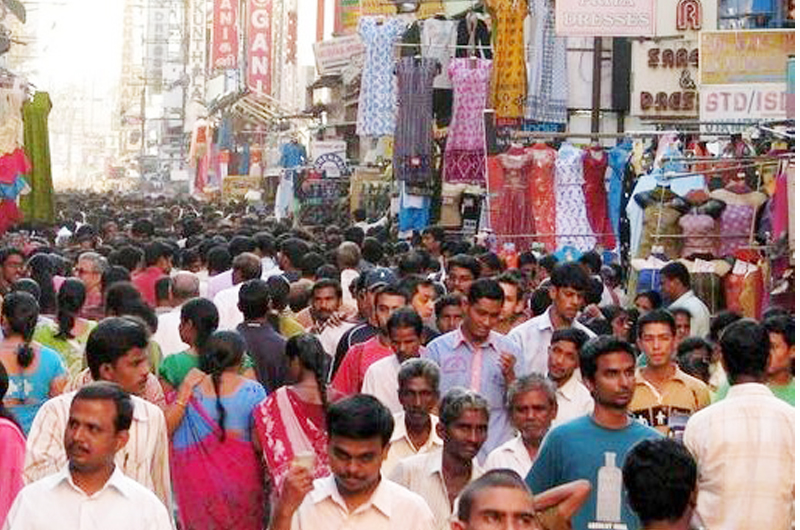
Currently, India has an estimated 1450-1500 million people and that figure seems likely to touch 1800 million by 2050 or even earlier. However, no alarm bells are ringing about this population explosion, with some even describing it as “demographic strength”. N.S. Venkataraman on why he feels India’s population needs to be downsized significantly
India has recently emerged as the most populous country in the world, outdoing China. It currently has an estimated 1,450-1500 million people and that figure seems likely to touch 1,800 million by 2050 or even earlier. However, no alarm bells are ringing about this population explosion, with some even describing it as “demographic strength”.
To put things in perspective, USA’s land size is 9.8 million sq km – nearly thrice India’s 3.3 million sq km, and its population density stands at 38 people per sq km, compared to India’s 492. Russia has a land size of 17.1 million sq km, and 8.5 people per sq km. Even China, with 9.6 million sq km, has only 151 people per square km. The country has successfully controlled population by the one-child-per-family rule, and has taken steps to stabilise it at that level.
No country in the world has to manage such a large population as India. Though India’s crude birth rate (CBR is the number of live births per thousand population in a year) has declined 0.7 point from 19.1 to 18.4, and its total fertility rate (TFR) has fallen for the first time to 1.9 in 2023, the decline is not uniform throughout the country. In Bihar, the CBR is 25.8 and in Tamil Nadu, it is 12. Bihar reported the highest TFR 2.8 among the bigger states.
The ground reality is that along with the falling CBR and TFR, lifespan is also steadily increasing due to advancements in medical technology. The average lifespan of an Indian was reported to be 73 years in 2023, as against 35 years in 1950. The country’s population is likely to increase steadily in the coming years if the present trend continues.
A section of Indians, who can be described as ‘population advocates’, want any possible reduction in population in the wake of falling CBR and TFR to be checked immediately. This demand does not take a holistic view of the country’s population-carrying capacity, taking into account the lower and marginal economic levels, unequal distribution of income and opportunities, and prevailing unemployment levels.
‘Population advocates’ argue that while youth make up a major part of India’s population, the CBR and TFR moving below replacement level, combined with the increase in lifespan, would result in a large segment of aged people who won’t be productive. The population advocates cite the example of countries like Japan and Russia, where the steady fall in the CBR and TFR has raised concern about the average age of the population, and of China, which has been forced to give up the ‘one-child-per-family’ policy and is now encouraging larger families.
On the face of it, the argument may seem reasonable. However, India’s population density is now so high that such a view can’t be justified. In a cost-benefit analysis, the benefits of curbing population growth would be far higher and certainly much less harmful than allowing unchecked rise in the number of people. In any country, social peace and communal harmony can be well maintained only by ensuring that the employable population is kept reasonably occupied. And given India’s population density, it is impossible to provide adequate job opportunities for everyone of working age.
With increasing levels of automation, introduction of robots and development of artificial intelligence, job opportunities are likely to reduce significantly in the coming years. This is already evident in several sectors. A large section of the Indian population is engaged in agriculture. Already, farming activities such as harvesting and pest control are being mechanised, replacing manpower, to improve productivity and efficiency. This trend is likely to continue.
The Government of India is currently grappling with the unemployment issue, and there is increasing evidence of social tension because of unemployment and underemployment. In such a scenario, successive administrations have been trying to ‘buy peace’ by offering freebies to the people, but this has become unaffordable. Little wonder then, that a number of Indians are seeking to migrate to other countries in search of job opportunities. However, the influx of Indians into developed countries is now attracting resentment in the host nations – witness the anti-migration agitation in the United Kingdom and elsewhere.
When India attained Independence in 1947, the population was around 350 million people. In 75 years, it has reached a figure of 1,450 million. This should not go on. But the fact is that over the last several years, the government has not been effectively campaigning for population control, only paying lip service to the programme. Chief ministers of a few states have even been asking families to have at least three children, and some religious and regional outfits are also reportedly advocating bigger families for self-serving reasons, without understanding the grave consequences of population rise.
The government should actively aim at downsizing population to around 1,000 million in the coming years. This could help India become an economic superpower, given its many advantages, such as agricultural strength, mineral wealth, and the availability of skilled manpower.
(The writer is trustee, Nandini Voice for the Deprived, a not-for-profit organisation in Chennai that aims to highlight the problems of downtrodden and deprived people and support their cause, to promote probity and ethical values in private and public life and to deliberate on socio-economic issues in a dispassionate and objective manner. He is a chemical engineer.)
 from Webdoux