

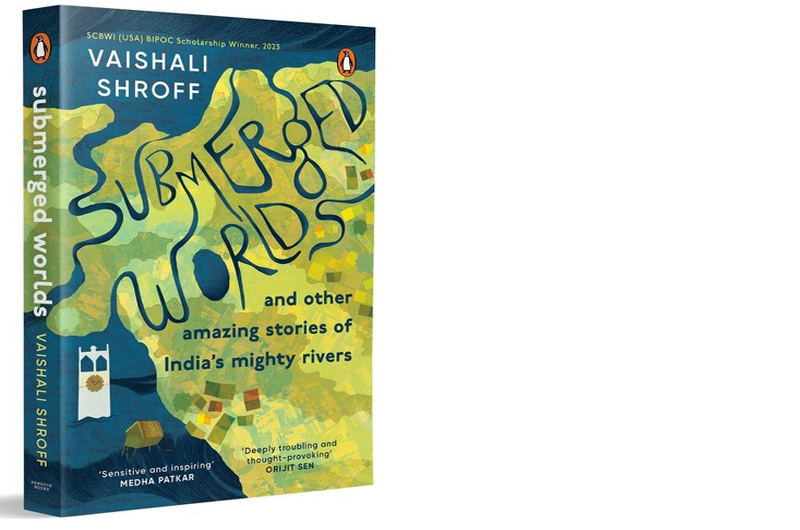
Submerged Worlds and Other Amazing Stories of India’s Mighty Rivers by Vaishali Shroff brings together stories of the ecology, mythology, politics, history and culture of India’s rivers. The book highlights the acute ecological crisis that rivers are enduring, while offering hope of rejuvenation through success stories, says Usha Rai. It points to stark contrasts between communities that traditionally and gently use the river, and unsustainable activities such as luxury liners, airports, dams and power plants, she says. Here is her review
Vaishali Shroff’s Submerged Worlds and Other Amazing Stories of India’s Mighty Rivers is a deeply moving exploration of India’s rivers. Well-researched and readable stories take you through their ecology, mythology, politics, history and culture. They highlight the importance of rivers in nature and society while telling you how they have been used, abused, neglected and abandoned. As Medha Patkar, the anti-big dam social activist says in her foreword, the book is like an encyclopaedia on rivers. There are stories on the death of rivers such as the Yamuna, encroachments on riverbeds, riverfronts and other infrastructure projects as well as construction of big dams on rivers leading to inhumane destruction and displacement. The book narrates threats posed by melting glaciers and polluted rivers. It tells you of blockages to the natural flow of rivers leading to floods in Mumbai, Chennai and Vadodara.
The inspiration to write this book, brought out by Penguin, came when Shroff was driving long the Tehri dam, India’s highest dam at 855 feet on the Bhagirathi River in the Tehri Garhwal District of Uttarakhand and saw the top half of a clock tower rising above the waters. The driver said it was the ghanta ghar of the old Tehri Town which was submerged with about 125 villages when the dam was constructed. The driver’s home too was under the river. Having lost his livelihood and home, he never thought he would be a tourist guide, showing people the place where his home lay buried.
Shroff seeks to put the spotlight on the water crisis which requires urgent attention, and she illustrates the book with sketches made by her. Though tinged with sorrow and remorse about dead and disappearing rivers, there is also hope that all is not over for the Yamuna, Ganga and other Indian rivers. They can be rejuvenated with people’s initiatives. The book should be included in the Central Board of Secondary Education’s range of books for a better understanding of our environment and rivers.
Melting of the third pole
What comes out strongly is the danger to our environment, to people and wildlife when we tamper with rivers. The Himalayas are home to the largest ice mass outside the polar region. There are 9,575 glaciers covering an estimated 37,466 sq km in the Indian Himalayas, as per a national glacier inventory conducted in 2018-19. The 75-km long Siachen glacier was devoid of pollutants but human activities like the building of military posts, chemical leakages and human waste over the last 40 odd years have made it susceptible to climate change.
Much of the earth’s water supply comes from glaciers. The Himachal Council for Science, Technology and Environment and the Space Application Centre in Ahmedabad found that Himalayan glaciers have shrunk from 23,542 sq km in 2019-20 to 19,183 sq km in 2020-21. Himalayan rivers, like the Lidder in Pahalgam, Kashmir, originating from the Kolahoi glacier, are a source of joy and the lifeline for people living downstream. But the Kolahoi is melting at an alarming rate and the chopping of trees in the Lidder Valley has contributed to rise in temperatures. Due to the imbalance in the glacial mass, the flow of water to Lidder and the Jhelum has reduced, impacting irrigation and agriculture. People are moving from cultivation of water-dependent rice and maize to apple cultivation, which requires less water and gives ten times the return of apples grown on dry land. Uttarakhand and Himachal Pradesh will bear the brunt of glacial melts, says Shroff recalling the Chamoli glacial outburst of 2021 that caused flash floods in which 200 people lost their lives.
Shroff also tells you the stories of the Gangaputras — the Majhis and Mallahs or the ‘children of the river’. A marginalised community today, they ferry people across the river but with the introduction of luxury liners, that source of livelihood has diminished. They also work as gotakhors or divers collecting the coins thrown by visitors to have their wishes fulfilled. They may earn Rs 200 to Rs300 a day. Sometimes, they are asked to dive to retrieve corpses in various stages of decomposition.
Lifelines of rural India
Like the Majhis and the Mallahs, who have lived for thousands of years beside the river, the future of the tribes of the Andaman and Nicobar Islands is at stake due to human interference. While the Andaman archipelago has one perennial river, the Kalpong River, the Great Nicobar Island has five perennial rivers, all originating from Mount Thullier, as freshwater streams. But there is trouble in paradise. Under the Great Nicobar Development Project, an international airport, a trans-shipment terminal, a township and a power plant are proposed at Galathea Bay. This could demolish the ancestral villages and foraging regions of the indigenous Shompen and Great Nicobarese tribes who have learnt to live judiciously for centuries using the island’s resources without destroying them.
The story of Jawai Village or the Leopard Village of India, along the banks of the Jawai River in Pali District of Rajasthan, is also one of living in harmony with nature. Even if a leopard picks up a goat of the Rabari Tribe, they accept it believing their goddess would compensate them with two goats. Though normally a territorial animal, leopards in Jawai share space with other animals — even allowing visitors to see their cubs. The 96-km long Jawai River is picturesque and home to many migratory birds including bar-headed geese and the tall and stately non-migratory saras crane. Thanks to the Jawai dam, constructed by the Maharaja of Jodhpur between 1946 and 1957, the dam’s lake and the area around is rich in biodiversity, home to sloth bears, leopards, hyenas, nilgai and chinkara and is a birdwatcher’s paradise. From herding goats, the Rabari youth today work as cooks in the safari lodges and study hotel management to build on tourism to their villages.
The Chambal ravines, along the Chambal River that flows from the Vindhya Range in Madhya Pradesh to Rajasthan, were notorious for dacoits or baghis, but things happened when people moved out of these areas, says the author. Nature restored its bounties. The river water flowed unsullied and clean. Today it is home to the gharials, the Ganges River dolphin, endangered red crowned roofed turtle, the graceful Indian skimmer and other species. The National Chambal Sanctuary was established in 1979 along 452 km of the river. However, there is a threat of sand mining along the riverbanks.
For sheer reading pleasure, there is a chapter on rivers that carry the gold embedded as grains in rocks and alluvial deposits. The 395-km long Subarnarekha or the Swarnarekha (which means gold) of Jharkhand is a gold-bearing river. Between 10 am and 4 pm, women stand in the river, their eyes peeled on the sand and stones being carried by the river. They scrape mud from the river banks and sift the sand through sieves to get rid of the stones and gravel and collect the sieved liquid in wooden bowls for a whole week. Then they extract the gold from the liquid amassed by adding mercury to form a mass. The mass is heated over coal till the mercury evaporates and all that is left is gleaming gold which is sold in the Sunday market. The Subansiri, a tributary of the Brahmaputra, is also known to have carried gold. Gold washing was a thriving industry in Assam in the reign of the Ahom Kings in the thirteenth century. The craft of gold washing was stopped after the British took over Assam in 1826.
The book also looks critically at the National River Linking Project and raises pertinent questions on water conflicts and the inevitable ecological damage that the 30 links proposed may cause by building large dams on rivers with surplus water to be directed to water-deficit regions. The book, however, ends on a positive note with stories of people like Ashok Upadhyay known as Yamuna Baba and Siddharth Agarwal working to clean up rivers and create awareness of keeping our rivers and their surroundings clean and eco-friendly. While Upadhyay and the Friends of the Yamuna Foundation work at the Chhath Ghat in Delhi, physically removing garbage and conducting evening aarti to draw attention to the plight of the Yamuna, Agarwal and his supporters are walking some 7,000 km along rivers like the Ganga, Ken, Betwa, Sindh, Luni and Mahakali creating a data base and raising awareness on the state of India’s rivers.
(Courtesy: Mongabay India/ india.mongabay.com. The writer is a veteran journalist. Over the course of her career which spans several decades, she has been a pioneer in reporting on women’s issues, health, environment and development. This is a condensed version of her original review.)
Link to original article: https://india.mongabay.com/2025/06/a-fascinating-book-on-indias-rivers-and-their-travails-book-review/?mc_cid=9864018e5c&mc_eid=fe2778811d
 from Webdoux