

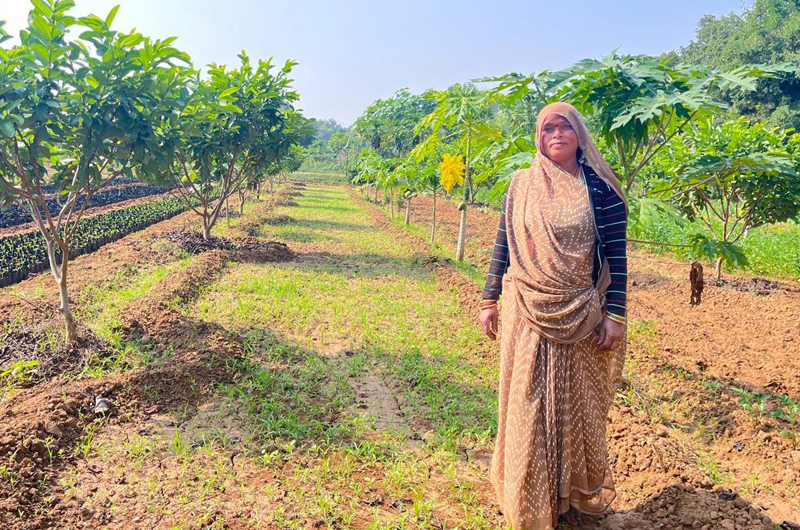
Bharat Dogra profiles a feisty woman farmer in Madhya Pradesh who, despite minimal resources, has managed to increase her income by adopting natural farming methods. Diversification has helped her to save some crops in times of adverse weather conditions and her success proves what can be done even with few resources, he says
Climate change-resilient farming is sometimes depicted as a burdensome process. However, Saroj Kushwaha, a woman small farmer of Pathari Village in Tikamgarh District, Madhya Pradesh, has been practising it and has succeeded in reducing the burden of fossil fuels on her farm, besides improving soil conditions, in the process boosting the nutrition, health and prospects of her family, while increasing her net income.
Saroj has employed such creative methods of climate-resilient farming that the hard work no longer seems like drudgery to her and, even more important, her son, who was non-cooperative earlier, now works happily alongside her. The family has a total of around four acres of farmland, in different places. About three years ago, influenced by a campaign for natural farming and farm biodiversity initiated by voluntary organisation SRIJAN (Self-Reliant Initiatives through Joint Action), Saroj and her family decided to make a number of significant changes in their farming patterns.
Firstly, they shifted from chemical to organic fertilisers made on their own farm from cow-dung and cow urine and some other locally available ingredients. Easily accessible organic materials were also used to keep away pests. This significantly reduced their expenses and the fossil fuel burden of their agricultural activities.
Secondly, a relatively small part of the land was devoted to vegetable and fruit cultivation. A multi-layer garden makes it possible for them to grow about 15 vegetables on the plot. In addition, they have planted about 100 fruit trees, including guava, mango, amla, lemon, berry and lichi. The crop diversification has added to the family’s income.
Thirdly, Saroj has started a fruit tree nursery to supply others – a livelihood diversification that has stood the family in good stead. The family continues to cultivate the cereal, legume, oilseed and millet crops they were growing earlier, but diversification has helped her to save some crops in times of adverse weather conditions.
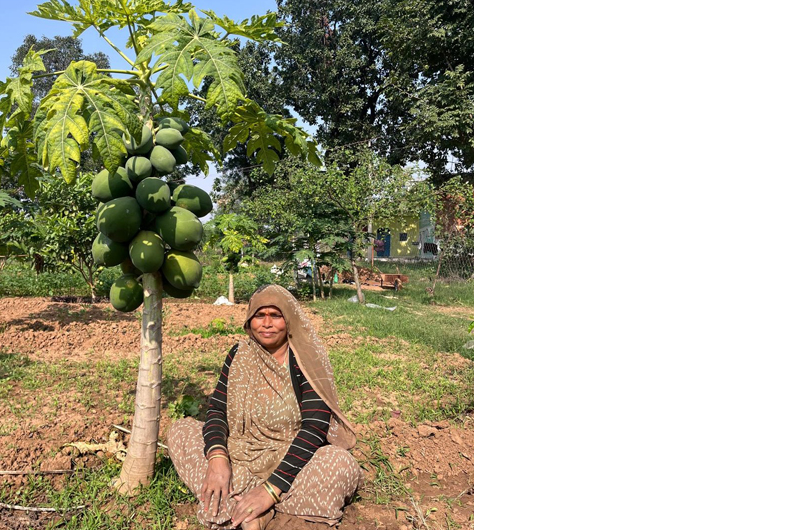
As of now, Saroj has one cow, one buffalo and seven goats. They provide the base for natural farming and add to the diversity of the family’s nutrition and income, allowing them flexibility to meet unexpected expenses. Reducing dependence on external inputs helps her to cut costs and avoid debts. Well-constructed field bunds help in water and soil conservation. Besides having access to better nutrition, the family is also making healthy food available to others.
Saroj is a live example of the success of climate change-resilient farming through well-thought-out, highly creative methods – with the help of SRIJAN – using only limited resources. Saroj herself takes some of the farm produce, particularly vegetables, to the market regularly. “Traders and customers know that I bring very healthy vegetables, so they compete with each other to buy my produce and I am able to sell it very quickly,” Saroj says with a broad smile. As a member and shareholder of the Ken Betwa Women Farmer Producer Company, she is able to get good quality seeds and market much of her produce at a fair price.
Saroj is happy that her soil is showing significant signs of improvement. The increased capacity of the land to absorb carbon due to so many trees being planted, and doing away with several inputs based on fossil fuels, drive Saroj’s contribution to climate change mitigation. Of course, problems persist, and Saroj still needs help. The increasingly erratic weather, leading to losses such as the recent damage to the kharif crop, is an example of the problems she faces. She and other farmers engaged in natural farming practices need help from the various climate justice and climate response funds.
On the other hand, it is to be noted that many small farmers with limited resources get trapped by using unsuitable and expensive technologies and inputs plugged by powerful interests, and cannot recover easily, going from one crisis to another, including having to borrow money at very high interest rates. Saroj’s success proves what can be done even with few resources. Hence government should allocate much more funds and resources for supporting such sustainable and ecologically protective farming practices in various ways.
(The writer is an independent journalist and author who has been writing for over five decades, providing a strong perspective on peace, justice and protection on the environment. He lives in New Delhi.)
 from Webdoux