

This story describes the acute challenges that communities that live in the mangroves of the Sundarbans in West Bengal face. Renowned for its mangroves and biodiversity, the Sundarbans in recent decades has been deeply affected by rising sea levels and increased frequency and intensity of cyclones leading to environmental degradation. This has led to the destruction of the mangroves that have protected the islands for centuries, says Sushmita Malaviya, explaining how repeated devastation has affected the lives of those living there. She describes how SHG members of Agnikanya, Pallishree and Deepsikha have emerged as key change-agents with women leading the movement to protect not only themselves and create a better future for their families, but for their immediate environment too
“When a cyclonic storm hits us, our mud homes get flooded. Our agricultural land is destroyed as the seawater floods it. We lose our livestock, too. Men are forced to leave the village in search of work. Sometimes we have nothing to eat,” says Thakur Dasi a resident of Kultali Baikunthapur, 24 Parganas, West Bengal. Sitting on a bamboo mat with other women, she maintains a calm posture, reflecting the voice of the members of her self help group (SHG).
What Thakur Dasi and other women like Purnima Maity of Agnikanya SHG are referring to are the unique and acute challenges that communities that live in the mangroves of the Sundarbans in West Bengal face. This vital UNESCO-recognised region is renowned for its mangroves and biodiversity. In recent decades, however, life here has been deeply affected by rising sea levels, increased frequency and intensity of cyclones leading to environmental degradation. This has led to the destruction of nature’s bounty – the mangroves that have protected the islands for centuries. The repeated devastation has affected the lives of those living there, as it has led to coastal erosion and the disappearance of fish and crabs, shrinking livelihoods.
Purnima says, “The kind of cyclones that we have experienced – our forefathers did not face them.” The immediate aftermath of Cyclone Amphan in 2019 highlighted the vulnerability of both the ecosystem and the communities residing within it. “When the sea water breaks through embankments during a cyclone, it affects agricultural land. It takes two years to overcome the damage caused to the soil by high salinity,” Thakur Dasi explains, adding that the next two years after such an incident mean a very frugal existence for their families. Another SHG member Seema Bhunia adds, “There is no factory here, only cottage industries. There is no alternative but to work as a daily labourer.”
such as nurseries, making incense sticks, the community is also being encouraged to diversify into crab farming and rearing goats to establish
additional sources of income.
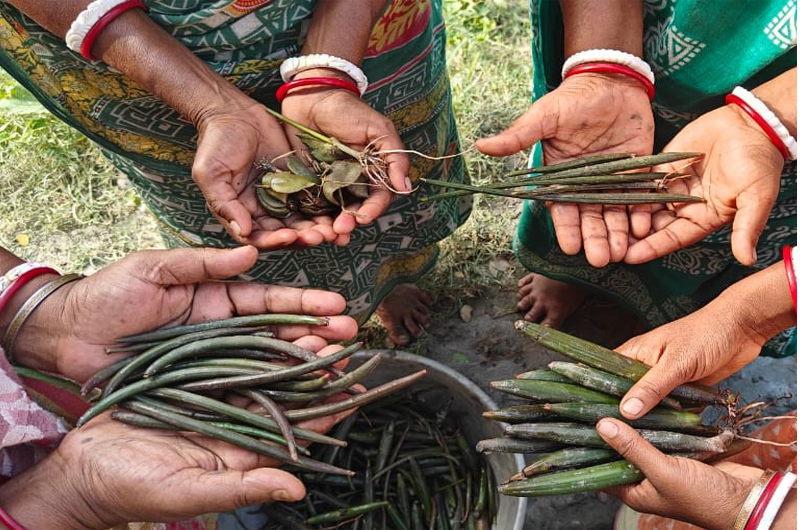
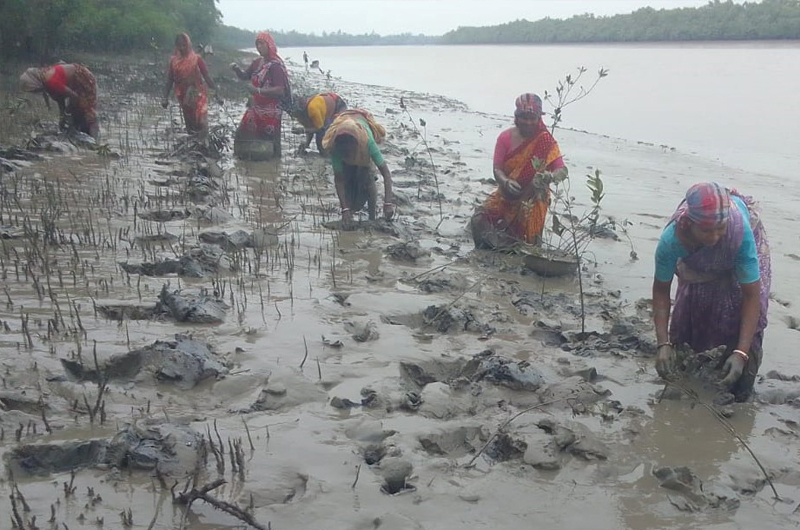
Says Susanto Giri, secretary of Baikunthapur Tarun Sangha (BTS), a community-based organisation in the Sundarbans, “There was an urgent need to explore resilient ecological solutions. We explored three critical ecological restoration activities, such as mangrove plantation, stream-bank protection and essential pond rejuvenation.” In 2012, BTS initiated awareness-raising activities and brought women together to reflect on their immediate environment. Then they were trained to plant mangrove saplings in low-tide areas. The women collected seeds from nearby mangroves, nurtured them in polybags, watered them daily, and protected them. Once ready, the saplings were packed and women started small nurseries near their villages. Each nursery raised about 15-20,000 saplings in a season.
Says Giri, “Over the past few years, women have been preparing nursery beds near the river, planting native species such as Avicennia, Sonneratia, Rhizophora and Bruguiera. Each of these is suited for different soil and water conditions. Women have also been trained to be the guardians of these nurseries and they monitor growth and progress of the saplings.” He added, that the women began selling each sapling at around Rs 3, and together they earned nearly Rs 600 without leaving their village.
“The training that we have received has helped us learn where and how to plant the mangrove saplings,” Seema points out. Alongside, in the agricultural work that the women were associated with, they were nudged to intercrop to achieve better results. Additionally, many men like 49-year-old Debasish Pradhan, a farmer, have actively participated in rebuilding stream-banks that were destroyed by successive cyclones and flooding. “Protection measures for the stream-banks are crucial for preserving the delicate ecological balance of the numerous waterways crisscrossing the Sundarbans. These interventions prevent coastal erosion, stabilise riverbanks, and reduce sedimentation, thereby protecting critical habitats and agricultural lands,” he explains.
With regular guidance from BTS, some of the businesses have come to fruition in 2023. Says 52-year-old Sarsawat Pradhan, who has been involved in preparing nursery beds and planting mangrove seeds, “We planted five varieties – sundari, hental, goran, koyra and genoya – and we have sold them to the Forest Department, panchayats, back to BTS and in markets.” Instead of spending the money they earned on immediate needs, the women thought ahead. Some was reinvested in nurseries, some was kept as savings for emergencies, and part of it was used to start new small businesses, such as honey collection, crab farming, incense stick production, and small shops. This way, they not only made their work sustainable but also created new opportunities for the future.
In the villages of North Baikunthapur and Debipur, where these women are actively engaged, there are 1,853 households. At a recent Agnikanya SHG meeting, women sit around with Baikunthapur Tarun Sangha Project Coordinator Nilufa Parvin. “During these meetings, we welcome new group members and review our work. The group has set a target to collect 40,000 seedlings. At these meetings, they review their progress and what they need to do to get to their goal,” Nilufa says.
Three self-help groups had come together to support the intensive work, often knee-deep in clayey soil. “We want to continue this work, as we are protecting our homes and our motherland,” the women chime in together. Their work over the years has helped SHG members of Agnikanya, Pallishree and Deepsikha emerge as key change agents in protecting communities from storms and in checking coastal erosion. Agnikanya SHG sold 4,000 saplings and two boats full of saplings were transported 19 km away to Nagenbad. “Our SHG Agnikanya has 12 members and we also have small side businesses such as selling muri (puffed rice), rearing goats and crab farming.”
Understanding the implications of the work and seeing the momentum that it was picking up, expansion was the next step. Today, supporting grassroots organisations in the Sundarbans after Cyclone Amphan, the Sustainable Environment and Ecological Development Society (SEEDS) has gradually expanded nature-based solutions to check severe storm surges in this region. Beginning with initial targeted interventions in the Patharpratima Block, SEEDS has strategically broadened its reach to include Kultali, Gosaba, Canning I, and Basanti Blocks. At its core, the initiative focuses on critical ecological restoration activities such as extensive mangrove plantation, vital stream-bank protection, and essential pond rejuvenation.
The very first phase of intervention focused on the Gopalnagar Gram Panchayat (GP). This period was particularly critical, as it coincided with the recovery efforts following Cyclone Amphan. SEEDS Co-founder Manu Gupta, underscores the importance of partnering with community-based organisations and equipping them with the skills and capacities to build locally led climate resilience efforts. “The region has experienced an increased number of severe cyclones. Ecological restoration and enhanced community resilience are the only way to safeguard the Sundarbans from future extreme climate events,” he explains.
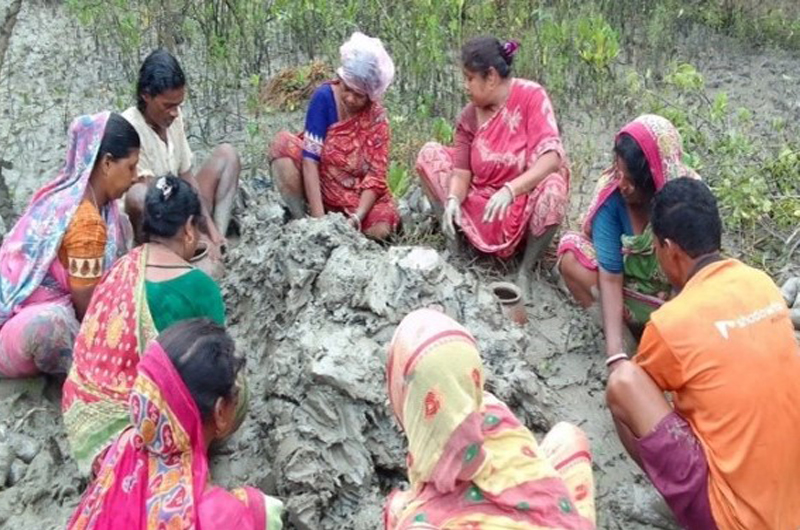
training the women to plant mangrove saplings in low-tide areas.
Over the years, the efforts have helped increase biodiversity – return of crabs, fish, and shorebirds, trapping coastal soil leading to natural land-building and blue carbon sequestration that contributes to climate mitigation. When asked if their work has begun to show some benefits, Sapnashree of SHG Pallishree says, “When Cyclone Remal hit in May 2024, the places where we had planted the saplings and they had grown the sea water did not enter. The riverbanks did not break and agricultural fields were protected.” As an afterthought, she adds, “It has also been cooler in the summer.”
As the women learn, they are also aware that more needs to be done. Mukti Pradhan of Agnikanya SHG articulates that so far the income that they have been generating is not sufficient. “We have to think of ways to increase our income. It would be good if we learn how to make thermocol designs or tailoring. Can we be trained for it?” Purba Debijur, Jhumpa Das, Kanika Mondel and Seema Bhuniaalso echo similar thoughts, saying, “We want this work to continue.”
That’s not all – the women go from house to house, raising awareness in communities and leading efforts to build resilience to face storms. They are planting mangroves, restoring natural ecosystems that protect villages from storms even improving the soil. Today, SHG members of Agnikanya, Pallishree and Deepsikha are driving a movement to increased biodiversity. Their efforts are bringing back fish, crabs and shorebirds, protecting the stream-banks that are leading to natural land-building. These efforts are clearly demonstrating that nature-based solutions are cheaper, long-lasting, and something that local people can manage themselves.
While the BTS training has helped the women explore business such as nurseries, making incense sticks, the community is also being encouraged to diversify into crab farming and rearing goats to establish additional sources of income. Through this journey of flipping being disaster affected today women and their immediate communities hold the keys to restoration of degraded mangrove patches and embankments. Women are leading a movement with key stakeholders such as panchayat level officials to protect not only themselves and create a better future for their families, but for their immediate environment too.
(The writer is a communications professional who has worked with Hindustan Times andCentral Chronicle, both in Bhopal, and Patriot and The Statesman in Delhi. Since 2007, she has supported large public health programmes in India such as polio, routine immunisation and family planning. She is a WomenLift Health Global Fellow 2024.)
 from Webdoux