

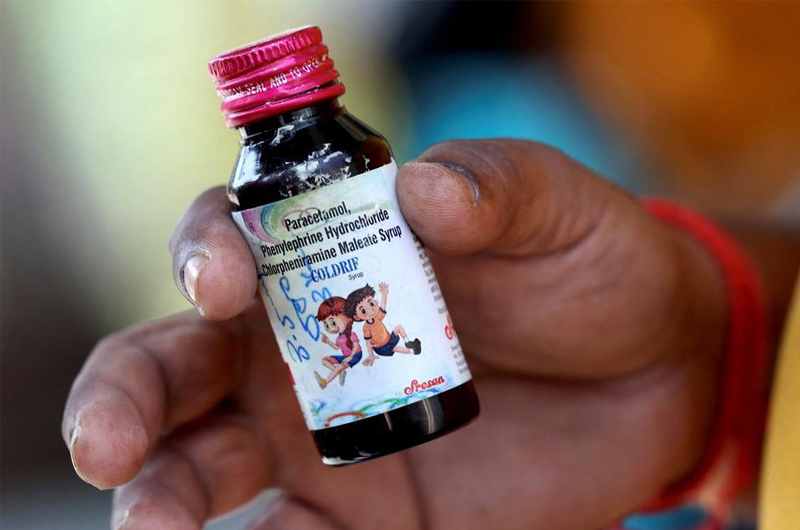
It was usually the case that young children in far-off places such as Gambia and Azerbaijan or even Iraq would die after consuming India-made adulterated cough syrups, but the latest incidents of death of children in Madhya Pradesh and Rajasthan show that the bells have begun to toll at home as well, says Pradeep Krishnartray. At least 16 children are reported to have died in the two states because they consumed a cough syrup that was adulterated with diethylene glycol, which is dangerous for human consumption, especially when children are involved, he says, while providing perspective to the story, dwelling also on how the media reported it
It was usually the case that young children in far-off places such as Gambia and Azerbaijan or even Iraq would die after consuming India-made adulterated cough syrups. The Indian media would then bemoan the tragic loss of young lives, the Central Government would hurriedly summon the state health secretaries, issue advisory, the courts would haul up the pharmaceutical companies and, occasionally, the erring company would shutter down. All this wouldn’t get the Indian pharma industry mend its ways. Its exports, led by government initiatives and high demand, would continue to climb.
But something has changed this time. The latest incidents of death of children in Madhya Pradesh and Rajasthan show that the bells have begun to toll at home as well. The media reports that at least 16 young children have died in Madhya Pradesh and Rajasthan because they consumed a cough syrup that was adulterated with diethylene glycol (DEG).
DEG is a dangerous for human consumption, especially when children are involved. Used in paint, plastics and other industries, DEG is an industrial solvent. It shouldn’t be used in the manufacture of cough syrups, especially those that are meant for young children. Instead, pharmaceutical companies should use propylene glycol as an excipient (excipients are substances which do not have any therapeutic value in a drug but are inert substances used often as diluents). Propylene glycol imparts a sweet taste and colour to the syrup, making it agreeable for children.
For young children suffering from cold and cough, diethylene glycol is poison. Its consumption can result in renal and neurological toxicity, and death, as seen in the two states. Some manufacturers, however, use it because it costs less (scrupulous companies use the more expensive pharma grade (not low quality, industrial grade).
That Diethylene glycol can cause death has been known for a long time. DEG-induced deaths were perhaps reported first from the US almost 80 years ago. In that incident, more than 100 people had died, a third of them being children. The chief chemist of the pharmaceutical company that manufactured the drug (called Elixir Sulphanilamide) committed suicide before he could be hauled up in a court of law. The regulatory design was overhauled afterwards and no known cases of diethylene glycol contamination have been reported in the US since then.
The world did not learn from the US experience though. Outside of Asian countries, more than 10 cases of mass poisonings have been documented. They come from China, Nigeria and some other countries. The Indian story is unfortunately no exception. Despite winning the coveted title of being the ‘pharmacy of the world’, the country has hobbled from one tragic incident to another. In 2022, 70 children in Gambia died because of consuming a cough syrup manufactured by a Haryana-based company. WHO’s investigation showed that the Indian company was at fault. The Indian Government contested the WHO finding.
A year later, in 2023, at least 18 children in Uzbekistan died. The Uzbek authorities blamed the manufacturer of Indian cough syrup. WHO again issued a global alert against India-made syrup Cold Out in a 10-month span after medicines contaminated with toxins were found in Iraq. The syrup was manufactured by Fourrts (India) Laboratories. “The substandard batch of the product is unsafe and its use, especially in children, may result in serious injury or death,” the alert warned.
The syrup found in the Iraqi market had 0.25 per cent of diethylene glycol and 2.1 per cent of ethylene glycol. The amount exceeds the safety limit for both at 0.10 per cent or less, WHO said. In the months preceding early 2023, WHO asked people not to consume syrups manufactured by two Indian companies, Maiden Pharmaceuticals and Marion Biotech. The syrup was linked to the deaths in two countries, Gambia and Uzbekistan.
There are several issues that dog the sad state of manufacturing of drugs in India. One of the most obvious but not so well known is the lack of coordination between different drug controllers at state level (each state has its own drug controller). Let’s take a specific example. At the top level, the Government of India is responsible for approval of new drugs but it has little say or control for issuing licenses for the potential manufacturer or its prosecution. That responsibility falls squarely on the state government.
At the next level, the drug may be manufactured in one state but consumed in any other state of the country. Most states have their drug controllers and the drug controller of a state where the suspicious drug is manufactured may not take any punitive action against an erring pharmaceutical company if the complaint originates from another state of the country.
At the third level is the rather lenient approach that courts sometime take against an erring pharma company. In some cases, the courts have given ‘simple imprisonment till the rising of the court’. This is how the system sometimes works: The management pleads guilty for manufacturing ‘not of standard quality’ drugs and the judge takes recourse to a special provision in the Drugs and Cosmetics Act 1940 and sentences the management to ‘simple imprisonment till the rising of the court’, ignoring the minimum mandatory punishment of one year that is prescribed. The management of the company goes scot free.
The media’s reporting also leaves much to be desired. If deaths happen in Odisha, then the newspapers published from Hyderabad bury the news in an inside page. In general, however, in matters related to health, media’s reporting is largely death- or event-oriented. When the event recedes into the background, the media doesn’t keep the story alive. It usually fails to follow up on a story or investigate the reasons for death. For example, what actions does the pharma company take after it has been found to be cavalier in its approach. Has the said company pulled its shutters? What action has the drug controller of the state where the offending company exists, taken? Has he extended support to other state’s drug controller? Why is the judiciary content with pronouncing ‘simple imprisonment till the rising of the court’?
The media may not have, but the Supreme Court of India took cognizance of such conduct and admonished “…The court while exercising the discretion in the exception clause has to record ‘exceptional reasons’ for resorting to the proviso. Recording of such reasons is sine qua non for granting the extraordinary relief. What is adequate and special would depend upon several factors and no straightjacket formula can be laid down.”
In 1986, 14 patients at the JJ Hospital in Mumbai died because of consumption of DEG. The then chief minister of Maharashtra appointed a sitting judge to head a commission of inquiry into the regulatory system. Justice Lentin submitted a report within a year, severely criticising the role of the joint commissioner of the Maharashtra Food & Drug Administration (FDA). He did not even spare the then health minister of the State of Maharashtra (who eventually resigned). An excerpt of the reports reads:
“These pages describe and illustrate… errors of judgment, misuse of ministerial power and authority, apathy towardshuman life, corruption, nexus and quid pro quo between unscrupulous license holders, analytical laboratories, elements in the Industries department controlling the awarding of rate contracts, manufacturers, traders, merchants, suppliers, the FDA and persons holding ministerial rank. None of this will be palatable in the affected quarters. But that cannot be helped.”
Alas! We don’t read such pronouncement or judgments anymore. The families of children who succumbed to DEG poisoning await the arrival of another Justice Lentin.
(The writer teaches at ICFAI University, Hyderabad, and is former director – Research at Johns Hopkins Center for Communication Programs, New Delhi.)
 from Webdoux