

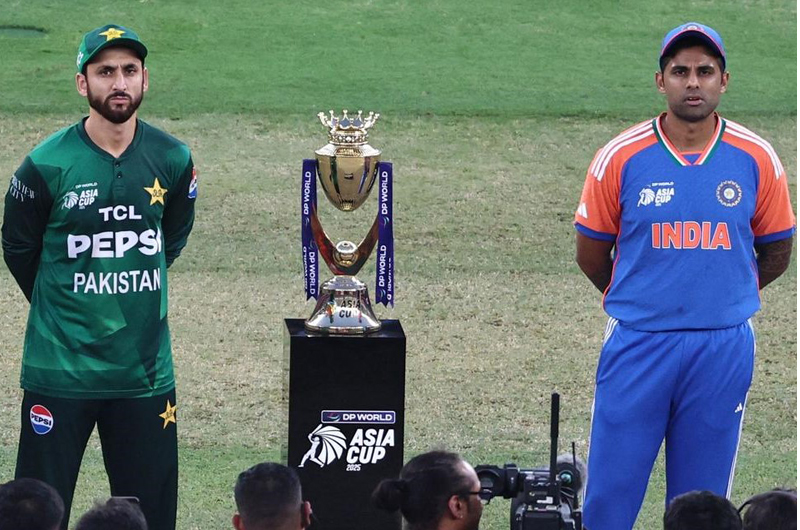
Three successive matches on Sundays between India and Pakistan was the dream of fans and broadcasters alike and that’s exactly what happened during the just concluded Asia Cup in Dubai, says Partab Ramchand, adding that India-Pakistan encounters are the most watched and followed in the cricket calendar whatever the format, and what occurred was a bonus for everyone concerned. However, this time, the interest was comparatively low, he points out, and wonders whether this was the right time for the two teams to clash on the cricket field when political undertones and off-field controversies overshadowed the contest between bat and ball
Arch rivals, intense and fiercely unmatched rivalry are phrases generally associated with cricket matches between the two countries wherever it is played. These days, of course, the games are confined to tournaments like the Asia Cup or the World Cup with the Indian Government making it clear that there is no question of bilateral contests between India and Pakistan. But is there really a contest between the two countries on the cricket field? India’s supremacy has been well marked in both ODIs and T-20s for quite a while now and the fact that India won all three matches in the Asia Cup was certainly no surprise. The rankings say it all. India are No. I in both the ODI and T-20 rankings while Pakistan are No. 5 and No 7 in the two formats.
In recent years Pakistan has slid considerably and there was much sub-standard cricket seen from their players during the Asia Cup. India, on the other hand, continue to be the dominant factor. Of course, the two teams have not played Test cricket since Pakistan last visited India in 2007. The following year the terrorist attacks took place in Mumbai – commonly known as 26/11 – and contests in the traditional format ground to a halt.
There has always been an undercurrent of tension whenever the two teams meet on the cricket field. Politically the relations have been soured since Independence and India and Pakistan have fought three wars since then. In addition, now and then there have been skirmishes and terrorist acts along the border and this has done nothing to improve relations. Indeed, for over 17 years from 1961 to 1978 there were no Test tours between the two countries which means they never met on the cricket field as these were the days before limited overs cricket. These days, while they clash in ACC or ICC tournaments, they have not played a Test match for 18 years.
As I said, because of the circumstances involved, there is always a layer of tension in matches between the two countries but what happened during the Asia Cup went beyond acceptable limits. The mood was plainly acrimonious thanks to the terrorist attack in Pahalgam and the Indian Government’s response by way of Operation Sindoor. One really wondered whether this was the right time for the two teams to clash on the cricket field and there were many who felt that India should boycott the matches. Interest which is generally sky high for India-Pakistan encounters was comparatively low.
The trouble started in the first game when Indian players refused to shake hands with the Pakistan cricketers after the match. This is a ritual that is generally followed but the gesture set the tone for what was to follow. While Pakistan coach Mike Hesson and captain Salman Agha criticised India for the refusal to shake hands, the Indian players did not change their stance during the future games too. Things became heated especially during the second game in the Super League stage with several verbal spats between the players. Indian captain Suryakumar Yadav was fined for ‘political’ remarks during the post-match press conference while Harris Rauf was also fined for his unseemly gestures on the field.
Following the final, which India won by five wickets, the team refused to accept the winner’s trophy from the Asian Cricket Council President Mohain Naqvi, who is also the chairman of the PCB and Pakistan’s interior minister. Indian players Kuldeep Yadav, Abhishek Sharma and Tilak Varma received their individual awards from other dignitaries on stage while side-stepping Naqvi who on his part did not applaud these Indian players.
The Indian stand was spelt out by BCCI Secretary Devajit Saikia who said: “We have decided not to take the Asia Cup from the ACC chairman who happens to be one of the main political leaders of Pakistan.” He was backed by skipper Yadav who said the team had taken the decision not to receive the trophy from him adding “no one told us to do it”.
“What India have done during this tournament is very disappointing,” said Salman Agha after the final. “They were not disrespecting us but they are disrespecting cricket. Good teams don’t do what they did today (referring to India refusing to accept the trophy). “We went to pose with the trophy on our own because we wanted to fulfil our obligations. We stood there and took our medals. I don’t want to use harsh words but they have been very disrespectful.”
It was the culmination of a series of incidents where India looked to limit any contact with Pakistan players or officials during the tournament. Political undertones and off-field controversies involving India and Pakistan overshadowed the contest between bat and ball. Unfortunately then, this Asia Cup will be remembered not for India’s record-extending ninth win in the tournament but for all the wrong reasons.
It has been known for long that it is impossible to keep politics away from sport, particularly when India and Pakistan are concerned. But what happened in Dubai underlined relations are now at an all-time low. In this sullied atmosphere, whether the two teams should play cricket against each other has become a highly debatable point.
(The writer is a veteran sports writer who spent his career working for The Indian Express and The Telegraph and Sportsworld. He lives in Chennai.)
 from Webdoux