

Ranjita Biswas gives an overview of the indigenous practice of holding certain spaces in Nature sacred and preserving their integrity, and highlights the importance of this concept to modern-day environmental conservation, providing examples from Bengal and the Northeast Region
Human beings cherish many things they consider sacred – hymns, rituals, books. To this litany can be added sacred groves and places. Sacred groves are distinct patches of vegetation, ranging in size from a small cluster of trees to a large forest spanning several hundred acres, which are consecrated in the name of local deities or ancestral spirits. Removal of any living thing from the grove is taboo.
This is an ancient practice going back centuries among communities around the world. Today, while environment depletion is a hot topic, this age-old practice has acquired a modern dimension – it is seen as contributing to conservation of the eco-system. This community-based system sanctioned by religion is mainly prevalent among indigenous societies. Their belief in the sanctity of the sacred grove also means that these forested areas have been maintained in a pristine state through the ages. In these days of ever-expanding urbanisation, sacred groves have been able to resist that relentless onslaught. It is estimated that around 100,000 to 150,000 sacred groves exist/existed in India.
Unfortunately, with rising population, some traditional practices have disappeared. Many sacred groves have completely vanished or are on the wane. Ecologist and conservation biologist Debal Deb of Kolkata points to the case of Yellow Bamboo Sacred Groves maintained by the Rajbanshis, a tribe inhabiting the plains of North Bengal. The bamboo is invaluable as a building material and for making household goods. “In a corner of their hut reserved for the bastu thakur (household deity) a pole of yellow bamboo is erected and traditionally worshipped with wood-apple leaves, flowers, incense sticks and an earthen lamp. In the sacred grove there is no idol or votive shrine. Today, the groves are gone,” Deb says.
In Bengal, sacred groves are known as thans with names such as gram-than, haritan, sabitrithan, jahera, deo-tasara, etc. In Assam too, the name is common and means a place of worship. Many taboos are imposed on the community with regard to these groves, and it indirectly helps to preserve the forests in virgin condition. But no votive images are installed here. “Deities were imagined by primitive societies to reside in stones, trees, animals and woods. This animism seems to be an expression of the gratitude to and respect for nature for providing goods and services to human society,” says Deb.
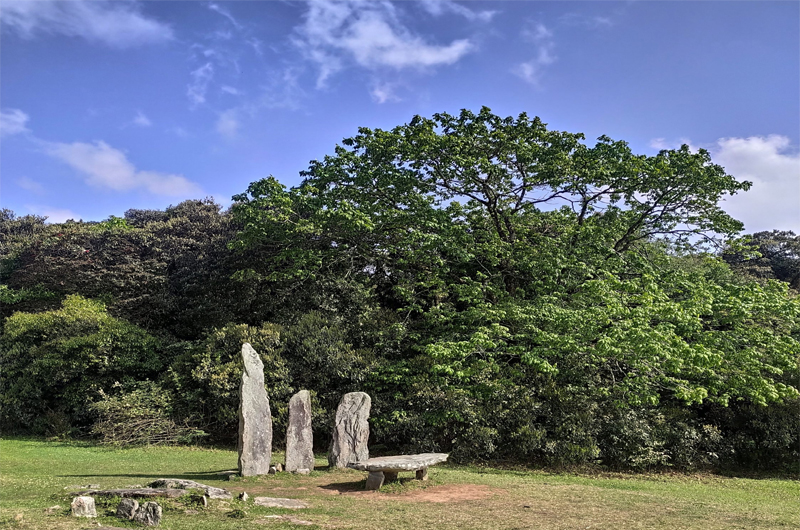
Meghalaya’s sacred groves are home to several species of trees that work as climate indicators. Photo courtesy, Meghalaya Tourism.
Sacred groves are typically found in Bengal’s south-western districts, Deb says, where tribal people make up a major part of the population. Under colonial rule, when the Permanent Settlement Act was passed (1793), all village forests were converted to agricultural lands and numerous groves disappeared. Today, sacred groves exist only where indigenous communities still maintain them under various social and religious edicts.
The Northeast Region is one of the two biodiversity hotspots in India. The tribes here traditionally preserve the sacred groves, which are found in Assam, Arunachal Pradesh, Manipur, Meghalaya and Sikkim. In the western parts of Assam, tribes like the Bodos and Rabhas have their own rituals to worship at the groves.
The Dimasa Tribe of the Dima Hasao Autonomous District in Assam consider that the area-gods hold control over the patches of forest and have their own abodes (dikho). Researchers Pramod Medhi and Sachin K. Barthakur have documented 12 ‘rediscovered’ dikhos in the district. “Out of 34 plant species considered sacred by the Dimasas, 13 are related to worship, and others to the naming of areas/villages or associated with the names of clans,” they note. Giant bamboo, Pear Bamboo, Pink Banana, Metico Pepper, Indian Smilax, Arecanut, Sandpaper Tree and Devil’s Cotton are among the most common species in the sacred groves of Assam.
Interestingly, though Meghalaya’s population is majorly Christian, the tradition of preserving the sanctity of sacred groves continues. Those near Mawphlang, some 26 km from the capital, Shillong, is well-known. The Khasi Community of Hima Mawphlang has been protecting the forest for more than a thousand years. They call it Law Kyntang (sacred grove) protected by deity U Ryngkew U Basa, a mystical creature. Meghalaya’s sacred groves are home to several species of trees that work as climate indicators, such as the Japanese Blue Oak. Rare species of animals and birds have also been documented.
Experts on biodiversity conservation say that sacred groves are an apt example of indigenous traditional practices promoting conservation of flora and fauna and the larger environment. This has led to ideas of declaring many grtoves as biodiversity heritage sites by communities and governments. In West Bengal, for example, the Department of Biodiversity has drawn up a list of around ten places to be declared sacred grove biodiversity sites. The Chilkigarh Sacred Grove is the biggest among them, spread over 60 acres in Jhargram District along the Dulung River. The famous Kanak Durga Temple is located here. It contains some 388 species of herbs, of which over 105 have medicinal value. Besides, the forest has 26 species of amphibians and reptiles. The grove is maintained by the Kanak Durga Temple Trust.
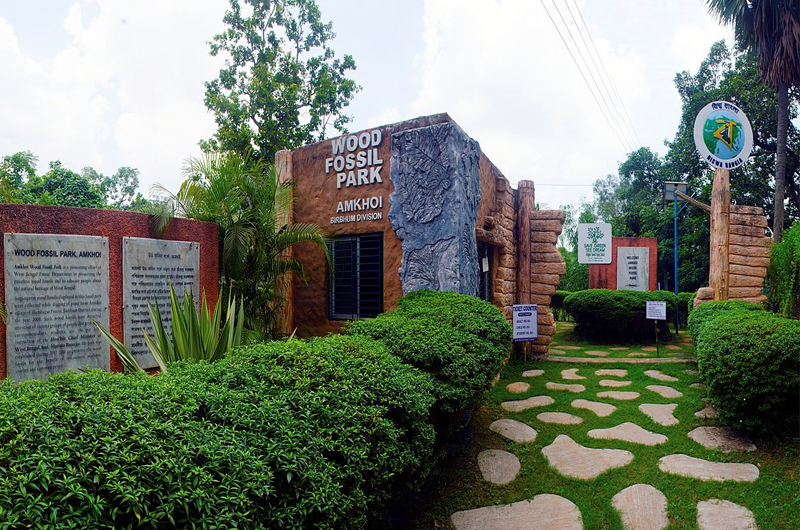
Sacred groves are not confined to forest areas. The Dhotrey Medicinal Plant Conservation Area (Darjeeling), Tonglu Medicinal Plant Conservation Area (Darjeeling), Namthing Pokhari, a Himalayan natural wetland, Baneswar Shiva Dighi BHS in Cooch Behar, an ancient pond attached to the Shiva temple, and the Amkhoi Wood Fossil Park (Birbhum) are also part of the biodiversity sites in West Bengal. Indeed, the Western approach to biodiversity conservation now recognises the value of the relationship between local environmental knowledge and community wisdom intrinsic to the concept of sacred groves.
(The writer is a senior journalist, author and translator. She lives in Kolkata.)
 from Webdoux