

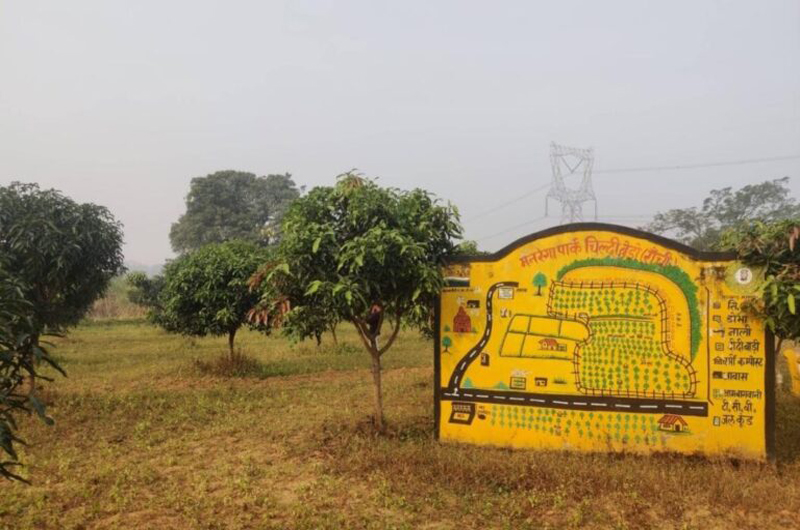
Farmers in Jharkhand, who have started planting on barren land under the Birsa Harit Gram Yojana Scheme, will receive carbon finance funds. The aim of granting funds is to help them maintain their plantations. At present, more than 30,000 beneficiaries are associated with the carbon finance scheme being implemented in 18 districts. There is a plan to add 125,000 beneficiaries. Experts emphasise on linking more farmers to this scheme as well as periodic monitoring of all such schemes. They also consider it crucial to create a system to preserve trees after the end of project tenure. Vishal Kumar Jain files a comprehensive report
Last year, while countries and organisations from across the world gathered in Azerbaijan’s capital Baku for COP29 and discussed carbon trading rules, about 3,800 km away, farmers living in Jharkhand were excited on learning that they would receive carbon finance funds in a few months. Farmers in Childari Village in Bedo Block of Ranchi, famous for peas and other vegetables, have chosen to avail the benefits of carbon finance — financial resources such as loans, investments and subsidies given to acquire greenhouse gas emission allowances. Carbon financing will be done through growing fruit-bearing trees under the Birsa Harit Gram Yojana (BHGY) — a state government scheme that aims to conserve barren land and make it cultivable to amplify livelihoods.
According to the Economic Survey of Jharkhand (2023-24), the BHGY scheme has been running since 2016-17 under MNREGA with an aim to increase employment opportunities in the state. Under the scheme, 135,122 farmers have planted mango and other fruit-bearing trees in 116,637 acres. Eligible farmers with a maximum of one acre of land are provided with financial help as well as assistance for five years. It is estimated that thanks to the scheme, each family has managed to earn profits of more than ₹50,000 annually. There, however, was a catch. It wasn’t clear how marginal farmers would continue maintaining their plantations after five years. To overcome the problem, the BHGY scheme has been linked to the carbon finance scheme, which will provide additional income to the beneficiaries for the next 20 years.
Additional livelihoods
Mongabay visited Childari Village and spoke to the beneficiaries of the BHGY Scheme. Beneficiary Namita Devi said she came to know about the initiative through the Rural Development Department of the Jharkhand Government, promoted by Transform Rural India Foundation (TRIF) and Intellecap Advisory Services. The beneficiaries said they were a bit hesitant before joining the scheme. The fact that they were told to share their bank details and were made to sign digitally made them suspicious. “We were not very keen initially because of past experiences. Then we consulted with the head of the panchayat and he explained to us about carbon finance. After this, many people from the village agreed to join it,” said Namita Devi.
Elaborating on past experiences, Raju, another resident, said, “In Nihalu Kaparia, our panchayat, biometrics of some people was done in the name of renewing gas connections. After this, money was withdrawn from their accounts illegally. People are a bit scared after that incident.” Namita Devi planted 112 mango trees on her fallow land in 2021-22 with the help of the Jharkhand Government. The trees are still small but, in the last season, she sold mangoes worth Rs 8,000-10,000. Namita, who joined the carbon finance scheme in 2024, says that the amount of carbon her trees have absorbed will be assessed through satellite surveys. On this basis, she will continue to be paid every year for the next 20 years.
TRIF Director Ashok Kumar told Mongabay, “The aim of BHGY is to enable people to earn money and have a permanent source of livelihood. Beneficiaries can plant on their fallow land. In the one acre model, 112 fruit and 80 timber trees are planted.” Ruth Khes, who planted trees on her barren land under BHGY, says carbon finance is a good scheme. She told Mongabay, “First, the beneficiaries are getting additional income. Second, it’s keeping the environment clean. Farmers are also getting motivated to plant more and more trees. When they will start getting money, they will be more involved in the process.”
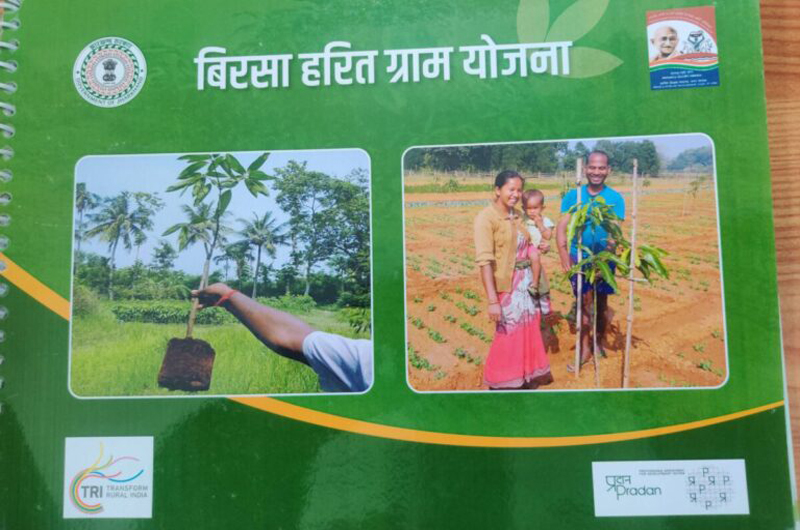
The Ministry of Agriculture and Farmers Welfare has prepared a framework for promoting a voluntary carbon market for the agriculture sector in India to encourage small and marginal farmers to avail carbon credits. For this, the Carbon Credit Trading Scheme was notified in December 2023. The government believes that introducing farmers to the carbon market can increase their income as well as accelerate environmentally friendly agricultural practices. Agriculture is one of the sectors selected under the offset mechanism of carbon trading in India. Through this scheme, entities/farmers can register projects related to reducing greenhouse gases for the issuance of carbon credit certificates (CCU).
Geeta Devi told Mongabay that the farmers who missed out on the scheme earlier want to join it now. She says that as the trees grow or get older, higher payments are made directly to the beneficiary’s account. She adds that the measurement of orchards will be initiated soon, following which farmers will get paid as per CCU credit.
How it works
Under the BHGY scheme, those who have been planting on one acre of fallow land since 2018 can apply for carbon finance. Each farmer will receive an additional income of Rs 60,000 in the next 20 years from carbon finance. The scheme is currently active in 18 districts. So far, more than 30,000 beneficiaries have taken advantage of the scheme. The first instalment is likely to be credited to the beneficiaries’ accounts by July-August this year (article was published in July). There is a plan to connect about 125,000 (1.25 lakh) beneficiaries with carbon finance in the next year. The funds required for the scheme are being provided by Rabo Bank (Co-operative Bank of Netherlands). Its accounting process is being completed by ACORN. At the same time, the responsibility of implementing it on the ground is jointly on TRIF and Intellecap India.
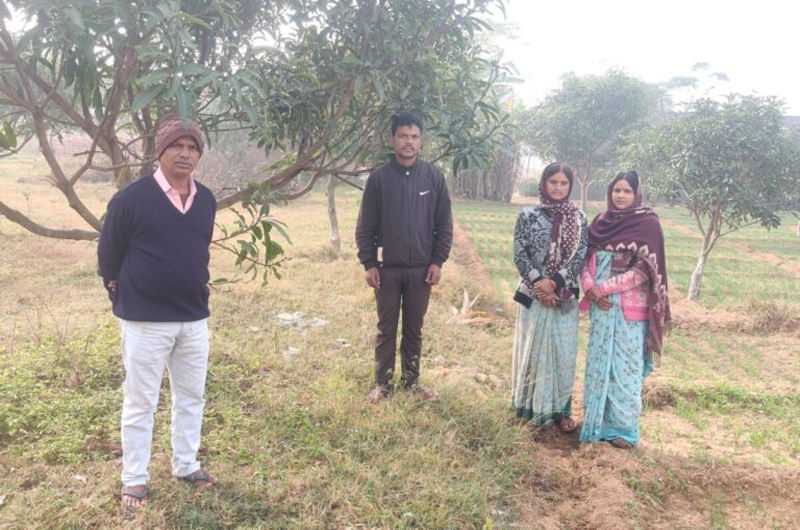
First, an agreement is signed with beneficiaries. They are registered on the portal created by ACORN. After this, polygon mapping of the plot is done. All the plants will be included under geo-coordinates. This process will be monitored through a satellite programme called sat-intelligence. There will mainly be two indicators — the thickness of the tree trunk, and tree cover. This will determine how much carbon a particular tree has absorbed. The calculation is done with the help of technology and there is no human intervention in it. As soon as it is calculated, carbon removal unit (CRU) will be credited to the beneficiary’s account. On the basis of this unit, funds will be deposited.
TRIF joint director Karimuddin Malik told Mongabay, “If we talk about the rate of carbon finance, then every portal has different rates. But, currently on ACORN’s portal, the price of one CRU is 35 to 40 euros. The price of euros will be taken on the day of payment. Eighty per cent of the payment will be credited directly to the farmers’ account.” Experts say that the initiative will increase the income of marginal farmers which will help in better maintenance of horticulture. They say that with increased production, a supply chain of fruits can be created and industries making food items can be developed. There is a possibility that the Mallika variety of mango will have a bumper yield. Then it can also be exported. This will ensure better income for the farmers.
Anurag Dhir, associate consultant, Intellecap Advisory Services, which provides consulting services in the field of climate and energy, says: “Small farmers are most affected by climate change. Due to crop loss, they get stuck in a debt trap. Therefore, our aim is that firstly, farmers get additional income through carbon finance. Second, they should have their own property and be able to earn from it even when there is no rain.”
(Courtesy: Mongabay India/ india.mongabay.com. This is a condensed version of the original.)
 from Webdoux