

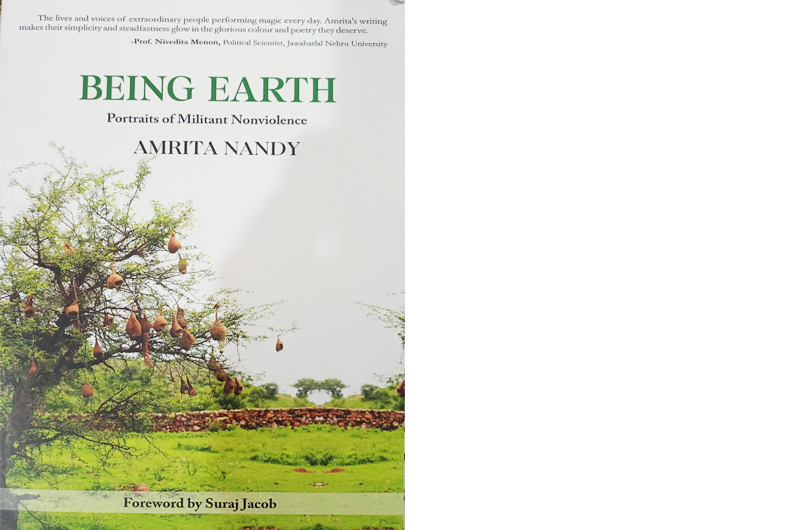
Bharat Dogra dips into a book by Amrita Nandy which tells tales of struggles, courage and timely help by a self-help group which has resulted in constructive work for society as well as personal development
Dheera Ram Kapaya came from such a poor family that even though he could not go to school himself, he was made to carry another boy’s heavy school bag for five km, in return for just one scoop of daliya (porridge). And though he eventually managed to enroll in school, he had to drop out after class five and join other adolescent workers. But Dheera Ram did not give up. He signed up for community efforts for forest protection, adult literacy and other constructive work, and, in doing so, his hidden talents for writing came to light. He became known for songs and scripts for street plays on forest protection, preventing child marriages and other social reforms.
Bhurki Bai never made it to school – she had to submit to an early marriage and became the mother of four children at the age of 19. Then an accident disabled her husband for life. Faced with seemingly insurmountable difficulties, Bhurki clutched at an opportunity that suddenly appeared in her remote village in the form of a self-help group. At times carrying her youngest child to meetings, she emerged as a leader, first mobilising women for repairing an irrigation source and then for protecting a pasture and planting trees.
Devi Lal lost his father when he was only 12. He had to leave school to accompany his mother and sister to work in a city for just Rs 10 per day. However, making use of some opportunities back in his village, Devi Lal fostered his innate leadership skills, and worked to protect pastures and lead struggles for forest produce rights.
Uday Lal Suthar had to leave his home as a teenager to work in cities, and finally set up a carpentry business in Mumbai. On a visit to his village, he attended a meeting where he found his true calling in protecting forests and pastures. Devoting himself to this work, he courageously fought against influential outsiders who were encroaching on community forest and pasture land.
All of these inspiring stories of young people overcoming extraordinary odds to become community leaders are from villages in Rajasthan’s Udaipur District. And another common factor is Seva Mandir, a voluntary organisation. Various members of the Seva Mandir family showed understanding and solidarity in helping and encouraging these emerging grassroots leaders, opening up opportunities and reaching out with a helping hand during difficult times, including in struggles against powerful encroachers and forest produce smugglers.
Ten such inspirational stories have been related in a compelling way in a recent book titled Being Earth—Portraits of Militant Nonviolence by Amrita Nandy, a senior academic. A note on the work of Seva Mandir by Narendra Jain and Ronak Shah provides a wider framework to these stories. A thought-provoking foreword written by Suraj Jacob provides valuable insights and also places the experiences in the context of several development debates and concepts. One of his interesting observations relates to seeing these experiences as a combination of struggles (sangharsh) and various kinds of constructive work (nirman). Jacob recalls the emphasis on combining these two concepts by Shankar Guha Niyogi, a leader of the workers, and, also by Mahatma Gandhi.
(The writer is an independent journalist and author who has been writing for over five decades, providing a strong perspective on peace, justice and protection on the environment. He lives in New Delhi.)
 from Webdoux