

Bharat Dogra profiles an important initiative to make medicines more affordable to the marginalised, by Dr Narendra Gupta and his voluntary organisation, Prayas, in Rajasthan. Linking local and wider concerns, Prayas has been associated with organising several important consultations on health issues and bringing out various related publications. From suggesting free supply of medicines in all government hospitals to seeking justice for women who were victims of unnecessary hysterectomies, Prayas has also shown commitment in meeting the health needs of about 60 villages under a mobile health programme
Rural health initiatives hinge greatly on effective and cost-effective medical facilities, as policy makers and grassroots workers know from experience. Building on this knowledge, Dr Narendra Gupta, founder of voluntary organisation Prayas, has been studying ways of improving such facilities for the weaker and marginalised sections. In this, he took the cue from Dr Samit Sharma, who, as collector of Rajasthan’s Chittorgarh District, was convinced that patients can benefit a lot if, instead of procuring expensive branded medicines, the government turned to the much cheaper generic medicines.
Prayas had been providing health services in the district and nearby areas for several years. Dr Narendra Gupta was associated with state- and national-level health campaigns. He had special expertise in issues relating to making available quality medicines at lower costs. In addition, he was in regular contact with those working at the national level on these issues, apart from having a firm grasp of the local people’s need for medicines.
Dr Samit Sharma leveraged these as district collector. Building on Prayas’s understanding and knowledge base, the effort of procuring and making available generic medicines in government hospitals of the district proved very successful. Sadly, the effort could not be sustained after Dr Sharma was shifted to another position. Dr Gupta, however, continued trying to reduce the people’s out-of-pocket health expenses and prepared several factsheets which proved helpful for policy reform in this regard.
When the Rajasthan Government began pre-budget consultations, Dr Gupta suggested free supply of medicines in all government hospitals. Then Chief Minister Ashok Gehlot was enthused about the idea, but funding was a concern. Because of Dr Gupta’s preparation, he was able to convince high-level government officials that if steps such as avoiding the purchase of expensive branded medicines in favour of equally effective generic alternatives were taken, the provision of free medicines at government hospitals was feasible without significant addition to budgetary allocation.
Dr Gupta and his team members like Chhaya Pachauli (present director of Prayas) were able to make a strong case that the supply of free medicines in government hospitals was not only highly desirable but also affordable for the Government. The initiative got a lot of appreciation at the national level, and Prayas members like Dr Gupta and Pachauli continued to work for its success. Millions of patients and their families have benefited from this programme, in terms of significantly reduced costs of treatment and care.
It was later decided to take the initiative a step further towards more comprehensive free healthcare by passing a Right to Health legislation in Rajasthan in 2022. Powerful interests tried to stop this, but Chief Minister Ashok Gehlot went ahead with it. The Prayas team extended valuable effort, along with some state-level and national health campaigns including Jan Swasthya Abhiyan. When the implementation of this law was subsequently delayed, Dr Gupta persisted with legal efforts to make it happen. He also took recourse to the Right to Information Act to create conditions conducive to early implementation.
The same persistence and determination has been visible in Dr Gupta’s pursuit of justice for women who were victims of unnecessary hysterectomies. After investigating reports of such cases in the Dausa area in Rajasthan, Dr Gupta and his team called for national-level consultations on the issue. When the wider consultations confirmed the existence of the problem particularly in three states, Dr Gupta took the matter to the Supreme Court of India. The case languished for some years. However, in 2023 the apex court issued wide-ranging directions to reduce and, if possible, eliminate the practice. At the time of my recent visit to Prayas’s area of work, I found Dr Gupta still busy contacting state governments to prevent unnecessary hysterectomies.
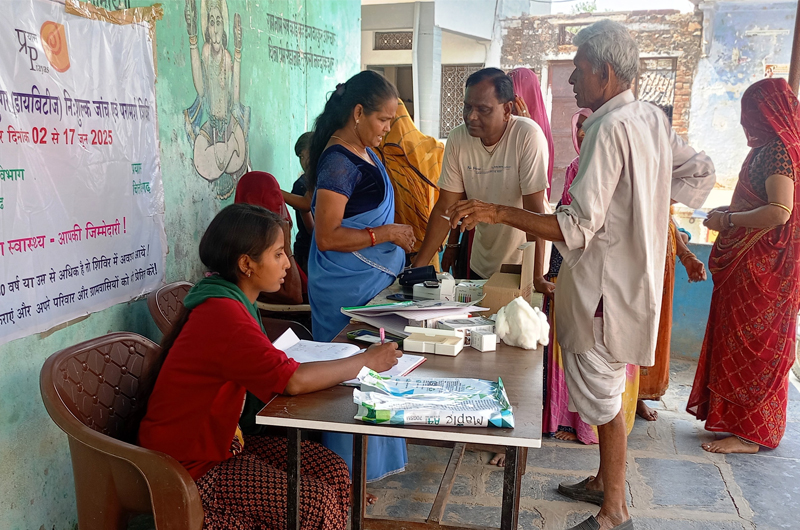
Earlier, Prayas had shown similar high commitment in meeting the health needs of about 60 villages under a mobile health programme. This included providing check-ups and treatment for several ailments and referring more serious patients to government hospitals. Dialogues on health issues or jansanvads were organised to debate right to health-related concerns. Of late, Prayas has been engaged in ensuring that people in the villages where it is working are better able to utilise various government schemes and services. As Vijay Pal, a member of the Prayas team based in Devgarh Village, says, “Access to health can significantly increase if people are well-informed about their rights and the availability of various schemes and services, and prepared regarding the procedures and papers needed.”
Prayas also helps the overall health effort by screening the rural population under its jurisdiction for diabetes and hypertension. Goverdhan, who has been closely involved in the programme, says, “In the course of these efforts it was revealed that quite a few persons have been victims of paralysis, and taking care of them has become an important issue for their households.”
(The writer is an independent journalist and author who has been writing for over five decades, providing a strong perspective on peace, justice and protection on the environment. He lives in New Delhi.)
 from Webdoux