

This case story is part of a collection, Stronger Together: How Jharkhand is Reviving Land, Water and Lives, a case story booklet that highlights the impact of the Mobilizing MGNREGA – An Effective Collaborative Water Security Programme in Jharkhand, implemented under the broader Jiwi Daah Hassa initiative. Supported by Welthungerhilfe and the German Federal Ministry for Economic Cooperation and Development, and implemented by WOTR, the programme enables rural communities to revive land and water resources through participatory planning and convergence with government schemes. Each story in the booklet reflects the power of collective action in building resilient, self-reliant villages across Jharkhand. This story is by Azera Rahman
Prabha Baaraof Devidhi Village in Jharkhand is very clear with what she wants from life. “I want to ensure that both my sons do well in their future, and that my village progresses and prospers. For these two aims, I am ready to work as hard as I can,” Baara, 46, said. Basanti Lakra, her neighbour and friend, who sat close by, agreed. “Everything we do is for the kids. But we also want the betterment of our community,”she added.
Baara and Lakra are MGNREGA (Mahatma Gandhi National Rural Employment Guarantee Act) mates, which means that they supervise projects under the government scheme in their village and work closely with the workers. It is not an easy job and often comes with unique challenges, but the women have earned the faith of their community through their effort and dedication.
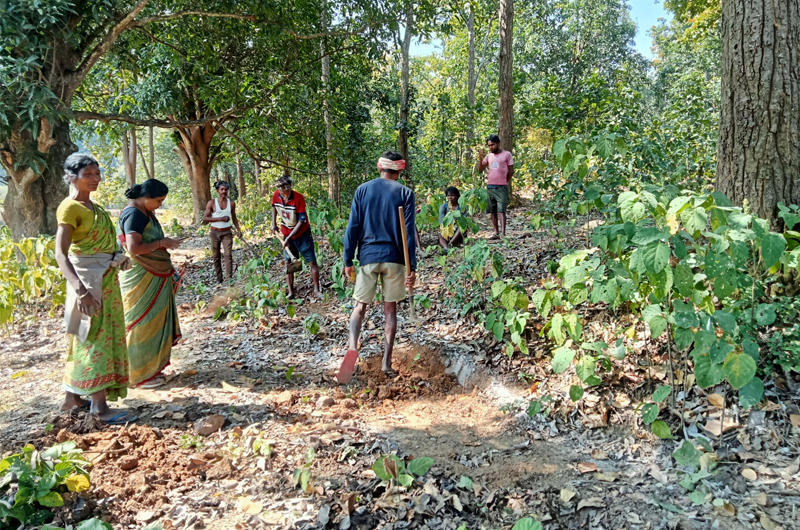
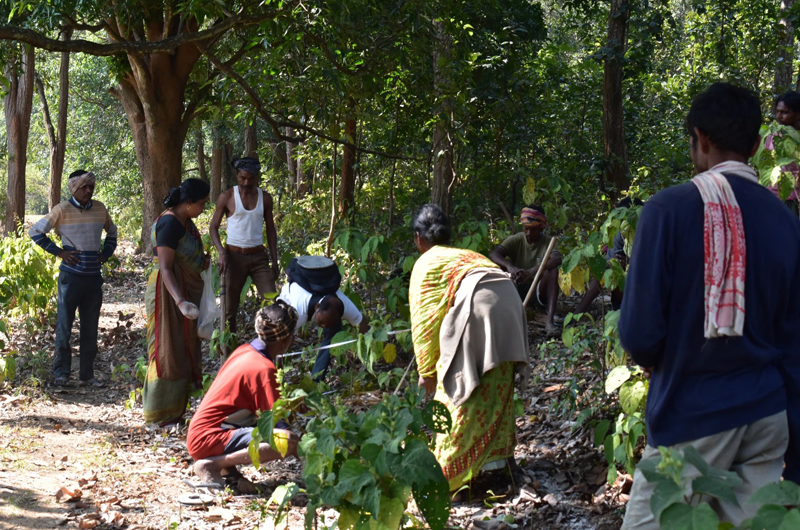
Sharing some of the things that they learnt during the training, Lakra went on to say that they were taught how to measure landusing a measuring tape, and then asked to demonstrate the same in a field. This was important because in their supervisory role, an MGNREGA mate has to often measure and demarcate land on which a day’s work has to be done by the workers. WOTR played a crucial role in mobilising efforts to conduct such trainings for women MGNREGA mates by the block level officials here in theGumla District. A clear understanding of their work has helped them do their work effectively and with confidence, the two women said.
Learning new things, implementing on ground
Baara, for instance, said that for her first project as an MGNREGA mate, she had to supervise the work for a trench-cum-bund to be made on a field in her village. “I first measured the land with the measuring tape given to us after the training, and then demarcated the portion where work had to be done with lime,” she narrated. Then she checked the names of the workers who had come for the work. This is again important because attendance would determine payments of the workers. “I monitored the work closely and even helped at times. The project took one and half months to complete,” she added.
Baara also said that she enquires if anyone needs work in the village, at times even going door-to-door. “The education level in our village is very low and people are not very aware. So I feel that it is my responsibility to do what I can so that our village as a whole can benefit and make some progress,”she added.
going, both the women had the same answer: a better life for their children.
Recording workers’ signatures as well as the village head’s at the end of every week is also a part of a MGNREGA mate’s responsibility. This ensures that workers’ payments come on time. “We have monitored three projects in the village till now and two are ongoing. All of them are makingtrench-cum-bunds,” Lakra said. Since it was winter during this visit and paddy had just been harvested in the fields, people were not very keen on working on anything else at that time.
“The projects will restart full-fledged after a few weeks when people start looking for MGNREGA work again,” she explained. Lakra spoke from experience. Her husband, who has a job card under MGNREGAand takes up such work, was taking a break after harvesting paddy in their field and would seek work after some time. Both Lakra and Baara, however, admitted that their journey has not been without its fair share of challenges. “Timely payment of workers’ wages is sometimes an issue with MGNREGA work and since we are at the frontline, we are at the receiving end of a lot of anger,” Baara said, and then looked at Lakra.
The women narrated an incident when, during one of their initial projects, the payments of some workers had not been credited on time. Seething with anger, the workers accused the two of siphoning off their money. “They said many hurtful things—that we were women so we did not know our work well,” Lakra said, “We broke down into tears and called Sir (Mritunjay Mahato, WOTR). He calmed us down and guided us to resolve the issue.”But no matter what they said, the workers refused to be convinced. So, the two decided to take them all to the MGNREGA officials at the block level. As it turned out, the payments were held for a technical reason and after their intervention, it came through. “It really upset us that they questioned our integrity,” Lakra went on to say, “But after that day, no one questioned our intent.”
When asked what keeps them going, both the women had the same answer: a better life for their children. Baara had no qualms in saying that she was running her household almost single-handedly because her husband is an alcoholic. “Most of our money goes into liquor. So I have to step up and do more. Not only do I want to earn better, but also want to set a good example for my sons,” she said softly and with a smile.
With her hard-earned money, Baara has put her elder son in an English medium boarding schoolin Gumla, the district headquarters, almost 70 km away. He is in class 11. “My elder son tells me that he wants to get a private job and help me; so that I don’t have to work so hard all my life,” the proud mother said, “But I tell him not to worry about me and continue to focus on his studies. I will put my younger son in that school as well.”
Lakra has similar plans for her two children, aged 15 and 10, as well. “I want to renovate our house and maybe add an extra room. Right now it’s a two-room house,” she said and took us inside her home. There was a pot of food on an earthen stove and the season’s paddy harvest was stocked behind a double-bed.“I make sure that all my work—cooking, cleaning, washing— is done by 8 am so that I can leave for work after that,” Lakra said, “It’s hope that keeps us going.”
(Courtesy: WOTR/ wotr.org. Azera is an independent writer and editor. She collaborates with a range of organisations, primarily in the development sector, and contributes stories on climate change, health, gender, and development to various media platforms.)
 from Webdoux