

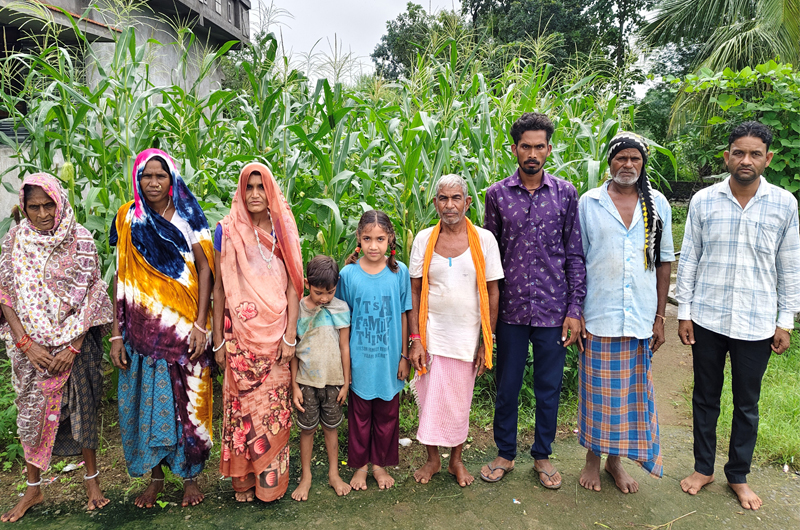
Residents of a small tribal village in Rajasthan are crusading for the preservation and propagation of collective wisdom. Bharat Dogra profiles a family which is actively participating in this cause and says such efforts of saving and conserving the diversity of traditional seeds and crops or plant varieties need to be widely encouraged
Baal Singh, an elder of the Bhil Adivasi Community in Kushalgarh area of Rajasthan’s Banswara District, is widely respected for his knowledge and understanding of the traditional farming practices of his community. Speaking to this writer at his home in Nisnawat Village, he emphasised that the diverse varieties of crops that form a part of the tribe’s farming traditions should be conserved and saved. He stressed that the hybrid crop seeds purchased from the market had been very harmful for farmers of his community and the practice of relying on them should be checked.
Pointing out that the hybrid seeds require chemical fertilisers and pesticides, and thus foster dependence on expensive inputs, consequently increasing expenses and debts and thereby endangering the survival of small farmers, Baal Singh also noted that such crops often also require more water. Further, several of the seeds and the methods used for cultivation have proved to be harmful for the soil. They are more susceptible to pests and sometimes farmers have lost heavily as they do not grow properly, he said.
In sharp contrast, Baal Singh pointed out, the traditional seeds preserved by the tribes can be trusted and their characteristics are known to the community. “We know how to care for them. They need less water and are more resistant to pests and diseases. They can be grown using low-cost inputs available in the villages, and no expensive material needs to be purchased from outside,” he said. “For small farmers like us, it is very important to avoid unnecessary expenditure and keep costs low.”
Maize is the most important crop for the tribe, and there are many varieties, to suit different tastes,” Baal Singh said, and stressed that the younger generations should be aware of such crop types. He showed me his farm in which the traditional hangdi pattern of cultivation is practised –nearly a dozen crops, including millets, pulses, oilseeds and vegetables, are sown simultaneously in a small field, but are harvested at different times of the year, so one crop or the other is available to the family at all times.
Such practices have been helpful for small farmers for a long time, and they know which crops can be grown together and which rotation schedule is most suitable. The intricate system based on the knowledge of many generations should not be lost and the younger generation should understand its importance, Baal Singh stressed.
Some years back, Vaagdhara, a voluntary organisation, came to work in the region, and Baal Singh became an enthusiastic supporter. Swaraj or self-reliance groups were formed in various villages and he was an active participant. His daughter-in-law, Pushpa, also became an important part of the women’s self-help groups or saksham samoohs aimed at promoting low-cost, self-reliant and ecologically protective farming methods among women.
Baal Singh’s son Dinesh is very committed to taking forward his father’s ideas of preserving seeds and natural farming practices. He says they are not old or outdated, but important for protecting the interests of the current and future generations. “There is so much talk of environment protection, but here in our village we are able to contribute through our daily life,” he says. Such efforts of saving and conserving the diversity of traditional seeds and crops or plant varieties need to be widely encouraged.
(The writer is an independent journalist and author who has been writing for over five decades, providing a strong perspective on peace, justice and protection on the environment. He lives in New Delhi.)
 from Webdoux