

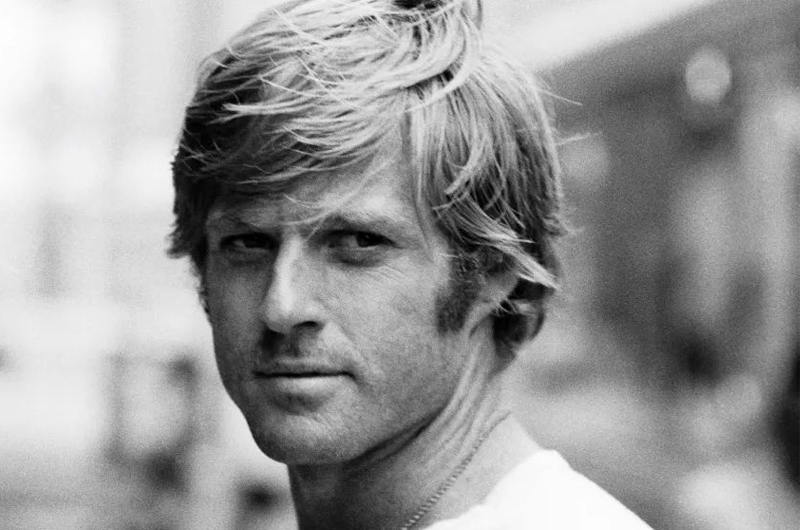
Stars of the Golden Era of Hollywood have their own singular aura. The greats from the 1930s to the 60s are all remembered affectionately for their dashing good looks, charming screen presence and their willingness to play different roles away from their usual image, says Partab Ramchand. If there is one personality from a later period who can match them in all these aspects, it has to be Robert Redford, he points out, and explains why in this tribute. Redford passed away recently at the age of 89
From the moment he first appeared on the screen in the early 1960s, it was crystal clear that the young handsome man with reddish blonde locks was marked for stardom. He had the looks, a magnetic screen presence and a virility that made him stand out from other leading men of his period. ‘He is going to go places’ was the general refrain of movie-goers and Hollywood’s Golden Boy as he was christened, did not disappoint. On the contrary, he rose to even greater heights, making a smooth transition from a charismatic young star with an unprecedented fan base to an actor who could play versatile roles with ease to a respected Oscar-winning director. At the end of it all, it is clear that Robert Redford is one of the iconic figures, fit to be ranked among the greatest personalities to emerge from the glamour world of Hollywood.
After displaying his talent in films like Inside Daisy Clover and This Property is Condemned in the mid 1960s, Redford attracted attention as the newly wed husband opposite his wife Jane Fonda in Neil Simon’s comedic play, Barefoot in the Park (1967), wherein he repeated his success on Broadway. His breakthrough role was just round the corner. He paired with Paul Newman for the first time in Butch Cassidy and the Sundance Kid (1969). It was a career-defining role for him, and such was the impact of the film that the Sundance Kid tag followed him all his life. The film was a runaway hit thanks also to the Burt Bacharach song, ‘Raindrops keep falling on my head’, and it was clear at the start of the 1970s that Redford was ready to step into superstardom.
And so it proved, for during the decade he was one of the most bankable stars even in a competitive field. He appeared in one hit after another, playing a variety of roles that successfully shed his good looking, sex-symbol image. Following one after another in quick succession were Jeremiah Johnson, The Candidate, The Hot Rock, The Sting, The Way We Were, Three Days of the Condor, All the President’s Men, The Great Gatsby, A Bridge Too Far, The Electric Horseman and Brubaker. Almost all of them were critically and commercially successful. The Sting, which paired him again with Newman, went on to win several Oscars, including Best Picture, besides getting Redford his only nomination for Best Actor while All the President’s Men was hailed as a classic. Here, Redford successfully shed his good-looking image while playing the role of Washington Post reporter Bob Woodward. His pairing with Barbara Streisand in The Way We Were was considered ‘magical’.
In 1980, at the height of his career, Redford surprised everyone by going behind the camera to make Ordinary People, which enjoyed extraordinary success. Redford always nurtured ambitions of becoming a director but few would have thought that he would be an instant success. The family drama won Oscars for Best Picture and Best Director. Redford went on to direct eight more films but could never top his work on Ordinary People.
Through the 1980s, Redford retained his box-office appeal while continuing to take on challenging roles and other responsibilities, such as producer or executive producer. His biggest success during the decade was Out of Africa in which he co-starred with Meryl Streep. The movie won seven Oscars, including one for Best Picture, and his performance was highly acclaimed even if he was overlooked by the Academy. At 50, Redford, like old wine, was getting better with age. Indeed, he remained a major star through the 1990s and into the New Millennium, appearing in Sneakers, Havana, Indecent Proposal and A River Runs Through It, which he directed, bringing a young Brad Pitt into prominence.
Redford remained active in films till his early 80s, his magnetism refusing to fade with age but, in the meantime, he was also associated with the Sundance Institute which he had founded in 1981. In a way, this remained his greatest cultural impact, for this was a non-profit organisation dedicated to cultivating fresh cinematic voices. It was a movement that inspired generations of artists and redefined cinema in the US and around the world. Directors such as Quentin Tarantino, David Russell, Robert Rodriguez and Chloe Zhao were nurtured by Sundance early in their careers.
Redford went on to create the Sundance Film Festival which became the country’s biggest festival for independent films. Away from movies, Redford was also involved in issues and causes and was a keen supporter of environmentalism, Native American rights, LGBT rights and the various arts. It came as no surprise when in 2014 he was named by Time Magazine as one of the 100 most influential people in the world, for Redford’s influence transcended films.
Not unexpectedly, Redford received a plethora of honours and accolades from all over the world. Besides the Oscar for Best Director, he was awarded a BAFTA Award, five Golden Globe Awards, including the Golden Globe Cecil B DeMille Award in 1994, the Screen Actors Guild Life Achievement Award in 1996, an honorary Academy Award in 2002, the Kennedy Centre Honours in 2005, the Golden Lion for Lifetime Achievement at the 74th Venice Film Festival in 2017, an honorary Cesar in Paris in 2019, and the Presidential Medal of Freedom given by President Barack Obama in 2016.
(The writer is a veteran sports writer who spent his career working for The Indian Express and The Telegraph and Sportsworld. He lives in Chennai.)
 from Webdoux