

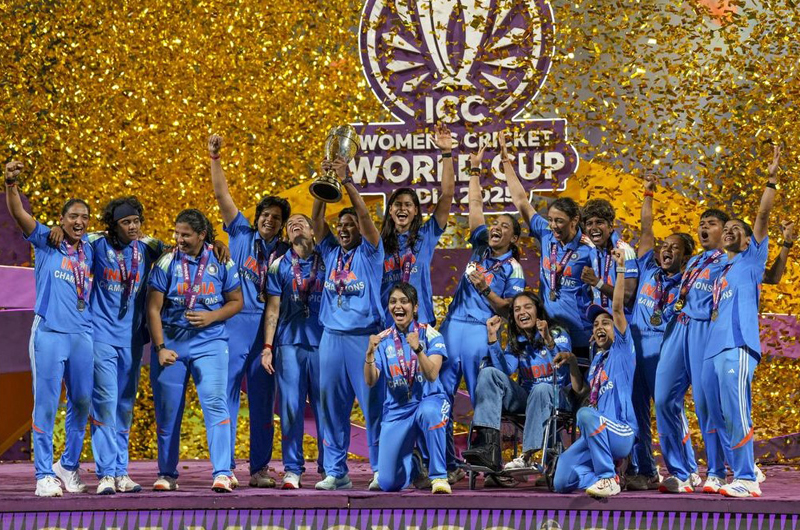
On November 2 in Navi Mumbai, India’s women’s cricket team emerged as champions of the world, winning the ICC World Cup. Referring to the players as “the iron maidens of world cricket”, Partab Ramchand describes the long and arduous journey of India’s women cricketers over the past 50 years or so, before they finally reached the pinnacle on “that glorious Sunday night”
They have faced every hurdle and obstacle on their way to the top. Over the years, India’s women cricketers have faced discrimination, a patronising approach, parental hindrance, neglect, lack of interest in their achievements, lack of encouragement from the authorities and a condescending attitude by men cricketers and those in administration. Yet, on that glorious Sunday night of November 2 in Navi Mumbai, Harmanpreet Kaur and her gallant band of women cricketers shoved aside nearly half a century of all this to lift the ICC World Cup for the first time and emerge as the iron maidens of world cricket.
As one who has followed women’s cricket in India since the embryonic days of the 1970s when the fair sex playing the game was a novelty, I have seen it evolve painfully slowly over the years. Thanks to the factors listed above, the growth took a lot more time than it would have otherwise. Despite all that they had to endure, the women retained their enthusiasm for the game. They continued to play and practise whenever and wherever they could, even alongside the few men cricketers who displayed a readiness to teach them the finer points of the game, impressed by their keenness.
It took years for women’s cricket to find its feet. Organising camps and tournaments, the formation of a Women’s Cricket Association of India along with the affiliated state units saw the game take shape but it was still the cricketers themselves who did much of the work in a bid to keep the game going and to encourage young players to take to the game.
In the mid-1970s, Indian women started to play international cricket but, only to be expected, progress was slow and painful. Even through the 1980s and 90s, interest was lukewarm. Shantha Rangaswamy from Karnataka was the torchbearer of early women’s cricket, excelling on the field. She provided the initial inspiration and there was considerable improvement in the overall standards but the factors stated above did not go away altogether and progress continued to be stilted.
Things really changed in the New Millennium. Players of the calibre of Mithali Raj and Jhulan Goswami emerged. They attracted considerable attention worldwide thanks to their impressive record. There is little doubt that the two players gave women’s cricket the further impetus it needed. Interest increased and at least some spectators came to the ground to see the action.
But, perhaps, the all important turning point came when the BCCI (Board of Control for Cricket in India) took over the running of women’s cricket. For long, BCCI didn’t much care about promoting the women’s game. Things changed when the Supreme Court-appointed Committee of Administrators of which former Indian captain Diana Edulji was a member took over the reins of the BCCI in 2017. It took steps to professionalise the women’s game, increased player remuneration and support systems, including central contracts, besides providing better support staff and better infrastructure for the players. But the reforms really took place in 2019 when Sourav Ganguly and Jay Shah took over as BCCI President and Secretary. BCCI took steps towards removing the challenges plaguing women’s cricket. Pay packets increased dramatically and these days women players earn as much as the men.
By this time, India had not only risen enough to be ranked only behind England, Australia and New Zealand, but were also good enough to make the World Cup finals in 2005 and 2017, only to go down in both. However, the way was clear now for the girls to make further headway. The frequency of Test matches increased and, in 2021, the Indians played their first-ever day night Test against Australia in Queensland.
The biggest game changer came in 2023 with the starting of the Women’s Premier League under Shah’s stewardship. It brought together the crème de la crème of world cricket, which reflected in the players’ enhanced performance. ICC (International Cricket Council) also took the cue from BCCI and introduced equal prize money for men’s and women’s tournaments. The culmination of all these positive moves was seen on November 2. The campaign was not without its hiccups and three straight defeats midway through the league stage threatened to halt the Indian challenge before the knock-outs. But in the words of Harmanpreet, a bit of introspection at this stage proved to be a turning point and, having made it to the last four, the Indians raised the level of their game to upset Australia in the semifinal and defeat South Africa in the title clash.
It is hoped that the triumph will do for women’s cricket what the 1983 World Cup victory did for men’s cricket. Victorious coach Amol Mujumdar is confident that the victory will inspire young girls to take to the sport seriously. As one of the heroes of the triumph, Jemimah Rodriquez, put it, “We wanted to make history and we did. This is for the girls watching who want to dream big.” But perhaps Harmanpreet put it best: “This win is a start. We wanted to break the barrier. Now we want to make it a habit.” Among the many images that remained in the mind following the victory, the most touching was provided by the captain who bent down and touched Mujumdar’s feet – a silent gesture of respect and emotional connection that spoke loud and clear about his rock-solid mentorship that went a long way in shaping the winning team.
(The writer is a veteran sports writer who spent his career working for The Indian Express and The Telegraph and Sportsworld. He lives in Chennai.)
 from Webdoux