

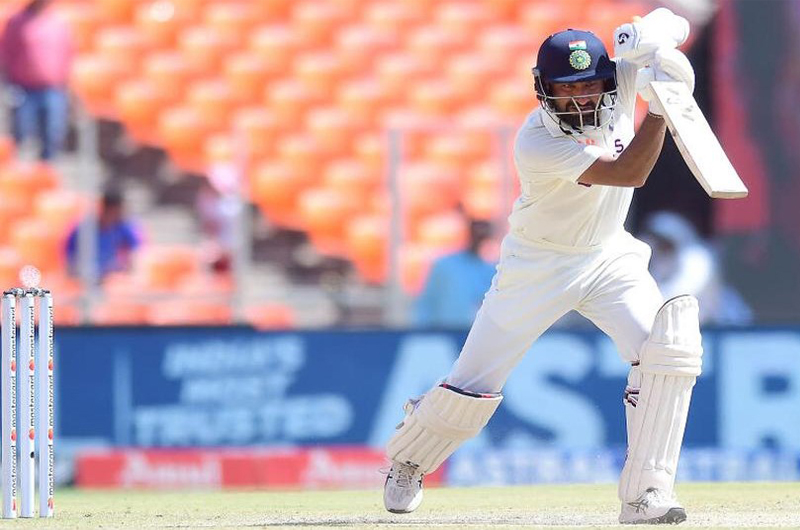
Succeeding Rahul Dravid at the pivotal No. 3 slot and making a success of it was going to be Mission Impossible but when Cheteshwar Pujara finally announced his retirement from all forms of cricket recently, he could look back with pride at a job very well done, says Partab Ramchand, adding that the chiseled strokes of Pujara in a way constituted the highest art form in the game. Over a career of 13 years comprising 103 Tests, Pujara was consistency personified, with a tally of 7,195 runs at an average of 43.60 with 19 hundreds and 35 half centuries
It is never easy to replace a legend and in this regard Cheteshwar Pujara had arguably the most enviable task in Indian cricket. Succeeding Rahul Dravid at the pivotal No. 3 slot and making a success of it was going to be Mission Impossible but when he finally announced his retirement from all forms of cricket last week, he could look back with pride at a job very well done. And every Indian cricket follower will echo this view for he not only provided substance but also the kind of solidity that Dravid possessed.
The final figures, too, compare suitably for while it would be too much to expect Pujara to match Dravid’s stats when placed alongside, they reflect the true measure of Pujara’s monumental contribution to the Indian team which was more than just the runs he scored. The value of those runs is enhanced when seen against the situation he came in and the manner in which he stood steadfast and immoveable even as wickets were falling at the other end. When the going gets tough, the tough get going goes the well-known adage and no one symbolised this better than Pujara. He was the glue that kept the batting together, the rock on which the batting was built.
Like Dravid, Pujara was India’s go-to man in a crisis. Throughout his long career he was that rarity – a Test specialist. In these days of reverse sweeps, switch hits, dilscoops and helicopter shots it was always heartening to know that there was a batsman like Pujara who still swore by the text book approach. Innovative shots have a place in a changing game and an environment eager for entertainment. But entertainment can come in many ways and the chiseled strokes of Pujara in a way constituted the highest art form in the game. He had a vast repertoire of the strokes prescribed in the coaching manual that would make the purists’ eyes sparkle with delight. Yes, even in the days of slam-bang cricket there was always an honoured place for a classic stylist like Pujara.
Besides that, Pujara built a reputation as Indian cricket’s crisis man. When Dravid retired, the hearts of the Indian cricket fans were filled with trepidation. Could the legend’s place ever be filled, they asked their minds filled with anxiety. But they need not have worried. In his first innings for India at No. 3 even as Dravid was still around, Pujara hit a stroke-filled 72 to steer his team to a seven-wicket victory over Australia in 2010 and it was quickly obvious that once the great man called it a day, the team had a like-for-like adequate replacement.
Over a career of 13 years comprising 103 Tests, Pujara was consistency personified, as the tally of 7,195 runs at an average of 43.60 with 19 hundreds and 35 half centuries will testify. Three double hundreds emphasize his insatiable appetite for runs. He just hated getting out and, limpet-like, he stuck to the crease, playing the rescue act time and again. His legendary powers of dedication, determination and concentration and his intense focus on the job to be accomplished was best brought out by a story that emerged shortly after he scored 193 in the fourth Test against Australia at Sydney in January 2019. As Pujara was compiling his marathon masterpiece, his father who had doubled up as his coach was undergoing cardiac surgery in a Mumbai hospital. No one knew what was going on inside his mind as he batted at the SCG. As his father put it best: “People react to situations and get distracted, but not my son. He remains focused on his goals and he is at peace with himself because of his spiritual nature.”
Because of this, Pujara was like a veritable monk at the crease and nothing could disturb him. During that four-Test series, Pujara was at the crease for 1,867 minutes – equal to 31 hours – in running up a tally of 521 runs with three hundreds and negotiating 1,258 deliveries. All this is clearly eye-rubbing and mind-boggling stuff, but so very typical of Pujara. His batting in Australia during that contest was his jewel-in-the-crown moment but then Pujara enjoyed several other moments of glory during which he scripted memorable victories or ensured a draw when it seemed most unlikely. The fact that he figured in 11 victories in SENA (South Arica, England, New Zealand and Australia) countries – more than any other Indian – is indicative of his ability to excel when it mattered most.
Pujara was a giant in domestic cricket. Very few Indian cricketers of his time played at the first-class level but he had a long and distinguished career with Saurashtra. He was a part of five Ranji Trophy finals and Saurashtra finished runners-up three times and won the title twice. Pujara’s tally of 21,301 runs in first-class cricket is the fourth highest by an Indian, behind only Sunil Gavaskar, Sachin Tendulkar and Rahul Dravid. Again, his tally of 66 hundreds has been bettered only by Gavaskar, Tendulkar and Dravid. He and Ravindra Jadeja are the only Indians with three triple hundreds. And when it comes to notching up double hundreds, Pujara is in a league of his own. With 18 such scores, he is fourth in the list after Don Bradman, Wally Hammond and Patsy Hendren, way ahead of the second-placed Indian Vijay Merchant who has 11 double hundreds. Not unexpectedly he was in demand to figure in county cricket and played several years for Nottinghamshire, Sussex and Yorkshire with great success.
(The writer is a veteran sports writer who spent his career working for The Indian Express and The Telegraph and Sportsworld. He lives in Chennai.)
 from Webdoux