

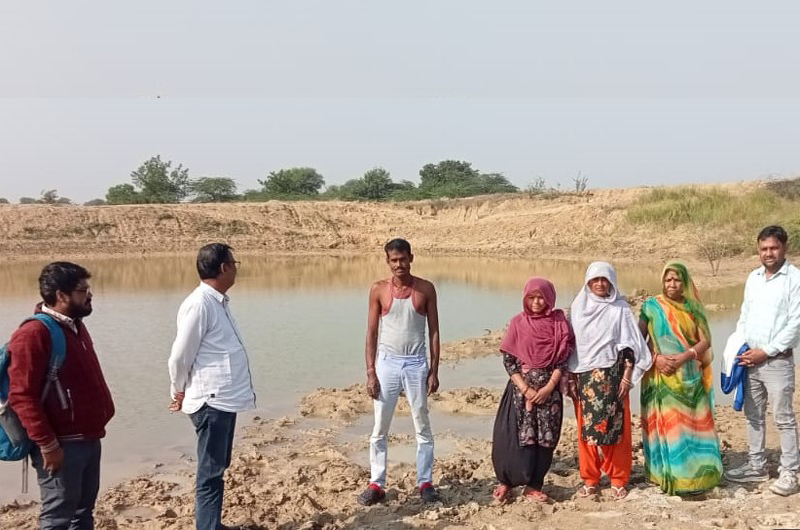
In some of the villages in Jhansi District in Uttar Pradesh, voluntary organisation SRIJAN is doing exemplary work in building on local knowledge to ensure that some water is available to the poor and weak sections even in the driest months of the year, says Bharat Dogra. In participative planning, it emerged that a natural water channel flowing in the village held a lot of potential which had not been tapped. It became the focus of the new efforts for water conservation
A check dam in Dakhneshwar Village of Jhansi District in Uttar Pradesh has become a symbol of hope for villagers trying to recover from adverse weather conditions experienced earlier in the year. Water had become the biggest constraint for farmers here, and voluntary organisation SRIJAN (Self-Reliant Initiatives through Joint Action) selected the village for priority conservation work under a project supported by HDFC Bank.
Sazeed Khan, a civil engineer and member of the SRIJAN team, explains: “We adopted a highly participative approach so that villagers’ perceptions regarding the sites and planning for water conservation based on their understanding of local conditions are taken on board.” Team leader Pankaj Sharma adds, “In our interactions with community members, particularly women, we heard again and again that water is of the greatest importance for the development and indeed the survival of villagers, and so we placed the highest importance on water conservation.”
In participative planning, it emerged that a natural water channel flowing in the village held a lot of potential which had not been tapped. It became the focus of the new efforts for water conservation. While the construction of the check dam at an appropriate site helped to conserve rainwater for a long stretch, its effect was significantly enhanced by digging about 50 ditches. They ensure that even if the water in the check dam is exhausted, a certain amount of water will still be available in the ditches or dohas.
The dam and dohas have a wider impact too – they raise the water table and increase the water availability from other sources. This helps farming, and also helps animals get more fodder while grazing. The dam will hopefully be able to irrigate about 150 acres of farmland to some extent, including some areas hitherto uncultivated due to water shortage. The silt from the ditches is deposited on agricultural land, improving fertility. Also, farm ponds, building bunds and other water conservation efforts are being undertaken. All this has brought a new hope to a village seeking to recover from serious damage to the earlier kharif crop.
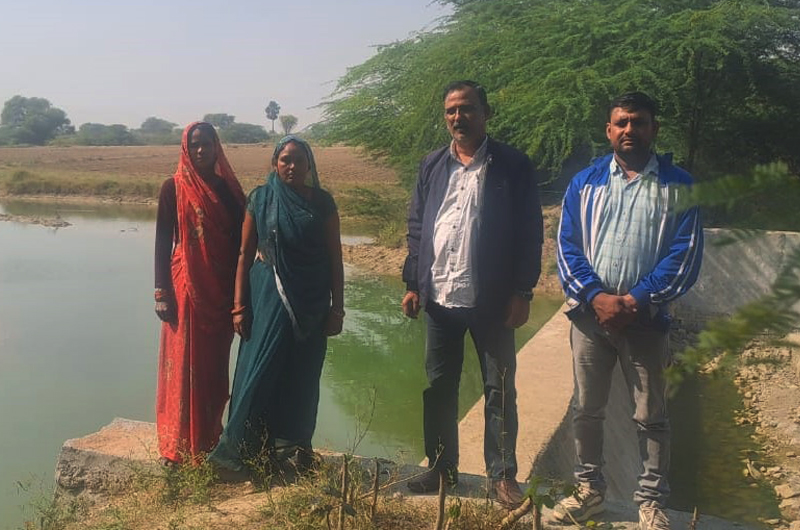
In nearby Kuretha Village, the need for water conservation initiative has been even more pressing in recent times. “When people find subsistence difficult, they have to migrate in search of work. Migration is at very high level in Kuretha,” says Praveen, a woman of the village. What SRIJAN has been able to achieve here in the course of recent months is quite impressive. An earthen dam has been built on a water channel. Its potential for conservation has been increased by creating an injection well close by, helping to directly recharge and raise the water table.
In addition, an ancient water tank of the village was de-silted after decades. The silt removed from it has helped improve the fertility of farmland while the capacity of the tank to conserve rainwater has improved significantly. This has been helpful not just for the people of the village but also for a much wider area, as there is no other comparable water source in the region. Most discussion on water sources takes place in the context of the needs of people, but the needs of farm animals are also very important, as these animals are crucial to the survival of the villages. SRIJAN’s efforts make available more water for animals, including strays and wild animals and birds, during the dry season.
In the course of discussions with the villagers, an important issue raised by them related to inequality of water distribution. Small farmers cannot afford the expense of digging bore-wells in these rocky areas, and big farmers are free to draw a large amount of water. Some of the biggest farmers, having gained control of a very big share of the water, often tend to waste it despite the ongoing water scarcity and increasing problems of small farmers and weaker sections. This adds to the importance of the efforts of SRIJAN in tandem with the poor and weak sections. Special care is taken to help the weaker sections to diversify farm crops, and such initiatives can thrive only with better availability of water.
Thanks to SRIJAN’s help, the villagers are hoping for a better rabi or winter crop to help make up the losses they suffered earlier in the year. However, beyond the immediate future, such water conservation efforts are very useful in the long-term and for sustainability, particularly in the context of erratic weather conditions due to the impact of climate change. Concerted efforts are needed to ensure water availability not only for part of the dry months, but even into the two or three hottest months of the year, when the water crisis is at its peak. This involves not just storing up rainwater, but encouraging rural communities to practice restraint in their use of water, to see that the supply lasts into the driest season. In addition, the concept of greater water equality needs to be addressed, so that more sustainable water-use patterns can be established.
(The writer is an independent journalist and author who has been writing for over five decades, providing a strong perspective on peace, justice and protection on the environment. He lives in New Delhi.)
 from Webdoux