

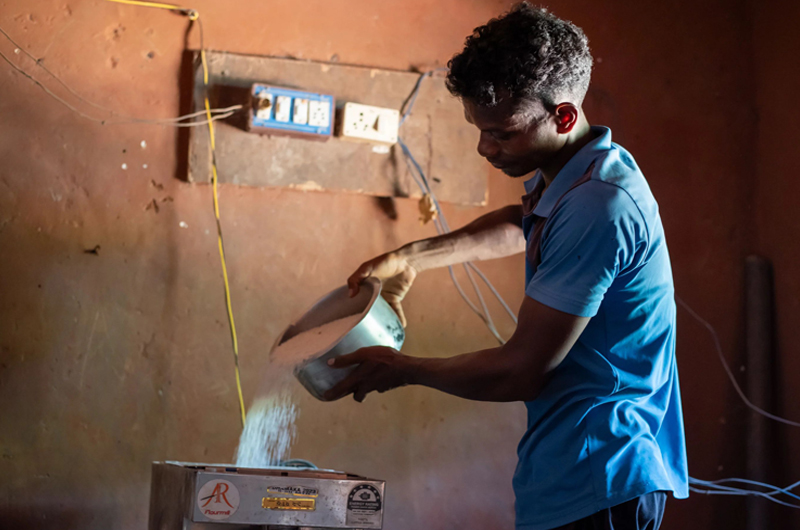
This is the story of Babulal Gamango of Munisingi Village in Odisha’s Gajapati District. A pulveriser provides him a reliable source of incomeand, withbetter access to water, his farmland holds new possibilities. His story reflects the impact of targeted interventions (by WOTR in this case)and how access to alternative livelihoods, water security, and community-driven development can create lasting change, says Anupriya Pandey, as she describes how Babulal managed to overcome the odds to support himself and his family
As the sun sets over Munisingi, the village quiets down. The sound of a pulveriser fills the air inside a small home. Babulal Gamango sits near the pulveriser, his hands deftly scooping rice grains into the grinder. For him, this machine is more than just a tool—it is a step toward a stable future, a way to support his family without leaving home.
Babulal’s journey has been far from easy. Born into a family struggling to make ends meet, a childhood ailment—likely polio—left him with a disability that made walking difficult. Growing up in a family of six, with his father working as a migrant labourer in Mumbai and his mother toiling in the fields, Babulal learned early on that survival meant sacrifice. Schooling ended after the 5th grade, as the family prioritised earning over education. When his father passed away seven years ago, the responsibility of providing for the family fell on Babulal’s shoulders.
Determined to support his family, Babulal migrated to Bangalore in 2018, training himself in tile-fixing to secure a better income. He managed to earn Rs 8,000 monthly, sending money home to his ageing mother and younger sister. But the physical demands of the job took a toll, and a severe illness forced him to return to Munisingi. With little income and few options, life was an uphill battle.
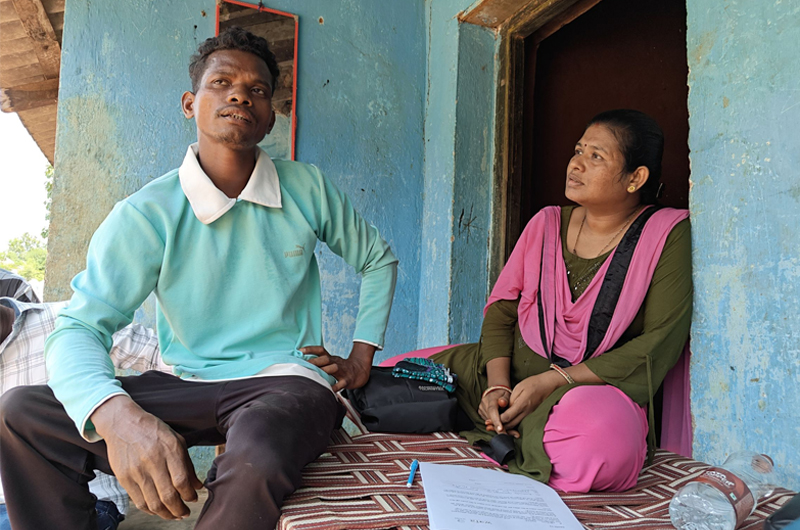
Like most families in Munisingi, Babulal’s household depended on agriculture and cashew cultivation for sustenance. Their one-acre plot was dedicated to cashew farming, but the returns were meagre. His mother’s age prevented her from working, and the family relied on small earnings from labour jobs and government ration schemes. Water scarcity added to the challenges.
The broader agricultural landscape in the region presented similar struggles. Paddy yields ranged between 16.5 and 18.5 quintals per hectare—40 per cent below the state average—while cereal production was just 7.5 quintals per hectare. Food insecurity remained a persistent issue, with only three per cent of cultivable land used for a second crop. Farmers, burdened by loans, were often forced to sell half their harvest at lower prices due to the lack of structured market access. Cashew farming, spanning 2,940 hectares, faced declining yields due to soil erosion and inadequate water conservation measures. Outside businesses controlled the trade without farmer associations, leaving local growers with minimal returns.
In 2021, Babulal noticed how other villagers turned to goat farming as a financial safety net. Inspired by their resilience, he invested in a small herd. “Whenever there was an emergency, I saw people selling goats to manage. I thought I could do the same,” he recalls. His journey took a more promising turn when he attended a village development committee meeting, where the need for a local rice and turmeric pulveriser was discussed. The nearest one was several kilometres away in Udasingi Village, making processing difficult for many villagers. Recognising the potential, WOTR, through its project supported by Andheri Hilfe, selected Babulal as a beneficiary.
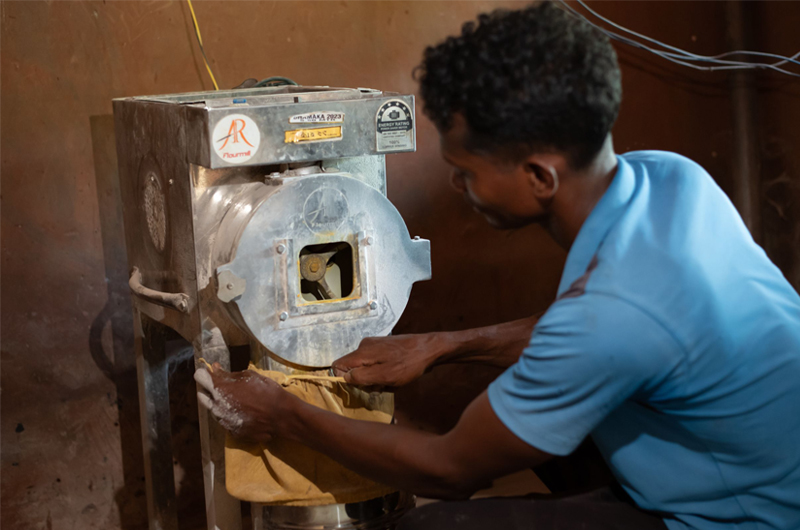
The initiative was part of a broader effort to promote alternative livelihoods in Gajapati and Rayagada Districts. WOTR has provided 27 pulverisers, advanced carpentry training and tools for 14 individuals and provided support for 53 goat-farming units, five grocery stores, and seven mushroom cultivation initiatives across 26 villages. With the pulveriser installed at his home, Babulal quickly established himself as a reliable service provider in the village. Charging Rs 30 per kg for turmeric grinding and Rs 25 per kg for rice grinding, he now earns an average of Rs 1,550 per week, with peak earnings of Rs 6,000–7,500 during wedding and festival seasons.
“This machine has changed things for me,” he says. “I don’t have to migrate for work anymore. I can stay home and still provide for my family.” While the pulveriser gave Babulal a steady income, agriculture remained essential to his household’s sustenance. One of the biggest challenges in Munisingi was water scarcity, which limited crop yields and made farming unpredictable.
To address this, WOTR constructed a check dam in the village, benefitting 12 farmers, including Babulal’s family. The increased water availability significantly boosted their cashew yields—from earning just Rs 10,000 last year, their income from cashew sales rose to Rs 30,000 this year. Inspired by the improvement, Babulal now hopes to cultivate vegetables in the coming seasons, ensuring a more stable income. Beyond the check dam, WOTR has supported Munising Village through additional water and soil conservation measures:
- Land development: 2.8 hectares of land has been levelled, creating cultivable land for six families.
- Water conservation structures: 285 running metres of continuous contour trenches and 337 running metres of staggered contour trenches have been constructed, benefitting 37 households.
- Soil retention: Over 200 running metres of stone bunding has been installed, supporting 19 beneficiaries.
- Irrigation support: Two pump sets and one sprinkler set have been provided, ensuring improved water access for farmers
These interventions align with WOTR’s approach of ensuring that resources serve the broader community rather than being limited to individual landowners. Today, Babulal’s life is steadily improving. The pulveriser provides a reliable source of income, and withbetter access to water, his farmland holds new possibilities. While there are still challenges ahead, he is moving forward with determination, finding stability and hope in the opportunities that have come his way. His story reflects the impact of targeted interventions— how access to alternative livelihoods, water security, and community-driven development can create lasting change.
(Courtesy: WOTR/ wotr.org)
Link to original article: https://wotr.org/blog/turning-challenges-into-opportunities-the-story-of-babulal-gamango/?utm_source=Newsletter+Audience&utm_campaign=e4c3c5b913-EMAIL_CAMPAIGN_2023_10_05_09_18_COPY_01&utm_medium=email&utm_term=0_-6c813ef187-1449594897
 from Webdoux