

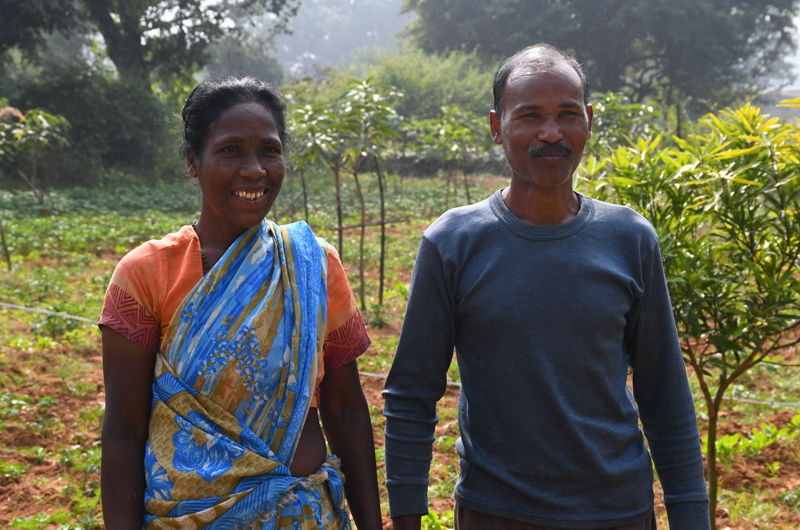
This story by Azera Rahman is from a picturesque village called Ringnitoli in southwest Jharkhand. Sylvester Ekka’s one-acre land, now flourishing with vegetables and mango plants, was once a difficult land to grow anything on. However, a village-level meeting by representatives of WOTR changed everything for Ekka. His land was identified by WOTR as ideal for raising a mango plantation. Ekka and his wife planted mango saplings, other fruit trees, and even grew vegetables on a farm. Inspired by the change in their lives, other people in Ringnitoli have now decided to grow mangoes on their land as well
Nestled among the verdant hills of southwest Jharkhand is a picturesque village called Ringnitoli. On the day of this writer’s visit, 52-year-old Sylvester Ekka, a farmer, was sitting on a chair beside his vegetable farm, writing something carefully in a diary.“If I don’t write down how much I have spent and how much I have earned, how will I know if I am making any profit at all?” he asked. As it turns out, he is making good profit, so much so that Ekka and his wife have now started work on building a concrete home for themselves, right next to their beloved mango saplings.
“Our household income has increased by at least 20 per cent since we decided to plant these mango saplings, interspersed with seasonal vegetables,”Ekka said as he pointed at the one-year-old saplings. “Since then, not only have our lives improved, but others are getting inspired by us as well.”
A rocky start
Ringnitoli, for all its natural beauty, is a difficult landscape to do agriculture. An uneven terrain, farmers here are heavily dependent on the rain for their crops; and although the average annual rainfall in the Gumla District—where the village is located—is nearly 1100 mm, other issues such as high runoff, low water retention and, now, erratic weather patterns, have made farming challenging.
Ekka’s one-acre land, which is now flourishing with vegetables and mango plants, was, therefore, once a difficult land to grow anything on. “When I bought this land more than 10 years back, I knew it would be difficult to grow anything in it. So I planted teakwood trees on the periphery so that I can sell them after 25-30 years for a good amount of money on maturity. In the meantime, however, I could just grow the three-month variety paddy, and urad dal,” Ekka said, “I have another two-acre land in a different place where I cultivate paddy.”
A little over a year ago, a village-level meeting by representatives of WOTR changed everything. Ekka’s land, like many others’, was identified by WOTR as ideal for raising a mango plantation. This identification was part of a detailed project report prepared by WOTR for 52 villages in Gumla District, after which they played the crucial hand-holding role of raising awareness and making government schemes easily accessible to those who needed them.
For example, Ekka was aware of the Mahatma Gandhi National Rural Employment Guarantee Act (MGNREGA) but, in his own words, was “scared” that he would lose ownership if he were to register his land under the government scheme. “The WOTR representatives, however, told me that no such thing would happen. Instead, I can get paid for work on my farm and also get the mango saplings for free once the plantation gets the approval of the gram sabha and the block-level MGNREGA officials,” Ekka said, “They promised to help me through the process.”
Success inspires action
However, it took some time for Ekka to be completely convinced. As he continued to mull over the prospect of a mango farm, Ekka’s wife, Sosan, intervened and encouraged her husband to take the chance. “I was very clear in my thought: if someone is offering to help, we should take it. We live close by so we can take care of the mango plants, and like they said, even plant vegetables for additional income,”Sosan, 42, shared. The idea of diversification and having more than one source of income appealed to her.
Ekka, on the other hand, still needed some more convincing. This push came in the form of an exposure visit to a nearby village in the Raidi Block, where farmers have raised similar mango plantations. During this visit, as Ekka listened to a woman narrate how, by year three, she and her husband started earning almost Rs 1 lakh a year from their one-acre mango plantation-cum-vegetable farm, he realised that it was a better bargain than cultivating paddy.
“I like to do all my calculations in my diary. Once home, I realised that, after four years, if I can earn a lakh a year from the mango trees, I can save the money for big expenditures. Meanwhile, our regular expenditures can be taken care of by selling vegetables that we would plant in between the mango saplings. We will also reduce our expenditures because we will be eating vegetables from our own farm,” he narrated. Suddenly, the prospect of a better future, especially for their two sons, aged 15 and 10, gave him the thrust to take the leap of faith.
Charged by a renewed hope, Ekka, with the help of WOTR, approached the gram sabha (village assemble) for approval of the mango plantation under MGNREGA. He also underwent training by WOTR on the nuances of raising a mango plantation. “My wife and I dug 3x3x3 feet pits to plant the mango saplings in, and also dug a trench around to protect the young plants from cattle,” he said. The duo planted 96 mango saplings of three varieties—Amrapali, Neelam and Dasheri—each at a distance of 15 metres. They also planted a few other fruit trees, like litchi, guava and lemon. But what about irrigation of the crop?
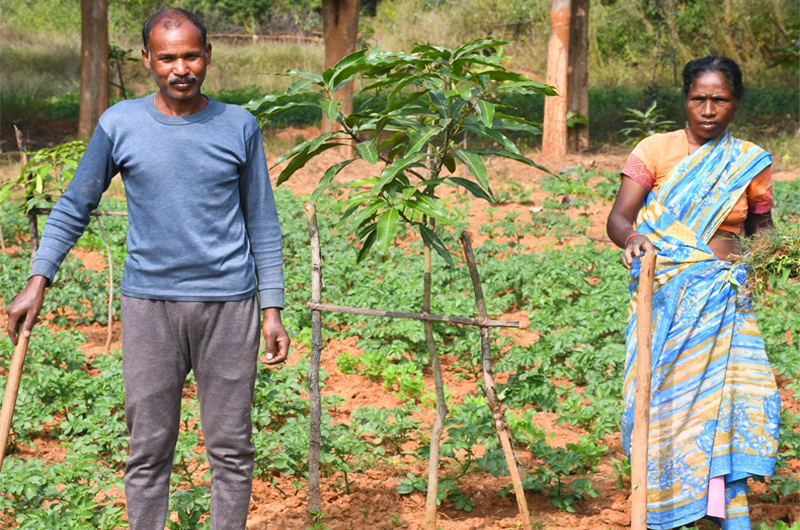
of the MGNREGA Scheme, he has been able to make his land productive.
Building a strong future and inspiring others too
Ekka said that for his work on the farm, he received Rs 31,000 under MGNREGA. He used this money to buy a small water pump which has helped him irrigate his land from a pond close by. “Earlier, getting water from the pond was difficult, but with the water pump, irrigation has become easier,” he said, “Under the guidance of WOTR and the training that I took from them on vegetable farming, I am able to grow seasonal crops and irrigate them on time. I would have never thought of vegetable farming earlier, but now I am growing potatoes, French beans, cabbage, cauliflower, tomatoes, chilli, mustard, groundnut…thanks to this, I earned Rs 40,000 from my vegetable harvest this winter.”
Buoyed by his success, Ekka is now also exploring drip irrigation. As the conversation veered from farming to family life, Sosan said that the quality of their life has become better than what it was, be it in the quality of food they consume, or the household items they buy. There is also a growing sense of security, and with this, the thrill of planning for the future. “We have got the foundation made for six rooms in our soon-to-be house. A room and the toilet are already built; we are now going to build the rest,” she said with pride. They have also bought a water tank. A four-wheeler, a tractor, perhaps, that will help them in ploughing the land is also on the anvil.
Inspired by the change in his story, 10-15 other people in Ringnitoli have now decided to grow mangoes on their land as well. “People keep coming to see what I am doing, how I am doing things. I tell them all that I have learnt. Now, 10-15 such people have decided to come together to plant mangoes on a big plot of land. I am happy that everyone is seeking to do better in their lives,”Ekka said with a smile.
(Courtesy: WOTR/ wotr.org. The writer is an independent writer and editor with over 20 years of experience. She collaborates with a range of organisations, primarily in the development sector, and contributes stories on climate change, health, gender, and development to various media platforms.)
Link to original article: https://wotr.org/blog/how-mango-farming-boosted-incomes-and-inspired-a-village-in-jharkhand/?utm_source=Newsletter+Audience&utm_campaign=32202e4387-EMAIL_CAMPAIGN_2023_10_05_09_18_COPY_01&utm_medium=email&utm_term=0_-6c813ef187-1449594897
 from Webdoux