

Bharat Dogra visits remote hamlets in Uttar Pradesh and gathers insights into the issues that prevent children from going to school regularly, and the changes a voluntary organisation has managed to bring in by going the extra mile
There is widespread consensus in India on the urgency of ensuring school education for all children but when you visit the poorest communities in remote villages, you realise that at the practical level there are several problems that stand in the way of these children attending school regularly.
Hamlets of the Sahariya tribal community are scattered over many villages of Babina Block in Jhansi District of Uttar Pradesh. Often located some distance away from the main settlements, these include some of the poorest households. There are several reasons why till recent times many of these children found it difficult to go to school. In many homes, as both the parents go out for work, children of school-going age are often assigned the task of looking after younger siblings. Also, many couples often migrate for several weeks at a stretch and have no viable alternative to taking their children along with them, and this disrupts school attendance.
Another issue relates to documents such as birth certificates, essential for school admission. Enquiries by this writer revealed that to obtain a birth certificate for a child, the Aadhaar card or other approved ID cards of the parents are required, and it is a multi-step process involving the tehsildar in Jhansi City and the pradhan (chief) of the concerned village. If the parents either don’t have a valid ID or have lost it, the process becomes even more complicated. Once the birth certificate is obtained, the child can be admitted to a school, and teachers will handle the process of getting an Aadhaar card for the child.
This writer found that, as a well-connected and educated person, he would need to spend about Rs 150 on the process, but was told that, all expenses combined, parents often spend Rs 1,000 or more to get the document made. In the light of these problems, despite the availability of government schools close by, many Sahariya children could not attend or dropped out.
However, Sabal, the educational initiative launched by voluntary organisation Parmarth Samaj Sevi Sansthan recently, has resulted in significant progress in helping Sahariya children to be regular at school. While the most visible sign of Sabal is the informal school started in each of the 20 communities covered by this effort, much has been happening on other fronts too.
when government schools have holidays, Sabal institutions work in the mornings. Teachers have learnt to make the best possible use of the limited
space and time they have.
Aditya, one of the teachers at these informal schools, says, “I realised that apart from teaching, I must help children and their families obtain identity documents. I have been running around a lot for this, in addition to attending to my normal duties. However, the effort has been worthwhile because this ensures that many children will be able to continue education.”
Himanshu Nayak, who has been closely associated with the initiative, says about 500 children needing such help had been identified, and the task of acquiring birth certificates and related identity work had been completed in 235 cases, while for other children, work was in progress.
Aditi Trivedi, coordinator of the initiative, has interesting things to say about how some practical problems were resolved. When the time for migrations came, teachers and others involved in the project brainstormed with those planning to leave and other community members to see if students could stay behind with a relative or neighbour. As the parents were really interested in their children continuing studies, some solutions could be worked out.
Also, some children who came willingly to the informal school within the hamlet were somehow reluctant or even scared to go to the government school located some distance way, Aditi shared. Sabal teachers started coming early to the hamlets to encourage these children to go to school and even accompanied them to the school gate. The children would later attend the Sabal School too, remaining there till evening. This meant that parents who were away all day could be sure that their children were safe. The informal schools are also fine with children bringing along siblings not yet of school-going age – another advantage.
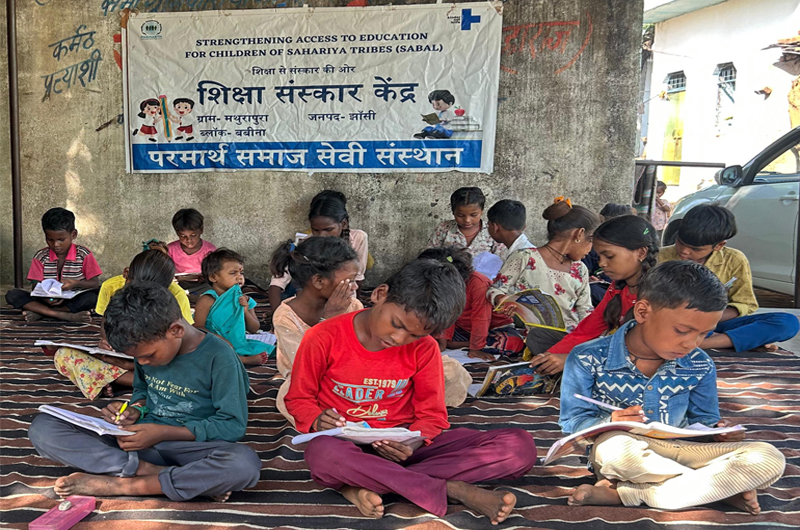
The community school runs in the evening during normal days, so that children who are going to the government school can first go there. However, when government schools have holidays, Sabal institutions work in the mornings. A day at the informal school typically starts with prayers. Then, as there are children from several age-groups and classes, teachers divide them into smaller groups to meet their specific needs as far as possible. Teachers have learnt to make the best possible use of the limited space and time they have.
People in various hamlets have donated rooms for the school and children generally decorate them well. Though the rooms are a blessing during inclement weather, the children and teachers often prefer a more open space nearby when the weather permits. Games and extra-curricular activities are organised as well.
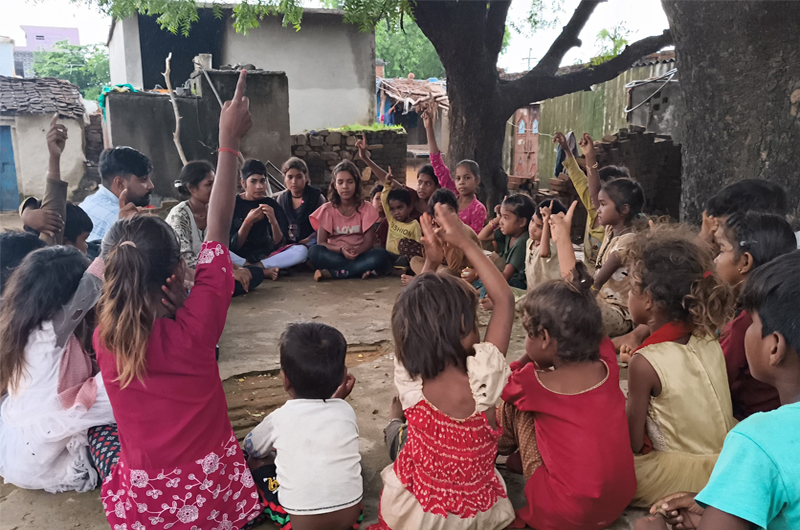
One important aspect of the initiative is the setting up of balsabhas (child assemblies), eco clubs and kishori samoohs (groups of adolescent girls). At the balsabhas, various children are selected as prime minister, education minister, environment minister, health minister, etc, and allocated certain responsibilities. In Mathurapur hamlet, for example, Aradhya, a studious and socially alert girl, is the prime minister. She lives up to this responsibility – whenever the teacher is held up temporarily, she promptly assumes that role. Similarly, children who are in the eco club take charge of newly-planted trees and look after them well.
(The writer is an independent journalist and author who has been writing for over five decades, providing a strong perspective on peace, justice and protection on the environment. He lives in New Delhi.)
 from Webdoux