

Despite forming 73 per cent of the rural agricultural workforce, only 12.8 per cent of women own land. Women typically manage household duties and demanding farm labour, often without fair pay or basic acknowledgement. Empowering women in agriculture is essential for achieving long-term economic and social equity. When both genders are on an equal footing, it directly contributes to the development of the entire community and society. This article by WOTR Communications shows us how this is possible and the positive shift evident in Jalna, a district in Maharashtra
Travel through rural western Maharashtra, and amidst the lush green fields, you’ll see men operating tractors and ploughing. Yet, look closer, and you’re sure to spot a woman, her sari pleats gathered and tucked, wading through muddy waters, meticulously planting paddy at equal distances. Shift to eastern Maharashtra, and the scene transforms: a woman in a white shirt, now red with dust, protecting herself from the scorching sun. A white scarf or gamcha covers her head as she swiftly wields a sickle, chopping sugarcane and loading it onto trucks. These women are the unacknowledged backbone of India’s agricultural sector.
Despite forming 73 per cent of the rural agricultural workforce, only 12.8 per cent of women own land. Women typically manage household duties and demanding farm labour, often without fair pay or basic acknowledgement. So, why is this recognition so crucial? Empowering women in agriculture is essential for achieving long-term economic and social equity. When both genders are on an equal footing, it directly contributes to the development of the entire community and society. We’re already seeing this positive shift in Jalna.
Women, agriculture and collection centres
“Women know the economics of the household but are rarely aware of the business of their farmland and produce. This should change, and that is why leadership of women in agriculture is necessary,” says Seema Eknath Kandhare, a 35-year-old farmer from Khaparkheda Village who is employed at the Sonkheda collection centre for maize in Jalna, Maharashtra.
Seema has spent almost her entire life in the fields. However, she stepped out of the household to earn an income for the first time around two years ago, when she started work as a wasundhara sevak with WOTR (Watershed Organisation Trust) in Bhokardan, Jalna. Daily work usually involved guiding farmers about usage of organic formulations, instructing women on how to design kitchen gardens and examining the nutritional status of children, pregnant and lactating mothers in the region. “The first director of the Purnakarth Farmer Producer Company (FPC) selected four women, including me, to start working with the company to collect the produce and examine it. That’s when I started working with FPC,” recalls Seema.
The Purnakarth FPC – set up by Watershed Organisation Trust under the ProRISE (Resilient Incomes for Smallholder Farmers through an Ecosystems Approach) Project supported by Walmart Foundation – wanted to include and recruit more women in its functioning. However, families were reluctant to allow women to work outside the confines of the household and the field. With fewer women employed at the company, convincing the community to have them work alongside men was no easy task.
Then, a novel idea was introduced, which changed the situation slowly, with lower membership fees. Membership fees were structured to encourage women’s participation: 500 rupees for women compared to 1500 rupees for men. Members also received incentives, including lower prices on organic inputs, better minimum support price rates, and reduced fees for drip irrigation infrastructure.
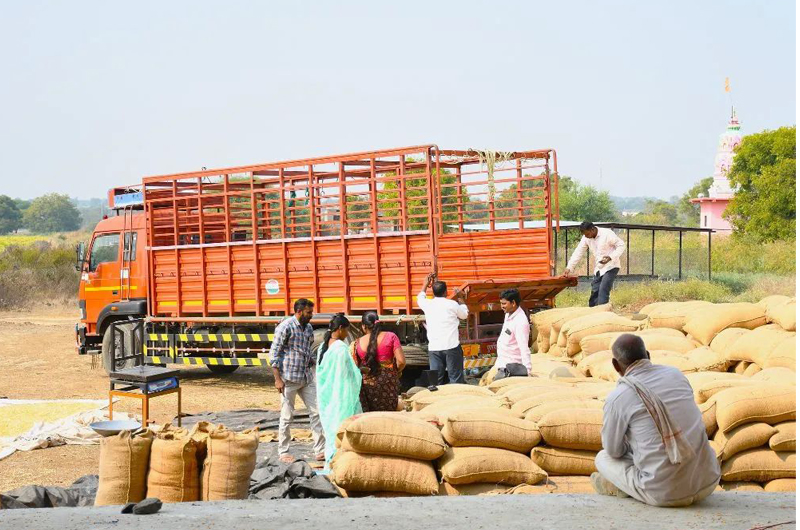
“We talked to women when we visited the fields to collect produce and conducted multiple meetings to explain the benefits of joining FPCs. Earlier, women didn’t even see the income from agriculture. Traders paid in cash, often under market value. Now, with direct bank transfers, women gain control and transparency,” adds Seema. This initiative has steadily blossomed into a significant societal transformation across the region. Now, 13 women are managing 12 collection centres across Jalna’s five FPCs, all of which deal in maize, connecting with over 1,800 farmers. Farmers either bring their produce to the collection centre or it’s picked up directly from their fields. To ensure smooth operations and prevent mix-ups, farmers typically inform farmer producer organisations (FPOs) via a WOTR-developed app about their expected harvest yields and deposit times, usually a fortnight before the planned harvest.
Decentralised collection centres serve as key points in the vegetable supply chain, where produce received from farmers and other sources is inspected, stored, and then sorted for further processing or dispatch to mandis (wholesale markets). Decentralised collection centres ensure better reach to maximum member farmers and helps in reducing post harvest losses with the optimised and well planned supply chain. The primary objective of the centres is to ensure that fresh, high-quality fruits and vegetables are sourced directly from farmers with no middlemen, while ensuring reasonable prices for the produce. At the collection centres, all women staff are trained to assess the produce based on government guidelines, checking for moisture, fungus, discolouration, and foreign matter. Seema Kandhare, for instance, has also mastered operating the new 60-metric-tonne weighbridge at the centre.
Along with the collection centres, another arena witnessing a positive change, combining technology and agriculture, is using drones to spray pesticides and fertilisers. Three women have been selected to operate drones for pesticide spraying. These drones can cover one acre of farmland in just four minutes, reduce input use, and provide targeted application, minimising soil damage. Around 30 farmers currently benefit from this service, which saves up to 30 per cent on input costs.
When asked about her work and the increased involvement of women at the collection centre and as company shareholders, Seema expressed happiness with the progress. However, she noted the slow pace of change, observing that most of the produce brought to the centre and most of the market accounts are still managed by men. “More women need to be involved to ensure their financial security,” Seema emphasised.
The progress the five FPOs have witnessed is remarkable: from November 2024 to March 2025, 1,910 metric tonnes of maize was collected. Farmers received rates that were 900 rupees per metric tonne higher than the market average in April 2025 from the FPO. Apart from the efficient handling of the FPOs, the other factor behind the progress is the general trend in Jalna to cultivate maize.
Understanding Jalna’s shift in agriculture
In Jalna, Maharashtra, maize fields are more than a common sight—they’re symbols of transformation. This bright yellow, pearl-like crop is fast becoming the backbone of Jalna’s agriculture story, offering not only income but also resilience to climate stress. “Jalna’s soil and climate make it highly suitable for maize cultivation,” shares Yogesh Patil from WOTR. “Maize thrives in both the kharif and rabi seasons, requires less water than cereals like wheat and rice, and has lower pesticide input costs. Additionally, post-harvest residue is useful as cattle fodder. With the government’s ethanol blending policy, maize has become even more profitable.”
WOTR provides end-to-end support for maize cultivation—from sowing to sale. “Maize is a climate-smart, market-driven crop,” says Yogesh. Currently, five FPCs active in Jalna, supported by the ProRISE Project, are focusing solely on maize. Before sowing, orientation sessions with farmers by FPOs and after sowing, farmer field schools are held to train farmers on bio-formulations like Dashparni Ark, Jeevamrut, etc. FPO members regularly visit fields to monitor crop health. The FarmPrecise app, developed by WOTR and supported by Qualcomm, provides farmers with real-time weather alerts and pest advisories, which in December 2024 helped cover over 377 metric tonnes (MT) of maize from damage due to unseasonal rains.
The maize revolution in Jalna offers a blueprint for rural India. With smart agriculture practices, active women participation, and real-time climate alerts, the region is transforming challenges into opportunities—making maize the golden grain of both resilience and prosperity. With women at the helm, this revolution can act as a model for other regions and other states too.
(Courtesy: WOTR/ wotr.org)
 from Webdoux