

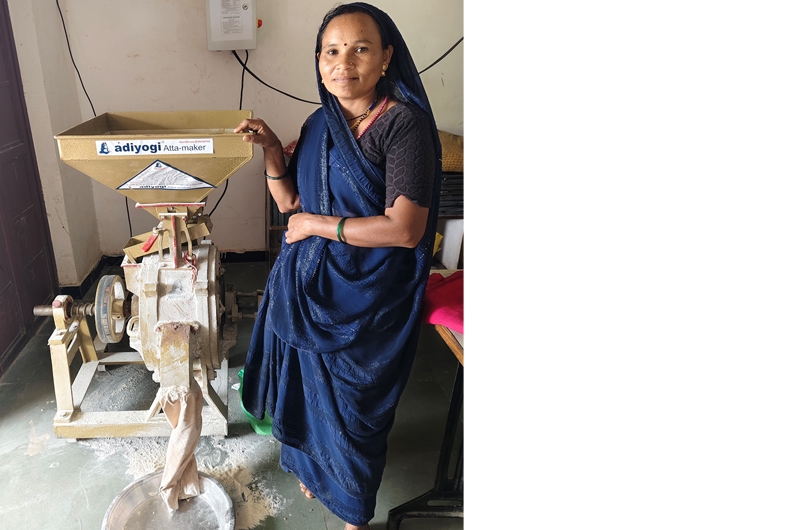
Voluntary organisation Vaagdhara has been providing diversified livelihood opportunities which have made life much better for women who were previously slaving away at unsafe, poor-paying jobs. Bharat Dogra profiles two such happy beneficiaries. He also profiles (second piece) two women and a young man in remote UP villages who, despite their limitations and personal traumas, have been selflessly working for the greater good
Monica works very hard. She is also happy. This joy is a recent experience. She had to work very hard earlier too, but that was a different kind of work – it was drudgery, with an element of risk. There is substantial literature on drudgery and how it can make life very difficult. Monica’s experiences exemplify the difference between two kinds of hard work — the kind that can be done happily and the kind that creates stress and distress.
Monica and her husband live with their four children in Jhikali Village of Rajasthan’s Banswara District. Till some years ago, their livelihood situation was so bad that the couple had to leave home almost every year to seek work at construction sites in the cities of Surat and Ahmedabad.
Monica tears up when she remembers those days. “I was not trained for it, but I had to carry about a dozen bricks on my head at a time while climbing rickety steps to the second or the third floors of buildings under construction.”
But things began to change when development work initiated by the government and the efforts of Vaagdhara, a voluntary organisation converged. The government installed a solar pump-set close to Monica’s home, improving irrigation. Vaagdhara provided guidance for natural farming which helped to reduce costs significantly and improve yields.
The organisation also provided a converter which enabled Monica to use the energy from the solar pump set to start a flour mill and operate it without recurring expenses. Her family’s initial effort at this had failed as the higher power capacity required wasn’t available. A sewing training programme by the government was the next opportunity which came up. Monica was quick to enroll and soon picked up the skill. She received a sewing machine.
Improved farm yields, the flour mill and tailoring unit provided enough income for the family’s essential expenses. They are now able to send all their four children to school, one of them to a relatively expensive one too. Earlier the family lived in a mud and thatch house, but now they have constructed a sturdier house which provides safe shelter in all weather conditions.
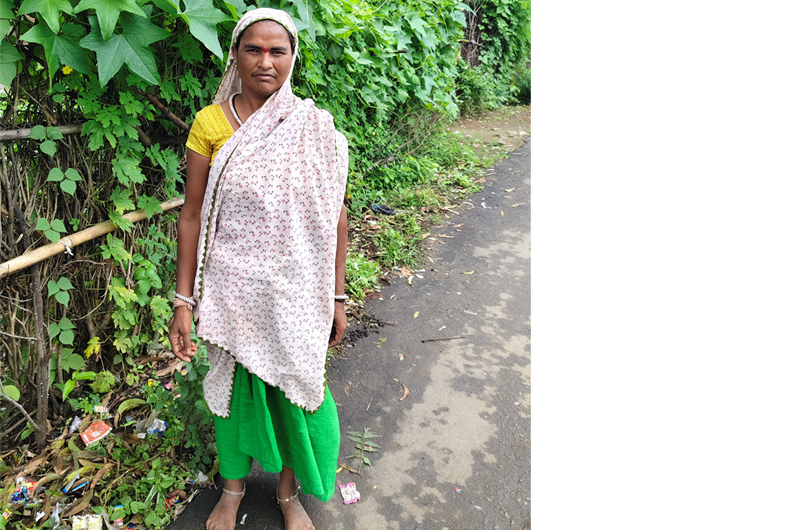
She decided to take up the training. After setting up a nursery, she established a daily needs shop in the remote
village, and a small flour mill, all contributing handsomely to the family earnings. Photo: P. Patel.
Jemli Bai, who belongs to the tribal Bhil Community and is a native of Borikhera hamlet in another part of Banswara District, used to work as a migrant labourer along with her husband in various cities of Gujarat till about a decade ago. “We were paid very low wages when we did get work and, sometimes, we would just stand at the place where labourers looking for jobs would gather, waiting in vain for someone to give us work. We lived in huts surrounded by slush, and it was difficult even to cook food for ourselves,” she recollects.
Then, during one of her visits to her village, she came to known about a training organised by Vaagdhara for starting a nursery of vegetable and fruit saplings. Jemli decided to take up the training. Vaadhaara staff realised she had a special aptitude for the work, and decided to extend additional help to her if she decided to set up a nursery, as it was keen to open up such avenues within the community.
So, Jemli set up her nursery, and began enjoying the work. She earned about Rs 70,000 in the first year, and has been steadily increasing the figure – it almost touched the half-million mark last year. Jemli and her family used part of the profits to start a daily needs shop in the remote village, and a small flour mill. Both provide some additional income besides being a boon to the villagers. Following natural farming methods, Jemli has been producing healthy food for her family on one half of her almost one-acre farmland (the other half is devoted to her nursery), while also cutting cultivation costs.
Jemli Bai, Monica and others like them have been able to capitalise on their latent talents with the help of a voluntary organisation. They work very hard at their various income-generating jobs, apart from seeing to household chores, and stand testimony to the potential that exists in remote villages which can be tapped for significant achievements if suitable diversified, sustainable livelihood opportunities are provided. As Baba Amte once said, many poor villagers do not need charity, they need opportunity.
Snapshots of commitment and courage – from Uttar Pradesh
A significant number of the poverty-ridden residents of Bhaggupurva hamlet in Banda District of Uttar Pradesh migrate regularly in search of work. While some take their children along, others leave their offspring with grandparents. As these elderly persons can barely look after their own needs, the children are neglected. They do not go to school, but roam around aimlessly. Once, three children were drowned, two in a pond and one in a canal.
Deeply affected by the tragedy, Urmila, a Dalit woman of the village, who was already involved with Vidya Dham Samiti (VDS), a voluntary organisation, decided to open an informal school with its help, so that village children could get some education and care. For over a year now, she has been teaching children for about two hours per day in the evenings, even without a permanent shelter for the students. Depending on the migration cycle, the number of children who attend the school ranges from 20 to 35.
Urmila, one of the very few women graduates here, divides the children into groups according to age and teaches them the basics of English, Hindi and Math. Keeping in view the recent tragedies, children are taught safety precautions. They also learn about health and hygiene. Saturdays are eagerly looked forward to, being Sports Day. She has already succeeded in integrating some of her students into the mainstream school, (although problems caused by the frequent migration of their parents persist.) The affection in which the children hold her is evident from the fact that those who have been mainstreamed insist on attending her school too. When the students or their grandparents experience any serious health or other problems, Urmila tries to arrange help from neighbours, or VDS and its sister organization, Chingari.
In another such school, in Missouri Village, nutritious food is provided, despite non-availability of project funds. Jitendra, the teacher in the school, is a talented youth from the same village. One of his arms was crushed in an accident (some say it was engineered by a local who didn’t like how assertive Jitendra was.) He is committed to teaching, even though only a small honorarium could be arranged for him. He has also resumed his own education.
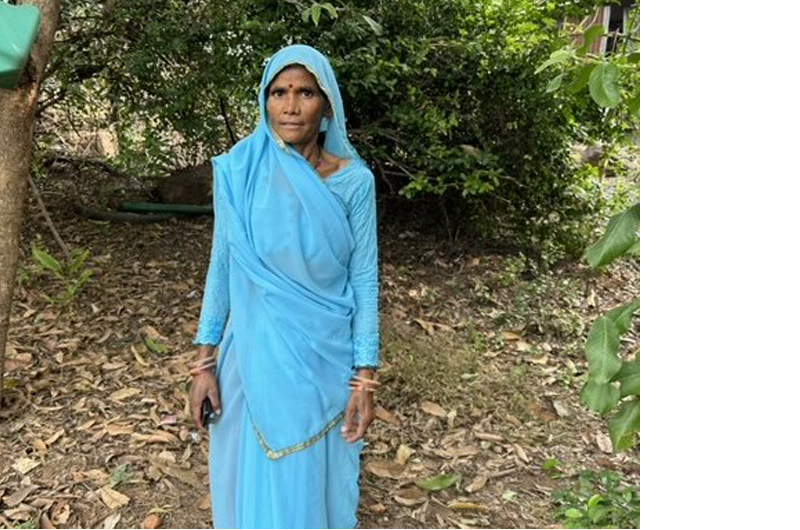
organisation, finding her exceptionally courageous and capable of taking initiative, decided to encourage her and selected her as the first jal saheli in
its water conservation and sanitation volunteer team. Sarkunwar played an important role in ensuring that good quality check dams were completed,
she was involved in planting nearly 15,000 trees under MNREGA and in the construction of 120 toilets for her village. She also made regular visits to
the village school to check that children were being served mid-day meals properly. Photo: Gaurav Pandey.
Sarkunwar of Udgavaan Village in Lalitpur District of Uttar Pradesh, is another icon of courage. Her husband suffered a disabling injury when he was away from the village on work, and had to return home. Then, when she was pregnant, she fell down a well, and was rescued only with great difficulty. A drought came, and people left the village to find work. What could Sarkunwar do? She started by collecting and selling fallen neem fruits, and used the money to plant ginger, which again she sold, earning Rs. 10,000, and somehow managed to help her family survive during the difficult time.
She heard of the MNREGA scheme, but when she reached the work site, she was sent away as she didn’t possess a job card. Her efforts to get one were unsuccessful till she met representatives of Parmarth, a voluntary organisation. They found her exceptionally courageous and capable of taking initiative, and decided to encourage her. Soon she became not just an MNREGA worker but a supervisor. Parmarth selected Sarkunwar as the first jal saheli (friend of water) in its water conservation and sanitation volunteer team, and subsequently she was elected unopposed as a ward panch (representative) and a member of the village school committee.
Sarkunwar played an important role in ensuring that good quality check dams were completed, benefitting 150 farmers whose lands were mostly uncultivated due to lack of water. Similarly, she was involved in planting nearly 15,000 trees under MNREGA and in the construction of 120 toilets for her village. She made regular visits to the village school to check that children were being served mid-day meals properly. She was outspoken at village meetings on development schemes, ensuring that projects were completed correctly. All this not only won her a lot of appreciation and respect in her own village, but people of other villages and even some officials started addressing her as netaji (leader).
While Sarkunwaris active in the development of the village at large, she does not neglect her family and farm, where she manages to grow a diversity of crops and trees despite its small size, as this writer saw on his two visits there. Even though her days must be full, she is still full of enthusiasm for new initiatives and exciting possibilities.
(The writer is an independent journalist and author who has been writing for over five decades, providing a strong perspective on peace, justice and protection on the environment. He lives in New Delhi.)
 from Webdoux