

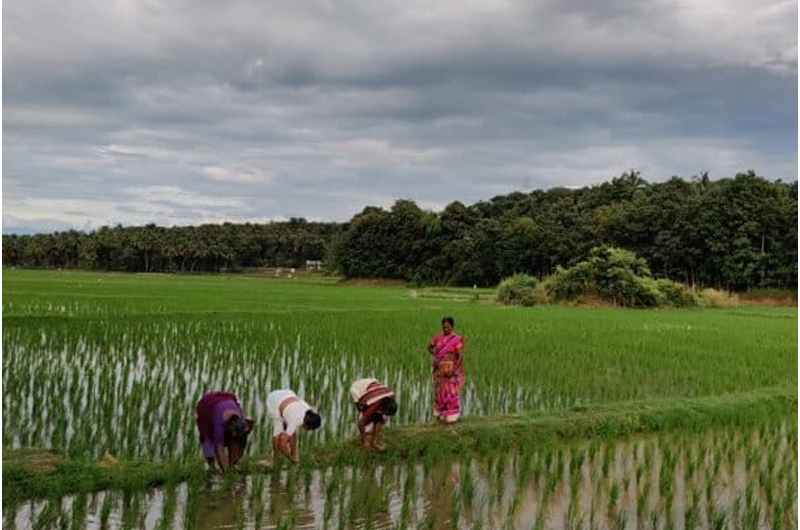
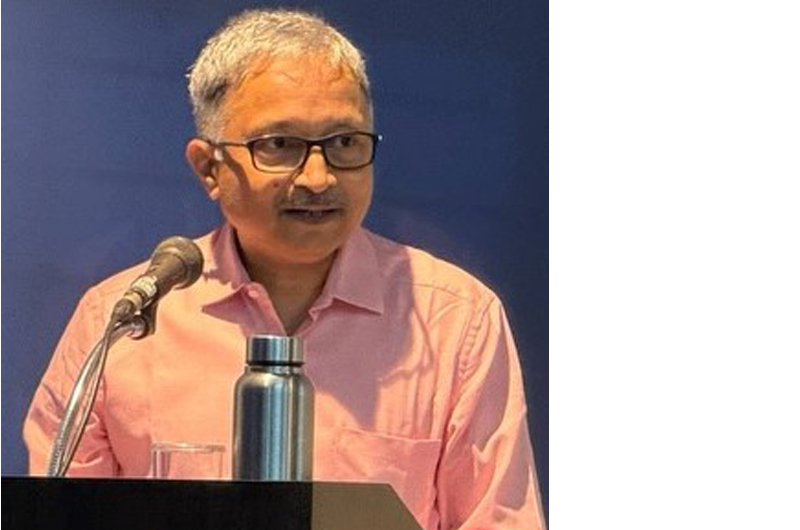
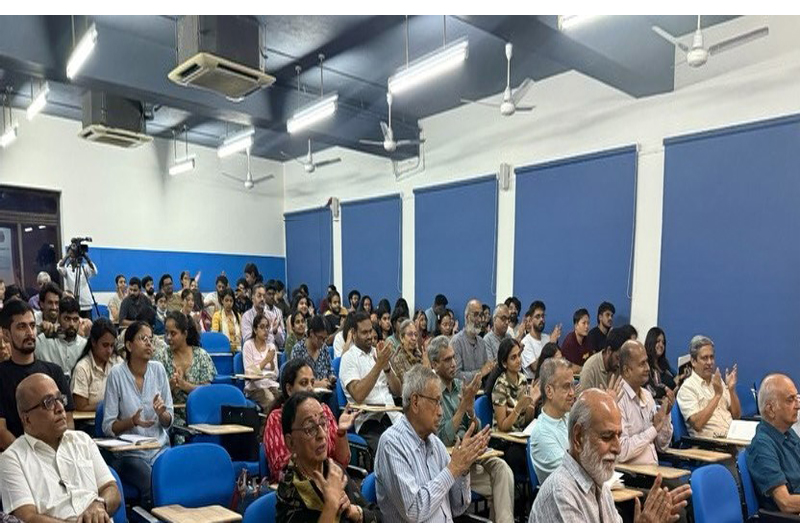
Mongabay-India Editorial Director S. Gopikrishna Warrier delivered this year’s T.G. Narayanan Memorial Lecture on Social Deprivation at the Asian College of Journalism in Chennai on December 12. The subject of his lecture was ‘Climate change and the marginalised in India’. Warrier brought out many pertinent points during his more than hour-long, sterling speech, complete with well-researched inputs. Here are extracts that cover those points as well as several interesting anecdotes he recalled
Talking about climate change and deprivation this evening in Chennai, do you remember the photograph that had gone viral during the Chennai floods of December 2015? It was of one of the city’s richest – industrialist Mr A.C. Muthiah – escaping the floods from his estate in Kotturpuram in a fishing boat. This image went on to become the iconic image of the floods, and the invariable caption was that the extreme weather events like the flood affected everybody alike – the rich and the poor.
The picture was real, but the conclusion was not true. Those days I used to live in Chennai, in an apartment off Arcot Road in Virugambakkam. During the floods my car was flooded – not fully though. Murugan, the young man, who came to our apartment complex to clean our cars was devastated in the floods. Living in a shanty on the banks of the Adayar River, he realised that water was rising when his belongings started floating around him on that fateful night when the water from the Chembarambakkam reservoir was let out. Mr Muthiah would have most likely returned after a few days to his home and continued to live on as if nothing had changed. I faced financial trauma for some time to get costly repairs done for my car. I know that for Murugan life never returned to the same for many months after the event. I want to leave this picture with you, before I start my lecture this evening.
The relevance of T.G. Narayanan today
This lecture is to celebrate the memory of Mr T.G. Narayanan, who was The Hindu’s correspondent in the Second World War years. He reported extensively on the Bengal famine of 1943, and went on to write a book on it. Mr T.G. Narayanan (or TGN) was born in 1911. I am a child of the 1960s. One of my challenges when I started preparing for this lecture was contextualising TGN’s work. My professional journalistic world started in the late 1980s and continues to the present. So, it is difficult for me to even imagine the framework of a journalist who worked in the earlier decades of the 20th Century. It got a step easier when my brother-in-law, who is in his early 80s, mentioned that he had met TGN in Geneva. My brother-in-law’s father was a senior official at the International Labour Organisation’s headquarters in Geneva, and TGN was on his assignment with the UN Secretary General. Suddenly, in my mind’s eye, I could imagine TGN as a person, a journalist and a diplomat.
There are some parallels between TGN’s journalism and writings and the work we do today. In his book Famine over Bengal, published in 1944, TGN links the roots of the devastating famine to the Japanese Pearl Harbour attack and the occupation of Burma, thereby linking a regional issue to a global process. Today, to understand and deal with climate change, there is a constant need to appreciate the global and the regional or local issues in parallel. The second parallel is that, like with the 1943 famine, climate change also does not happen in isolation. TGN brought out the linkages of the famine to politics, society and economic realities of the time. Likewise, as journalists covering climate change, we cannot look at climate change only as a meteorological or scientific process. We need to constantly work to unravel the linkage of climate change to political, social and economic forces.
Let us look at the third parallel. TGN begins Chapter 11 of his book – which is on the situation in Calcutta – thus. “Famine is a killer. It kills particularly the poor and weak. It kills children quickly. It kills them without giving them much of a chance. War is also a killer. But its victims don’t come from a particular class. You may be a banker’s son and your fellow a farm-hand’s son. Both of you stand an equal chance of being blown to bits by a bomb or shell. It is not like that in a famine. The banker’s son will escape and the farm-hand’s son will probably die. In a war, the farm-hand’s son has a chance of hitting back at the enemy. In a famine, he has not a dog’s chance of even barking back at the unseen enemy. There is no escape for him from starvation and a slow death.”
The same holds true today. Even though climate change affects everybody, it is the poor and the marginalised who bear its brunt the most. I will focus more on this later in this lecture. The fourth parallel between TGN’s world and ours is not from something that he had written, but from a paper written on him and his journalism. In a 2020 paper, titled Gandhi’s Newspaperman, published in the Modern Asian Studies journal, two academics from the University of Iowa – Subin Paul and David Dowling – commended TGN for finding gaps within the environment of censorship of the time and report incisively and critically. He could do his journalism operating behind two shields of perceived non-threats to the British. The first was writing for the English press, which the administrators considered less radical than the Indian-language press. Two, he was writing for The Hindu, which was known to have a more measured approach in its criticism of the British.
Now, how is this relevant today? Ask me – I edit Mongabay-India a digital publication that has earned its credibility for incisive reporting on the environment and climate change. In the last decade, we journalists were operating in a world where even a perceived criticism of the government could invite a visitation by one of the enforcement agencies. So having to make impact with our stories, without flagging unwanted attention, is a skill that many of us have learnt on the job. Ironically, frequent visitations of another kind have been shielding us environment journalists from trouble. With frequent and increasingly intense floods, droughts and heat waves affecting almost every Indian, nobody can say that our work is not needed. This is even though after 1991 economic reforms we environment journalists have been frequently labelled as “anti-development” and in the more recent years even occasionally as “anti-national!”
A sub-continental unit
This evening, we have gathered to remember Mr Narayan’s writings and journalism on the deprived and contextualise it with the immediate and present challenge of how climate change adds to the deprivation of the already marginalised. So, let us start our process by looking at a larger theatre, just as how he would have done, had he been living today. South Asia as a theatre for climate change, is unparalleled across the world. A peninsula, which was geologically a part of the African Plate about 150 million years ago, broke apart, drifted through the ocean and crashed against the Eurasian Plate less than 100 million years ago. The highest ridge in the world – the Himalayas – rose as a result of this collision, thereby preventing any chance for the monsoonal winds to cross them and move northward beyond the mountains.
Next only to the poles, the Himalayas hold the third largest mass of ice in the form of glaciers. It is called The Third Pole. This glacial melt, along with spring water from below the snow line, is the source of water that supplies the main food growing belt in South Asian countries – the Indo Gangetic Plains and the Brahmaputra Valley in India; the Indus plains in Pakistan; the Padma Delta in Bangladesh; and the mountain rivers in Bhutan and Nepal. Nature does not respect political boundaries. Natural units sometimes include more than one country, and at times are part of a country. The South Asian sub-continent is one such unit with the Himalayas forming one boundary and the Indian Ocean region (including the Arabian Sea and the Bay of Bengal) forming the other boundary.
The South Asian monsoon is of critical importance when discussing climate change in the region. Every year rain bearing winds start from the Indian Ocean, pass through southern Arabian Sea and pass on to land through the western coast, travel till they collide with the Himalayas, turn west and move all the way to Rajasthan and neighbouring Pakistan. At the same time (though less known), moisture laden winds travel from the Bay of Bengal, over northeast India, hit the Himalayas, turn west and join the winds coming from the western Indian coast. Together these two streams constitute the southwest monsoon, which provides the predominant rainfall supply for the South Asian countries. Three months later, these same winds take the return route to the Indian Ocean. On the way, the winds pick up moisture from the Bay of Bengal and cause rainfall on the eastern coast in the form of northeast monsoon.
We constantly read about how the El Niño and the La Niña – which are atmospheric systems over the Pacific Ocean – affect the South Asian monsoon. An El Niño year in the Pacific usually means hotter summers and droughts in the Indian Subcontinent, and La Niña brings more than normal rains. But it is not just these Pacific systems that impact the monsoons, explains Prof Sulochana Gadgil in her 2008 paper. The monsoons are dependent on the combination of at least three factors. First is the vapourisation of water in the seas through the process of convection around the Indian Subcontinent as the summer heat moves to these latitudes above the equator. When the sea surface temperature crosses 27.5 ˚C, water vapourises. These clouds then move according to the air pressure difference between the land and the sea.
The second are the changes that are caused by the El Niño and the La Niña. During the El Niño process, convection is suppressed over the equatorial Indian Ocean as well as the Arabian Sea and the Bay of Bengal. On the other hand, during La Niña, convection is enhanced over these oceanic regions. Thus, there are reduced rain and droughts in El Niño years and increased rains and floods during La Niña. Gadgil looked at a longer period of time and checked if this relationship was always true. She found that there were El Niño years when there were above average monsoons and La Niña years when there was drought. Obviously, there was a third element that needed to be considered. This is based on the anomaly of the east-westwind over the central Equatorial Indian Ocean. It is called the Equatorial Indian Ocean Oscilation, or EQUINOO. This causes strengthening of the convectional forces (resulting in increase in vapourisation and cloud formation) in the western or eastern side of the Equatorial Indian Ocean. There is increased rainfall over the Indian subcontinent when the convection is stronger over the western part of the Equatorial Indian Ocean. Each of the three factors are sensitive to the temperature profile over the ocean and the land. This, in turn, is changing rapidly due to the warming of the earth due to the excessive emission of greenhouse gases.
A warming Indian Ocean and Arabian Sea – more extreme weather events
If the monsoon system is the sustenance for South Asia, then there are threats to it due to climate change. Recent research from the Indian Institute of Tropical Meteorology and multiple institutions across the world shows that the Indian Ocean is getting consistently warmer. Currently, the Indian Ocean has marine heatwaves for 20 days in a year. The research finds that it could go up to 220 to 250 days per year by 2100. Just think about it – a 10-fold increase in the number of heatwave days in the next 75 years. In geological time, frame this is like a fraction of a second. Within the larger Indian Ocean marine ecosystem, it is the Arabian Sea which is picking up much of the heat. Another multi-institutional study from 2022 reported that the number of marine heatwave days in the northern part and the southeastern part of the Arabian Sea have increased since the 1980s.
Linkage to economy and society
Sulochana Gadgil died in July. I was researching to write an obituary. What fascinated me while reading her work was a paper in the Economic and Political Weekly in 2006, co-authored with her son Siddhartha Gadgil, in which they had looked at the correlation between annual rainfall, agricultural production and the impact on the Indian GDP, over 50 years of data. In drought years, as it could be expected, there was a decline in agricultural productivity and production, and this had a negative impact on the GDP. So, in the years of excess rainfall it could be easily assumed that there would be an increase in crop production and therefore a positive impact on the GDP. However, that was not the case. In excess rainfall years, floods damaged standing crops and again impacted the GDP adversely. This is where climate change is leading us to where both droughts and floods will impact agricultural production and the GDP adversely. This year could well be the kind of year that Sulochana and Siddhartha Gadgil describe – a year of good monsoon, but also of floods, crop loss and infrastructure damage.
Independent journalist Manu Moudgil covered the Punjab floods of this year for Mongabay-India. Since the entire country looks at Punjab as the Green Revolution food basket, much of the media reporting was also about the rural hinterlands. However, the urban centers were in no less pain, with rivulets carrying sewage and industrial waste overflowing. One observation from Manu’s reporting is particularly thought provoking, and I want to share it here. Following calls on social media, farmers from across Punjab came in tractor trolleys with mud to strengthen embankments. Manu quotes Jugraj Singh, a farmer in Ghuram Village near the Harike wetland where Sutlej and Beas merge, as saying: “We don’t know these people or where they came from. They just arrived with soil to strengthen the bundh in our village which was about to give away.” Remember, this is the land of langars and community kitchens.
Marathwada, that region of Maharashtra that is known for its devastating and persistent drought, was flooded this year with the southwest monsoon, recording 128 per cent of the long-term average. A region that normally thirsts for water, was inundated with heavy rainfall that came in short bursts of time, destroying standing crops and infrastructure. Like in the case of Punjab, there were large cattle deaths, adding to the misery of the farming community. A case that made news from Marathwada was of a farm family losing 17 jersey cows overnight when the water flooded their cowshed.
In recent years, heat has been as much a cause for distress for the farming and pastoral community as floods. In 2022, the north Indian heatwave took a heavy toll on wheat production. It also affected livestock productivity, causing immense stress to cows and thereby reducing milk production. In 2025, just months before floods affected parts of the country, much of northern India was under a heatwave spell. A joint study by Climate Central and World Weather Attribution notes that India is among the countries affected by worsening heat since 2015. Such events, the report notes, have become 0.3˚C hotter and twice as likely.
The Great Indian Reverse Migration of 2020-21
I am sure that if TGN was alive and professionally active in the present decade, he would have written extensively about the COVID pandemic and the lived hardships it caused most of the country’s population. The forced reverse migration that millions had to undertake between 2020 and 2021 would not have gone unnoticed and unreported by him. The Great Indian Reverse Migration of 2020-21 was in scale comparable to the post-Partition migration of 1947-48. However, unlike the movement of millions of people that happened after India was divided into two countries, the COVID lockdown reverse migration is an event that the national government wants us to forget.
It is difficult to find figures on how many millions reverse-migrated during the COVID pandemic, when even figures on how many millions of Indians migrate within the country itself is vague. The last time we had a national census was in 2011. According to a report by the Indian Association of Study of Population, the 2011 census reports nearly 448 million migrants. When compared to the total population computed that year, this meant that nearly 37 per cent of the country’s population had moved from one place to another. It is even more difficult to find how many of these migrants returned under distress during the COVID pandemic. A 2022 study, using proxy sources, computes that 70.43 million (44.13 million in the first wave and 26.3 million in the second wave) returned home during the pandemic years. Compare this with the approximately 18 million migrants recorded during the Partition of India in 1947-48. Locked off from being able to earn a living, if there was anything that protected the millions from starvation was the good kharif harvests in both 2020 and 2021.
My colleagues Sahana Ghosh and Kartik Chandramouli had travelled to the Sundarbans in 2018, and looked at the linkages that sea level rise, increased vulnerability to cyclones and high tidal waves, salinisation and changing landmass had on the communities of the mangrove-rich delta. With their incomes drastically reducing, almost every family has people migrating to Kolkata or other parts of the country. Sundarbans is also tiger country, and when the island space reduces, tigers and humans have greater space overlap and conflicts. Sahana and Kartik met many tiger widows, who live through constant post-traumatic stress disorder.
The story of climate-induced trauma is not just from the Sundarbans, but also from coastal Tamil Nadu, where fish-workers were stranded mid-sea during Cyclone Ockhi are finding it difficult and traumatic to return to fishing. It is also from around the Tadoba Tiger Reserve in Maharashtra, where climate-induced resource loss is bringing tigers into habitations, leading to more conflicts, injuries and death. There is also the trauma of farm families in Marathwada and Vidarbha Regions of Maharashtra when the man of the household ends his life, unable to clear his debt after an unending cycle of extreme weather events.
The Sundarbans and the Marathwada Regions have been identified as two among five climate-induced migration hotspots identified by the Climate Action Network South Asia. The other three are Almora in Uttarakhand facing erratic rainfall and rising temperatures; Saharsa in Bihar due to recurring floods and rising temperatures; and Kendrapara in Odisha due to cyclones, floods, droughts and heat waves. In a study published in 2024, two researchers followed a group of Dalit migrants from Marathwada who had come to the textile township of Tiruppur to escape drought in their villages. However, they did not come to find labour in the hosiery industry, but with the urban sanitation company dealing with municipal solid wastes. The marginalised in one location are likely to get double marginalised in another location.
Double marginalisation due to climate change
One of the learnings that I have had while covering environment over the years is the understanding that most of the times climate change impacts sit on top of every other factor that causes disparity and distress for those who are already marginalised. Most of us Indians are just one disaster or one event away from bankruptcy. How much we can endure is a function of not just our earnings and savings, but also the relative positions that we have in the society. When the water in the common village well decreases during a drought year, it is not as if the remaining water is rationed with the same equity that existed during the years of plenty. The rich and powerful corner far more than the poor and the marginalised. Not a direct, but in a relatable analogy, Karnataka has no qualms in sharing (or flushing, if you may) Kaveri water to Tamil Nadu in an excess rainfall year.
The indications of the weaker sections of the population getting disproportionately hit have already started coming, and these are only going to increase in the years and decades to come. This is partially because in the past decades the rich have become richer and the poor have become poorer. This disparity was further enhanced during the COVID pandemic. This when combined with less access or dwindling common property resources make the poor more vulnerable to the impacts of changing climate. This marginalisation is true both in rural and urban environments. Since the time we started publishing Mongabay-India in January 2018, we have reported about the impact of the decline of commons from multiple environments.
After the COVID pandemic, a new class of workers has emerged in almost all urban centres in the country. We call them gig workers, thereby signifying that they are not associated permanently with an institution, and therefore not eligible for any protection that permanent employment can bring. They make life convenient for the urban consumer, come rain or shine. In fact, some aggregators pride in claiming that their workers can reach groceries to the customers within 15 minutes. That is lesser than the time that an ambulance will take to reach you if you have a heart attack! However, the health of these gig workers has been suffering due to extreme weather. A 2023 study that assessed the health of motorcycle-borne delivery workers in Ghaziabad, near Delhi, noted that they are exposed to higher concentration of particulate matter, benzene (which can be carcinogenic) and even ground level ozone compared to the population that does not need to spend long hours on the road. They also have a high exposure to heat stress during the heat wave days of summer. Unlike those who work from the comfort of offices or homes, the gig workers spend almost all of their days on the road, either waiting to pick up their orders or in traffic congestion. If there is anything that can provide them succour is the availability of urban commons such as parks or tree-lined avenues where they could rest between order-runs or during the peak heat of the afternoons. Many city administrations even deny them this support.
My colleague Simrin Sirur followed an ATM security guard in Delhi, who had suffered a heat stroke in the summer of 2024. Simrin met the 54-year-old Devi Prasad Ahirwar who collapsed while on duty one day. Fortunately for him, the people around him responded fast, poured water over him and moved him to a hospital. He was admitted with very high fever in a life-threatening situation. Though Devi Prasad survived the heat stroke, the medical expenses broke his family down. His employers stopped picking his calls, when he needed their support the most. A year later, Simrin travelled to Devi Prasad’s village in Tikamgarh District of Madhya Pradesh to meet him. He could not work anymore – the heatstroke had left an indelible impact on his brain. He could no longer speak clearly and felt dizzy every time he stood.
The way forward
I guess for a journalist who covered the Bengal famine of 1943 with compassion and empathy, Mr T.G. Narayanan would have wanted journalists many generations younger than him to look at the impact of climate change on people like Devi Prasad Ahirwar. Good journalism can create reverberations in the public mind, which hopefully in turn can result in improved and inclusive policies. That is the motivation that keeps all of us in this room going. I have been writing and talking about the environment and climate change for close to four decades now. There have been three major changes since the time I started till now. One, even in the 1990s, climate change was considered as a futuristic speculation. Today, after repetitious and frequent floods, droughts and heatwaves, climate change is for real for the public. That makes life one step easier for us journalists.
Two, the challenge still is how to tell the stories in a way that makes an impact, avoiding fatigue. This challenge is further complicated with newer forms of storytelling emerging regularly, especially since stories on any of the traditional platforms – print, electronic or digital – requires to be strengthened through social media. In Mongabay-India, we are fortunate that my younger colleagues are far smarter than I am in this department. The third change is very significant. I presume in TGN’s time it would have been acceptable to report a story in as straightforward a manner as possible. Today, merely telling that the climate is changing is not adequate. Journalists like us have to constantly look at nuances and linkages that make the larger messaging on climate change layered and interesting.
We journalists will need to keep the public discussion on the impact of climate change on the marginalised and stories of resilience from the ground alive. Sir Partha Dasgupta, internationally famous environmental economist, articulated the linkage between the global economic order and climate change to Mongabay-India in a 2023 interview. He said that the global order continues with the same model of economic growth that was designed after the Second World War. The belief is that when something is causing a problem with this model, then a component can be replaced to continue in the same trajectory. For instance, if fossil fuels are causing climate change, then they need to be replaced with renewable energy, and then the growth process can be continued with. We are seeing the problem with this thought-process. This dominant model does not care about the marginalised. It is for us to consistently and continuously bring them back into the discussion.
Note: T.G. Narayananwas a journalist with The Hindu during the war years. He was known for his coverage of the Bengal famine, the war on the Imphal front and his interviews with India’s freedom fighters. His writings on the famine were one of the earliest instances of investigative journalism. His coverage and analysis were recorded in a book Famine over Bengal and published by the Book Company of Calcutta. After Indian Independence, Narayanan joined the UN in New York and at the time of his death was the deputy and personal representative to UN Secretary General Dag Hammaskjoeld on Nuclear Disarmament at the 18-nation talks in Geneva. The T. G. Narayanan Memorial Lecture on Social Deprivation has been instituted at the Asian College of Journalism by his son, Dr Ranga Narayanan.
Gopikrishna Warrieris an environment journalist based in Thrissur in Kerala. He is presently the editorial director for Mongabay-India, an environment and conservation online publication (india.mongabay.com). He has written for the India Climate Dialogue, Nature India, Frontline magazine, The News Minute, India Legal, The Times of India, The Hindu and The Hindu BusinessLine. His pieces have also been published in the First Post and Forbes India.
 from Webdoux