

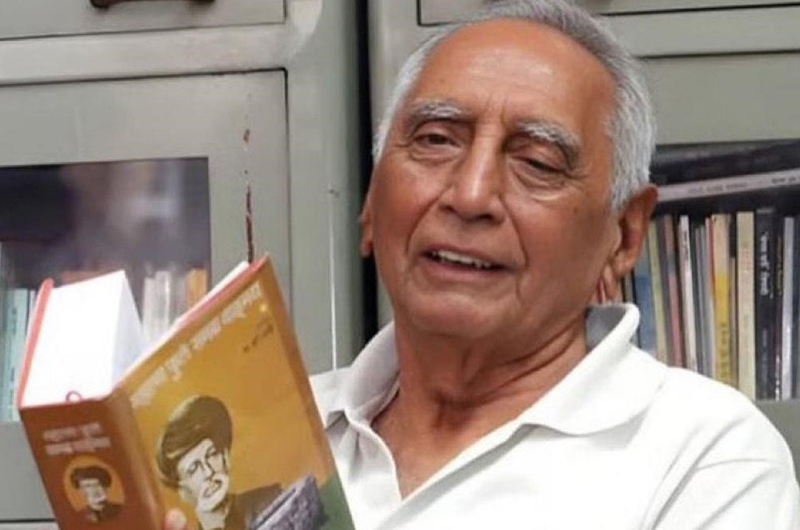
Baba Adhav passed away a few days ago, aged 95. As one of the most successful organisers of workers from the poorest and largely unorganised sections of society, he became a legend in his lifetime, motivating many by the struggles he led, says Bharat Dogra who had met and interviewed him. Adhav will always be remembered with great respect because of his deep commitment to creating a society based on equality, justice and dignity, specially focusing on those sections that suffered injustice and inequality, and he was a symbol of hope for millions of workers and oppressed people, Dogra points out
Baba Adhav’s personal integrity and deep commitment to the cause of workers was admired by all, even those opposed to him. He will always be remembered with great respect because of his deep commitment to creating a society based on equality, justice and dignity, specially focusing on those sections that have suffered injustice and inequality. He could be ideologically firm on issues, not making any compromises, yet at a personal level, he was gentle and friendly, as I got to know when I had met and interviewed him in Pune.
Adhav’s struggles and demands were quite innovative. He raised demands in such a way that they would seem relatively less burdensome and, hence, it became more likely for the authorities to accept them. For example, Adhav and his colleagues thought of the idea of a levy on all payments made to head-loaders which could be used to provide provident fund, gratuity, bonus, insurance, etc. His innovativeness was also seen in the setting up of low-cost community kitchens which served healthy food to workers.
Adhav was also deeply committed to his family, led by his wife Sheetaltai, a trained nurse who, on a lighter note, once listed him as ‘non-earning husband’. In fact, for some years, Babasaheb Pandurang Adhav, popularly called Baba Adhav, continued his practice as an ayurvedic doctor before giving it up to devote himself to the cause of workers. It was perhaps the ayurveda background that helped him to pursue justice and go on prolonged fasts even when old. His efforts to organise head-loaders (hamals) started in 1952 when he was only 22. It was a remarkable achievement to have been able to sustain such an effort for almost 70 years, linking it time and again with wider national efforts so that the experience gained and models developed in his main work area in and around Pune could reach a much wider number of workers.
Baba Adhav received The Times of India’s first Social Impact Award for Lifetime Contribution in 2011. As the newspaper reported, he got this award for “decades of selfless work to secure labour rights and social security for lakhs of people in the unorganised sector”. Earlier, The Week Magazine, which named Baba Adhav the ‘Man of the Year’ in 2007, naming him, tongue-in-check, ‘Coolie No. 1’ for all his hard labour to help head-loaders get their rights and dignity. If such awards came quite late in his life, jail terms came very early. Adhav served as many as 53 jail terms in his six to seven decades of struggles, the last one being in 2008.
As a result of such dedicated and sustained efforts of Adhav and his associates, many small as well as big unions (called panchayats) embracing the marginalised and unorganised workers were organised in Pune. Some unions were established in towns and villages of Pune District, while others, such as the one for head-loaders, came up in some of the most remote districts of Maharashtra; more specifically, the agricultural produce marketing committees in the districts. The unions brought improvements in working, living and social conditions of workers. Their earnings increased, more than 400 houses were built and more are coming up. A school provides good quality, free education to children of hamals and other workers.
Even in the case of unions formed much later, such as those of rag-pickers, substantial gains were achieved. Rag-pickers are now protected from police harassment and exploitation by scrap traders. Child labour has reduced greatly and many of them now have access to education. Group life insurance cover has been provided. In addition, medical insurance cover is provided by the Pune Municipal Corporation. Similarly, unions of domestic workers, vendors, rickshaw drivers and other unorganised sections have recorded important achievements. However, many of the economic gains could not have been sustained and protected but for the simultaneous setting up of several co-operative credit societies alongside the unions or panchayats, which enabled head-loaders, rag-pickers, vendors and rickshaw-drivers to obtain credit at a low interest rate. The facility helped them escape the clutches of moneylenders while also expanding their income-earning activity.
Nitin Pawar, who has been closely associated with Adhav’s many-sided work says, “Although at the national level, it is Baba’s contributions to unorganised sector workers which have been most highlighted, it will be a great injustice to confine his work only to this aspect. He has striven for much wider mobilisations in many areas to end socio-economic injustice. Way back in 1972 at the time of a serious drought, Baba worked tirelessly to end discrimination in access to water-sources in villages wherever there was social discrimination. Then he fought a long battle for providing justice to nomadic and de-notified tribes, and another one on behalf of devadasis or women who were victims of social oppression for pension to be provided to them. When he stopped his private medical practice, he helped create public-spirited hospitals. He was closely involved with Hamid Dalwai’s efforts for social reforms among Muslims as well as for reforms in the Bohra Community.”
Adhav’s vision for social change had a special place for a wider role for women. Women dominate the membership of some of the unions such as those of domestic workers, rag-pickers and, to a lesser extent, vendors. A socialist, satyagrahi (form of non-violent resistance) and a satyashodhak (someone who yearns for truth to prevail) was how Baba Adhav liked to describe himself. He was more a symbol of hope for millions of workers and oppressed people.
(The writer is an independent journalist and author who has been writing for over five decades, providing a strong perspective on peace, justice and protection on the environment. He lives in New Delhi.)
 from Webdoux