

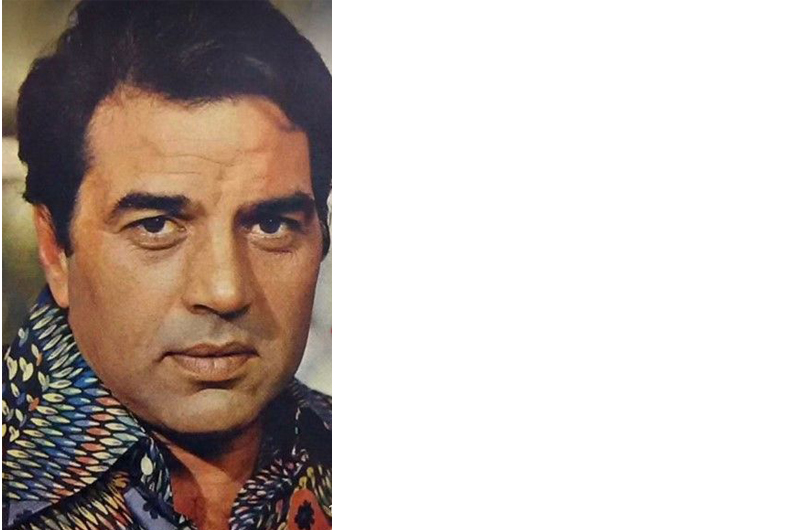
Dharmendra’s enduring image of being Bollywood’s ultimate He-Man somewhat camouflaged the fact that he was also a very fine actor who gave many memorable performances, says Partab Ramchand. Yes, he was the action hero supreme, but in the course of his long and illustrious career he showed that he could excel in emotive and softer roles, besides being absolutely at ease in comic roles, Ramchand points out. Here is his tribute to the legendary actor who passed away on November 24
Movie-goers might remember Dharmendra most fondly for Sholay, Yaadon ki Baarat, The Burning Train and the many routine but popular films he made with Hema Malini but then his CV also includes films such as Devar, Anupama, Satyakam and Chupke Chupke. Dharmendra first appeared on scene in the early 1960s, about the same time that other young hopefuls were entering the industry. He made his debut with Dil Bhi Tera Hum Bhi Tere opposite Kum Kum and Balraj Sahni. This was the time when Biswajit, Joy Mukherjee and Manoj Kumar also made their debuts.
While the Big Three – Raj Kapoor, Dlip Kumar and Dev Anand – were still very much around, as well as Rajendra Kumar and Shammi Kapoor who became big stars in the 1960s, the youngsters too carved a niche for themselves as good-looking actors who could play the romantic lead with ease. But by the end of the decade, the careers of Biswajit and Mukherjee had virtually ground to a halt while Manoj Kumar’s career was extended largely because of the films he produced and directed.
It was clear, however, that Dharmendra would not go the way of the others and would have a long and productive career. For one thing, he was the perfect combination of macho good looks with a physique to match. Indeed, no one has combined the two qualities better than this well-built Jat from Punjab. He had his first notable film early with Anpadh. The film starred Mala Sinha and Balraj Sahni but Dharmendra caught the eye as the well-educated young man who is shocked to discover that his wife is uneducated. His talent was clear and a great director like Bimal Roy wasted no time in giving him a big break by casting him in Bandini. He had for company Ashok Kumar and Nutan but more than held his own while giving a sensitive performance.
Next came Ayee Milan ki Bela with Rajendra Kumar and Saira Banu, which became a jubilee hit. And in 1965, Dharmendra delivered another super hit with Phool aur Pathar. Playing opposite tragedy queen Meena Kumari, he excelled in a no-holds barred role that not only underlined his acting histrionics but also his rugged muscular personality. Dharmendra struck up successful pairings with several top heroines of the day. With Meena Kumari, he again appeared in Mai Bhi Ladki Hoon and Purnima. With Mala Sinha, apart from Anpadh, he appeared in Ankhen, Neela Akash, Pooja ke Phool and Baharen Phir Bhi Ayegi. He also made hit films with Asha Parekh (Shikar, Aya Sawan Jhoomke and Aye Din Bahar Ke). But his most durable pairing was with Sharmila Tagore. The two made both commercially successful and meaningful films such as Devar, Anupama, Yakeen, Mere Humdum Mere Dost, Satyakam, Chupke Chupke and Ek Mahal ho Sapno ka. Dharmendra closed out a most eventful first decade in films with arguably his best performance as Satyapriya Acharya in Satyakam. As the idealistic young man for whom truth is everything, he gave a controlled performance under Hrishikesh Mukherjee’s admirable direction
Dharmendra started the 1970s with two big hits, Aadmi aur Insaan and Jeevan Mrityu, the latter marking the debut of Rakhee with whom he made the successful Blackmail later in the decade. At a time when Rajesh Khanna was the undisputed superstar and Amitabh Bachchan the biggest name in the industry, Dharmendra had his own fan following throughout the decade and remained a bankable star thanks to his ability to take on challenging roles. During the 1970s, he made a number of commercially successful films with Hema Malini (Dost, Naya Zamana, Dream Girl, Charas, Maa, Jugnu and, best of all, Seeta aur Geeta) and the pair struck a chord with the movie-going public like few screen pairs in history. But, of course, this was also the time when he made his twin crowning glories in Yaadon ki Baarat and Sholay, films with which his name is indissolubly linked. Towards the end of the decade even in the star-studded disaster genre movie The Burning Train, he stood out as the action hero supreme.
In the 1980s, Dharmendra retained his popularity but the quality of his films dipped. In many, his choice of roles could be questioned as during the decade he turned 50 and could have been more choosy. But on sheer personality and star quality he saw to it that some of the films were box-office hits. Dharmendra made the transition to character roles in the 1990s but made sure they were meaty ones essential to the story line. He also went into production, promoting the careers of his sons Sunny and Bobby. A highlight was Ghayal, which bore his touch though he was listed as producer. It marked a turning point in Sunny’s career, often acclaimed as his best film and triggered off the Next Gen angry young man role which he played so often during the decade.
Besides, Dharmendra did a lot of work on television, dabbled in politics (he was elected as Member of Parliament from Bikaner in 2004 on a BJP ticket), was fond of poetry and never let go opportunities to recite a few verses. But acting remained his first love and his career lasted till well into the New Millennium. In 2023, in his 88th year, he was seen in Rocky aur Rani ki Prem Kahani where he gave a poignant performance opposite Shabana Azmi.
Surprisingly, Dharmendra who appeared in more than 300 films in a career spread over six decades did not get a Filmfare Award though he was nominated five times. He did get one for Best Picture (Ghayal) as the film’s producer and a Lifetime Achievement Award in 1997. The crowning glory came with the award of the Padma Bhushan in 2012. When he passed away last month a few days short of his 90th birthday, film historians in assessing his legacy hailed him as “one of the most influential personalities in Indian cinema”. The acclaim was not confined to India. The New York Times called Dharmendra “one of India’s most versatile stars” while Variety remembered him as “one of Indian cinema’s most beloved and enduring stars”.
(The writer is a veteran sports writer who spent his career working for The Indian Express and The Telegraph and Sportsworld. He has more than a passing interest in old films and music. He lives in Chennai.)
 from Webdoux