

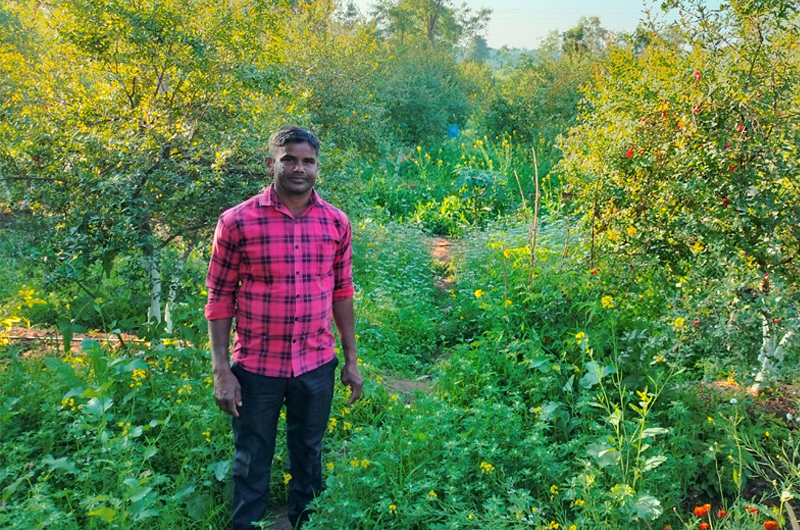
Bharat Dogra makes a comparative study of farmers in the Bundelkhand Region in Central India who have succumbed to the perils of climate change, and others who have made themselves resilient through creativity, discipline, and a little help from government and non-government agencies. One striking example is that of Balchandra Ahirwar who has eliminated fossil fuels related to chemical fertilisers, pesticides and weedicides, reduced the consumption of diesel by about two-thirds by using a power-tiller instead of hiring or buying a tractor, and improved soil, creating conditions in which more trees are sprouting on their own
With COP 30 in progress, I decided to visit some villages to see how small farmers, who constitute the overwhelming majority of agriculturists in India, are coping with the challenge of climate change. I wanted to meet farmers facing increasing difficulties as well as those who are coping well with the new challenges. In addition, I wanted to look at adaptation as well as mitigation aspects. Bundelkhand Region in Central India, I felt, would be a particularly appropriate place to visit, keeping in view the increasing problems of adverse and erratic weather conditions, particularly the extensive harm suffered by the previous kharif crop due to excessive rains which either prevented sowing or ruined the bulk of what the farmers managed to grow.
The damage was particularly extensive in Marumar Village in Tikamgarh District (Madhya Pradesh). Shishupal Singh, who owns three-and-a-half acres of land, told me that his entire crop was destroyed. He received no compensation for the loss and, therefore, had no money to buy either seeds or chemical fertilisers when the time came recently for sowing the next crop – the winter or rabi one. He had no alternative but to go to private moneylenders for a loan of Rs 40,000 at a high 3 per cent compound interest rate per month. Shishupal was able to mortgage some valuables and so the interest he was charged was lower than the five per cent per month those without this capacity were charged. Though they were able to sow the rabi crop, they have been pushed into a debt trap from which they will find it difficult to extricate themselves.
At the other end of the spectrum is Balchandra Ahirwar, one of the farmers who, with the help of SRIJAN (Self-Reliant Initiatives through Joint Action), a voluntary organisation, has emerged as a model of climate resilience. In addition, he is deeply involved with some local government efforts to promote natural farming. He is a good example of SRIJAN’s work in promoting climate resilience. Three aspects stand out in his context. First, although Balchandra has only two acres of land, he has been using it to grow about 40 crops. One part of the farm is devoted to a multi-layer vegetable garden, which grows over 20 vegetables and herbs and spices. Then there are over 60 guava, lemon, papaya, mango and jackfruit trees.
For those farmers who do not have a diversity of crops, after the three or four crops (in some cases only one – groundnuts) of the kharif season were destroyed by excessive rains, the land yields no earnings till the next rabi crop can be harvested in March-April the following year (2026). However, Balchandra can still earn by selling his fruits and vegetables and also secure his family’s nutrition needs. Despite adverse weather, he could still sow the rabi crop without getting into a debt trap.
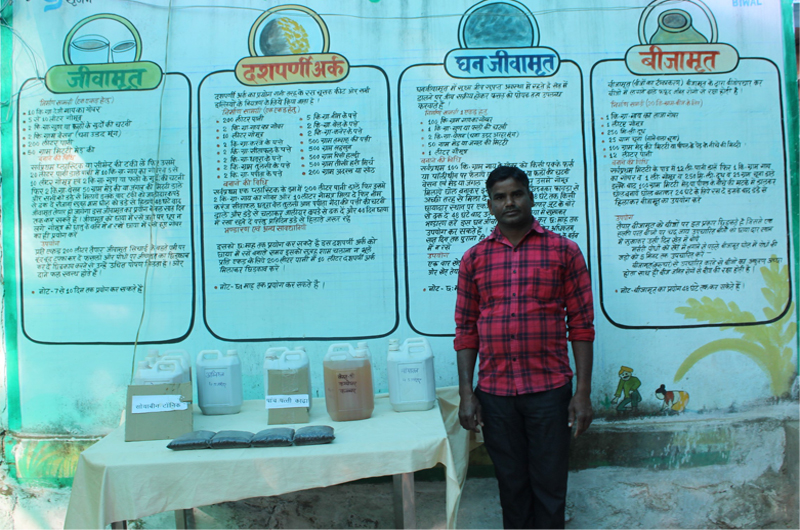
To keep away pests he uses a home-made spray. Hence, he is entirely protected from the high costs of chemical fertilisers and pesticides. As he
is able to make more of these natural farming inputs than he needs for himself at a bio-resource centre (seen above), he is able to sell these to
other farmers, adding to his income.
Secondly, while farmers who continue to use chemical fertilisers had to borrow money to pay for them and spend time sourcing them in times of scarcity, Balchandra relies on organic fertilisers prepared using cow-dung, cow urine and a few other ingredients available at or near his farm and home. To keep away pests he uses a home-made spray. Hence, he is entirely protected from the high costs of chemical fertilisers and pesticides. Thirdly, as he is able to make more of these natural farming inputs than he needs for himself at a bio-resource centre set up with the help of SRIJAN, he is able to sell these to other farmers (who for various reasons are unable to make these on their own) at a fair price, adding to his income.
Thus, with the help of SRIJAN, Balchandra and several other farmers in various villages have been able to adapt to climate change far better than others who do not follow these practices. Balchandra told me that soil conditions on his farm are improving steadily and there are many more earthworms now on his land. Natural pollinators including bees, birds and butterflies are plentiful too, while there are hardly any pests. It is very encouraging that Balchandra is trying spread these ideas to other farmers in the village. His two brothers are following in his footsteps. Since he is well-informed about government schemes, he has been able to convince more and more farmers in his village to take up natural farming with government assistance. All this, despite being from the traditionally weak community of Dalits.
Balchandra has contributed to climate change mitigation too. He has eliminated fossil fuels related to chemical fertilisers, pesticides and weedicides. By using a power-tiller instead of hiring or buying a tractor, he has reduced the consumption of diesel by about two-thirds. By improving soil and increasing moisture, he has created conditions in which more trees are sprouting on their own. The porous soil on his farm can retain more rain water; and in any case natural farming needs less water, reducing the need to lift water in the traditional way from wells. The soil also has more capacity to absorb carbon.
Balachandra’s efforts over the last six years has increased the production of food and fodder on his farm, and his produce is also much more nutritious than the output of non-natural farming methods. However, not all farmers are as hard working, creative or dedicated as Balachandra. Both government and non-government organisations must provide more generous support and longer-term projects to facilitate more farmers to follow Balachandra’s lead. Funds available under various climate concerns should also be used generously to promote climate resilient practices by small farmers. Creative and innovative ways of involving landless households should also be explored.
Care must be taken to avoid two traps. With the gradual spread of natural farming, there is a new trend of trying to sell all sorts of gadgets and expensive implements or products to farmers under the name of promoting productivity or convenience. Unwary farmers may be lured into spending beyond their means or even getting into entirely avoidable debt. The overall objective of reducing external costs, avoiding debt and promoting self-reliance of farmers and rural communities should be kept in view at all times. Secondly, many farmers are unable to realise their full creative potential because of the increasing temptation of alcohol and other intoxicants following the opening of liquor vends in villages. Some of the best performing and most creative farmers I have met in recent times, like Balchandra, are those who entirely avoid alcohol and other intoxicants. Hence, a social reform effort to reduce alcohol consumption is acquiring increasing importance.
(The writer is an independent journalist and author who has been writing for over five decades, providing a strong perspective on peace, justice and protection on the environment. He lives in New Delhi.)
 from Webdoux