

The US tariffs on a range of Indian products are impacting exports and cutting orders, endangering livelihoods, says Shweta Thakur Nanda. The US is a major market for India’s handicraft or cottage industry exports and has been central to the delicate revival by offering demand and visibility, say designers and exporters. The impact is expected to spread from local rural economies to India’s international market positioning, Nanda points out in this article
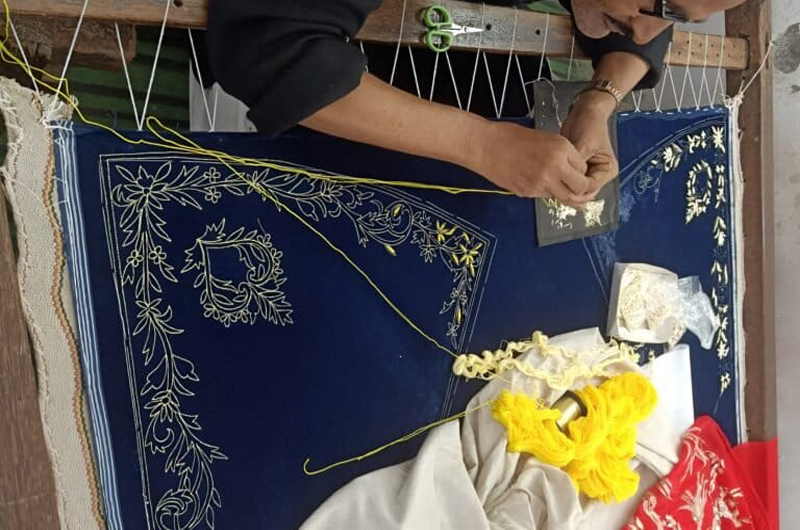
It is late afternoon, and Chowk, one of the oldest markets of Lucknow, is bathed in the golden hues of dusk. Amid hurried footsteps drumming on cobblestones, the cries of vendors and the thick aroma of kebabs, a narrow by-lane leads to veteran embroiderer Zafar Ali’s weathered yet quiet kaarkhana (workshop) of chikankari and zardozi. Sitting cross-legged on the cement floor, Zafar bends over an adda, a wooden frame stretched taut with fabric. With a hooked needle, he guides metallic threads through the cloth, bringing blossoms and vines to life.
“When tariffs go up, we are the first to be hit. If the businessman doesn’t get orders, he won’t place orders with me. My livelihood dries up then,” says Zafar, referring to the tariffs imposed by the US on textile imports from India. Zardozi and chikankari are artisanal hand-embroidery techniques. While metallic threads, stones and pearls are used to create opulent designs in zardozi, intricate white thread work is done on light-weight fabrics in chikankari. “When a shock like this comes, buyers start shifting, orders start drying up and things fall apart,” says 33-year-old Zafar.
In Srinagar, over 1,300 km away from Lucknow, pashmina and handicraft manufacturer and exporter Mujtaba Kadri echoes a similar sentiment. “The US is a primary market for us. Since the 50 per cent tariff has come into effect, there is hardly any order. The previous shipments have gone, and there is no fresh order. Right now, the business environment looks uncertain,” he rues. A similar situation is unfolding in Bhadohi, Uttar Pradesh, a hand-knotted carpet industry hub.
“The centuries-old carpet industry is in a crisis. Orders in the loom have been cancelled. When orders and exports get stalled, it has a cascading effect on the tradition, craft and inherited skills. It’s not just the exporters, but also the artisans and the weavers, who are equally affected by the crisis,” says Aslam Mahboob, owner of Alam Rugs, who claims that 60 per cent of his business comes from the US.
The US imposed 50 per cent tariffs on a range of Indian goods, including textiles, carpets, gems and jewellery and more. The tariff came into effect at the end of August, and exporters have seen an impact on the scale of orders they regularly receive. The Export Promotion Council for Handicrafts of India has expressed concern about the impact of the tariffs on Indian handicrafts that fall under various categories that have tariff rates set put by the US.
Beyond the corridors of diplomacy and the arithmetic of GDP figures, the new US tariffs strike at something far more fragile: India’s living heritage. For Ajrakh artisans of Kutch, pashmina weavers of Kashmir, blue pottery craftsmen of Rajasthan, zardozi embroiderers of Lucknow and hand-knotted carpet makers of Bhadohi, this is not a policy paper — it is survival itself. These timeless crafts are not only cultural treasures but also torchbearers of sustainable living, environment-friendly practices and engines of clean economic growth. Handmade with natural fibres, vegetable dyes and traditional techniques, they conserve natural resources, nurture grassroots entrepreneurship, support the circular economy and curb waste generation. Unlike mass-produced, chemical-laden factory goods with their heavy carbon footprint, they sustain artisan economies and remain, in every sense, planet-positive.
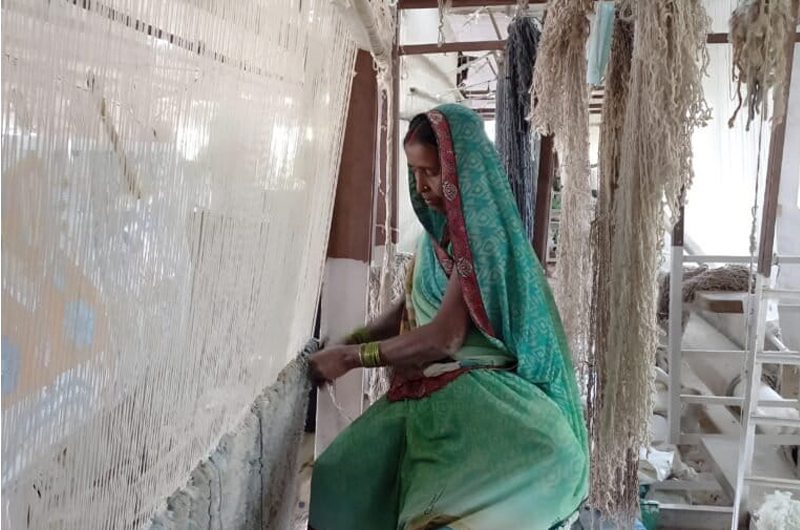
Rugs, claims that 60% of his business which comes from the U.S. is threatened by the imposed tariffs. Image by Aslam Mahboob.
A viable ecosystem threatened
Through years of concerted efforts by the government, private sector and the design fraternity, India’s traditional textile and craft sector had begun to revive steadily. What was once seen merely as a repository of cultural nostalgia was transforming into a viable ecosystem of heritage and enterprise. The industry had started drawing entrepreneurial energy and young talent, reimagining age-old traditions through a modern lens.
The US is a major market for India’s handicraft or cottage industry exports and has been central to this delicate revival by offering demand and visibility, according to designers and exporters “Traditional sectors like carpet, textiles, cottage-industry are like social and historical capital for a country like India. They offer sustainable livelihood, pride and legacy to our society and are mostly planet friendly. It has a direct linkage with art, design, craft and ideas which connects its economic movement and the tradition,” labour economist K.R. Shyam Sundar points out. “Even if additional tariffs are lowered to 20 per cent after negotiations, the blow would still be hard. The effort should be to ensure no additional tariff on cottage-industry sectors,” Shyam Sundar who is a retired professor of XLRI, Jamshedpur, explains.
Designer Gautam Gupta, who has been working on reviving Indian textile and craft tradition underlined that it will “impact women artisans the most”. “Craft hubs across India help them earn and dream. Their incomes, though modest, transform lives: a debt-free family, a daughter sent to college or medical bills paid.”
Potential demand slash
The new tariff risks derailing India’s craft revival by eroding competitiveness in its largest export market, slashing demand and starving small weavers of income. As buyers turn to cheaper substitutes, heritage hubs like Varanasi and Kashmir could see workshops fall quiet and skilled artisans migrate. For cottage industries already surviving on thin margins, the blow could mean cash crunches, job losses and stalled innovation which could undo years of progress. The high tariff places an immediate and significant strain on both exporters and over 3.5 million artisans, particularly women in rural and semi-urban areas, according to the Export Promotion Council for Handicrafts.
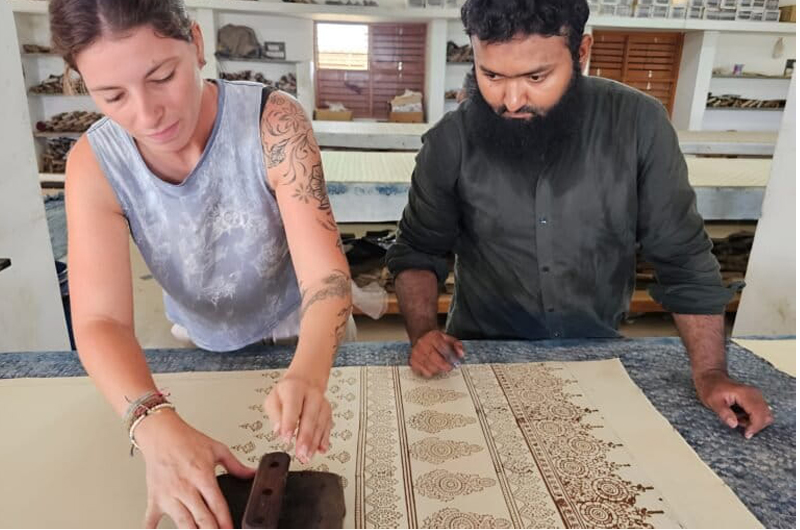
Ajrakh artisan and businessman Mohammad Soyab Abdul Karim of Kutch in Gujarat agrees. Block-printing an intricate pattern on a beige fabric inside his workshop, Karim explains that the tariff shock is both economic and cultural. Ajrakh is a traditional hand-block printing technique, in which hand-carved wooden blocks are used to create intricate patterns on sarees and dresses using eco-friendly natural dyes. “For kaarigars like me, ajrakh is more than our livelihood, it is our identity. When the business gets impacted, it would lead to my artisan community drifting away to other professions, workshops closing down, and traditional skills passed down through generations gradually perishing,” Karim says.
In Kotjewar, a village near Jaipur, artisan Ramniwas Kumar is ready to start painting the first batch of his blue pottery articles after the rainy season. He dips his wooden brush in the signature bright cobalt blue but hesitates before painting the vase. “The dye will dry, but will orders come?” he asks. “This tariff has broken our back.” “About 70 families live in our village, but barely a dozen still practise blue pottery. The younger generation is not drawn to it, given the uncertainty of income. If artisans keep leaving, soon blue pottery will survive only in books,” he says, gesturing to his workshop, where glistening pieces lie unsold.
Suresh Bhagvatula, a professor of entrepreneurship at IIM Bangalore, concurs. “Today’s artisans have other job options that weren’t available before. They can easily find work in cities as security guards, delivery persons, warehouse workers, or in shops. These jobs often pay better in the short term than traditional crafts. This is dangerous because once artisans leave their craft, they rarely come back,” says Bhagvatula.
Market beginning to bleed
India’s overall handicrafts exports stand at Rs 33,123 crore, of which exports to the US account for Rs 12,814.73 crore, according to the Export Promotion Council for Handicrafts. India’s handicrafts sector employs over 3.5 million artisans, particularly women in rural and semi-urban areas. Though precise data is lacking, millions continue to depend on allied craft sectors such as crochet, zari work, paper crafts, leather goods, jewellery and decorative items. “India’s craft sector has survived tough times before, but there will be serious problems in the short term (due to the tariff). Finding new markets to replace US orders takes time,” Bhagvatula adds that many work with low profit and may have taken loans to complete recent orders or bought materials for the busy US holiday season. “With fewer orders coming in, the poorest artisans will be hurt the most from debt.”
Mahboob of Alam Rugs agrees. He says that India’s carpet industry is worth Rs 17,000 crore and over 90per cent of the is export driven, to which the US contributes nearly 59 per cent. “It is impacting the livelihood of nearly 13 lakh people of the carpet industry in several states/UTs including UP, Bihar, West Bengal and J&K,” says Mahboob, who is also a member of the Committee of Administration of Carpet Export Promotion Council. Sundar notes that handicrafts belong to India’s vast unorganised sector, where any loss of income slows the circulation of money, dampens local demand and, in turn, weakens the rural economy.
The ripple is even sharper in international markets, says Mujtaba Kadri of Me & K, an exporter of pashmina shawls and carpets. “In global markets, buyers compare across countries. If your product becomes costlier, demand falls. Buyers shift to affordable substitutes — machine-made goods or cheaper imports. It weakens your market position and perceived value. Over time, importers start redesigning their supply chains without you.” “Our export margins are barely 10–15%. In a sector operating on such slim margins, even a small tariff hike is crippling,” adds Abdul Manan Baba, another Srinagar-based handicraft exporter.
Sundar emphasises that artisan communities are dispersed across geographies and far removed from centres of power. “There is a need to build an ecosystem that safeguards the sector’s interests and protects artisans during shocks such as these. It is good for heritage, for people, and for the planet.”
(Courtesy: Mongabay India/ india.mongabay.com. The writer is a journalist based in Delhi NCR. Her liking for research oriented in-depth stories on issues affecting common men and women helped her win the Observer Peace Foundation Award for Journalism and the Ramnath Goenka Award for Excellence in Journalism.)
Link to original article: https://india.mongabay.com/2025/09/us-tariffs-set-to-threaten-indias-traditional-craft-revival/?mc_cid=d9ca3da356&mc_eid=fe2778811d
 from Webdoux