

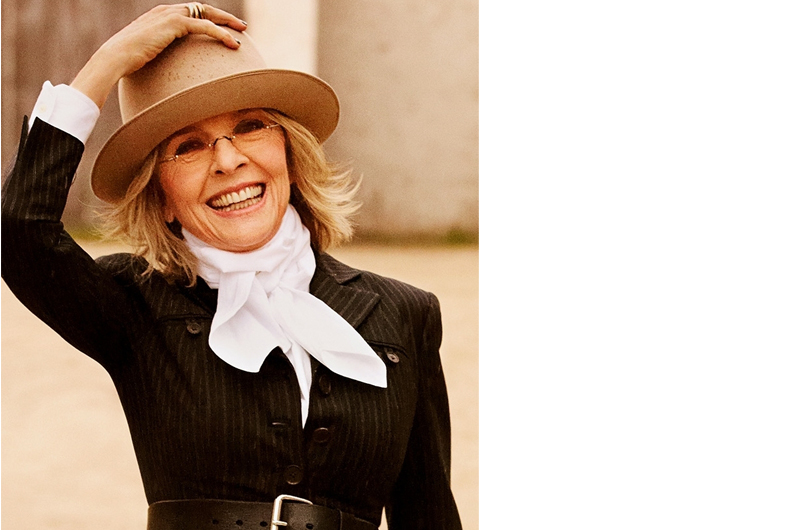
Diane Keaton who passed away recently at the age of 79 struck a chord with the American movie-going public like few other actresses of her time and ultimately emerged as a popular box office star being a key figure in the New Hollywood movement when a new generation of film makers came into prominence influencing the types of films produced, their production and marketing and the way major studios approached film making, says Partab Ramchand, as he traces her film career and times
She played quirky characters, sported an unconventional wardrobe and was anything but a glamour girl. But Diane Keaton who passed away recently at the age of 79 struck a chord with the American movie-going public like few other actresses of her time and ultimately emerged as a popular box office star being a key figure in the New Hollywood Movement. Keaton appeared on the scene when the movement was at its peak in the early 1970s and became an integral part of the changing structure. She defined the new wave of films admirably and built upon that image to appear in more than 60 films over a career that spanned half a century. And on the way her different, unorthodox style of acting brought her several awards, including an Academy Award, a BAFTA Award, two Golden Globe Awards and the American Film Institute Life Achievement Award in 2017.
Chiefly known for her collaborations with Woody Allen with whom she made eight films, Keaton first came into prominence with her appearances in the two Godfather films in 1972 and 1974. She also appeared in Godfather Part III made in 1990 by which time she had made a name for herself as a brilliant versatile performer. While she is best known for her comical talent, Keaton took on more serious roles as a challenge. She received a lot of acclaim for taking on a film like Looking for Mrs Goodbar immediately after finishing Annie Hall. While the latter film brought new life to the romantic comedy genre, getting Keaton a well-deserved Oscar, Looking for Mrs Goodbar had her portraying a dedicated teacher to deaf children by day and a prowler of singles bars at night, engaging in promiscuous sex. She excelled in the serious dramatic role as she did in the lighter Annie Hall.
By the end of 1977, Keaton had landed on the cover of Time Magazine, symbolizing her growing stature as an actress. The story dubbed her “the funniest woman now working in films”. The same year, Rolling Stone Magazine described her as “the next Katherine Hepburn”. The ambitious and level-headed Keaton did not let this kind of heady praise go to her head and continued to take on diverse roles to prove her versatility. If there were serious roles in Interiors, Shoot the Moon and Crimes of the Heart, she continued to display her comic talent in films such as Manhattan, Baby Boom and Father of the Bride.
Besides winning an Academy Award for Annie Hall, Keaton was nominated for an Oscar for her roles as activist Lousie Bryant in the historical epic, Reds (1981), in which she starred opposite Warren Beatty, a leukaemia patient in the family drama, Marvin’s Room (1996), and a dramatist in the romantic comedy, Something’s Gotta Give’ (2003). Her ability to excel in mature character roles, frequently playing matriarchs of middle-class families, helped her maintain her popularity well into the 21st Century.
Keaton did not confine herself to appearing before the camera. She also ventured into direction and in 1987 made her first film, Heaven, a documentary about the possibility of an afterlife. She directed a few more films, was prominent on television, was a well-known photographer and regarded as a style icon despite her odd dress sense. Her kooky, eccentric wardrobe in Annie Hall, for example, consisted mainly of vintage men’s clothing, including neckties, vests, baggy pants and fedora hats. Some of the clothes came from Keaton herself who was already known for her tomboyish clothing style years before Annie Hall. Soon after the film’s release, men’s clothing and pantsuits became popular attire for women. A 2005 profile in the San Francisco Chronicle described her as “Easy to find. Look for the only woman in sight dressed in a turtleneck. And on a 90 degree afternoon in Pasadena”.
Keaton’s overall image, however, will always be one of the great American actresses from the heyday of the 1970s. Asked what made Keaton funny, Allen said, “My opinion is that with the exception of Judy Holliday, she is the finest screen comedienne we have ever seen.” Charles Shyer, who directed her in Baby Boom, said Keaton was in the mould of iconic comedy actresses Carole Lombard, Irene Dunne and Rosalind Russell.
As one critic put it, “she is a treasure, with a personal and professional style that is difficult to explicate and impossible to duplicate.” Her ability to consistently convert and challenge herself on screen endeared her to the sternest critics who hailed her transition from “Allen’s ditzy foil to a gifted and erotically nuanced character actress and later an appealing maternal figure”. Another critic observed that Keaton remained more popular with audiences than her contemporaries because of “her friendly accessibility and charmingly self-effacing persona”. Audiences loved her because they identified with the women she portrayed on screen.
Nobody could be grave and goofy all at once like Keaton and this was the perfect combo for a heroine of the late 20th Century. Famously self-deprecating, she was noted for her wry sense of humour. Keaton often played a complex modern American woman, a paradox of self doubt and assurance which became her trademark.
(The writer is a veteran sports writer who spent his career working for The Indian Express and The Telegraph and Sportsworld. He has more than a passing interest in old English films and music. He lives in Chennai.)
 from Webdoux