

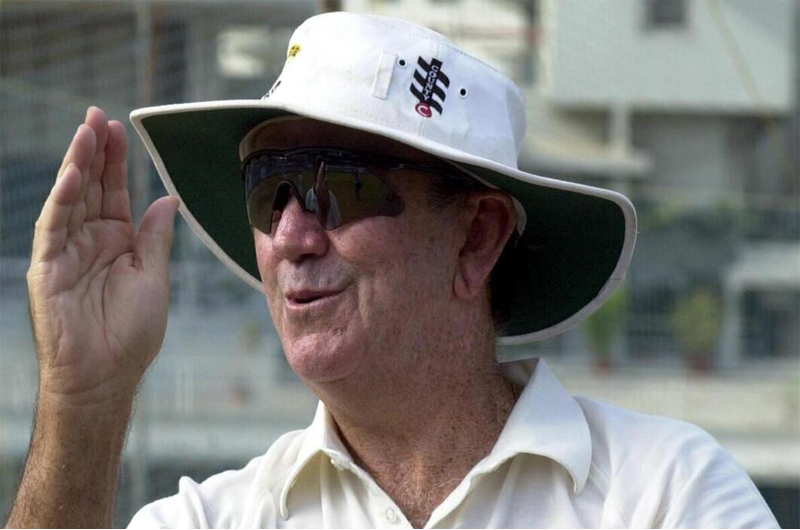
A batsman with an insatiable appetite for runs, a leg-spinner capable of troubling the best of opponents, a slip fielder par excellence, a shrewd captain, an inspirational coach and, in later years, a revered elder statesman good enough to be both in the Australian and the ICC Hall of Fame – Bobby Simpson, says Partab Ramchand, was a legend of the game, the only player whose name is linked to the only two tied Tests in history, in Brisbane in 1960 and in Madras in 1986, as he traces Simpson’s sparkling career
He acquired a CV that few cricketers can boast of. A batsman with an insatiable appetite for runs, a leg-spinner capable of troubling the best of opponents, a slip fielder par excellence, a shrewd captain, an inspirational coach and, in later years, a revered elder statesman good enough to be both in the Australian and the ICC Hall of Fame. Yes, Bobby Simpson was a legend of the game who is deserving of all the accolades that have poured through following his death on August 16 at the age of 89.
Simpson made his Test debut at the start of a transitional phase in Australian cricket with the retirement of Keith Miller, Ian Johnson and Gil Langley in South Africa in 1957-58. He quickly established himself in the side as a batsman who could open or go in the middle order. His bowling supplemented the greater skills of Richie Benaud and as a slip fielder he was in a class of his own, picking up the most difficult of catches in nonchalant fashion.
By 1964, Simpson was good enough to succeed Benaud as Australia’s captain. It was an unenviable task, for besides following a master tactician, the side he led to England was woefully short of experience. Since the previous Ashes battle, Australia had lost the services of Neil Harvey, Alan Davidson, Ken Mackay and Benaud. It was taken for granted that England would win back the Ashes. One newspaper, after carrying the news of the Australian team personnel, headlined the article: England, the Ashes are yours. But under the benign leadership of Simpson, the young Aussie side raised the level of their game and upset England 1-0 to unexpectedly retain the Ashes.
Leading admirably from the front, Simpson scored his first Test hundred at Old Trafford in his 30th Test and enjoyed the feeling so much that he went on to make it a triple. His monumental 311 for which he batted 762 minutes was only the second triple-hundred by an Australian, following Don Bradman’s 334 in 1930. He emphasised his insatiable appetite for runs while getting a hundred in each innings in Pakistan after the Ashes series. By now firmly in control as Australia’s captain, Simpson continued to contribute in no small measure to his team’s successes. He and Lawry established themselves as Australia’s finest opening pair, symbolised by their partnership of 382 against the West Indies at Bridgetown in 1965. However, by 1968, he handed over the captaincy to Lawry and retired at the age of 32.
But Simpson was far from finished. In 1977, when Australia were facing a major crisis with most of their players defecting to Kerry Packer’s World Series Cricket, the Australian selectors sent an SOS to Simpson who readily responded, still being very fit at 41. Now, he faced a different challenge as skipper, for he was in charge of a largely faceless and nameless side, totally emaciated with the leading players being unavailable. Again as a resolute fighter, Simpson rose to the occasion. The visiting Indians were the favourites to win but whipping his young and inexperienced team into shape and proving to be an inspirational leader with two hundreds in the five-match series, Simpson led Australia to a 3-2 victory. By now, he was 42 and there was not much of a future for him in the game and, after a series defeat in the Caribbean in 1978, he finally called it day.
Yet again, Simpson was far from finished. In the mid 1980s when the simultaneous retirements of Greg Chapell, Dennis Lillee and Rodney Marsh weakened the Australian side considerably and they were getting beaten by just about every opposition, Simpson was called upon to take over as the national coach. Not unexpectedly, he was again a success and, in tandem with Alan Border, led the resurrection. He was also co-opted to the selection committee and in 1987 Australia won their first World Cup. They regained the Ashes in 1989 and in successive contests thereafter. The fitting climax came in 1995 when they defeated West Indies in the Caribbean to end their run of 15 years without a series defeat and rising to be the No. 1 team in the world.
Simpson received due credit for instilling in the team members resilience and commitment with the emphasis being on fitness and fielding. In the course of his long and successful association with Australian cricket he achieved a unique feat. He is the only player whose name is linked to the only two tied Tests in history – as player in Brisbane in 1960 and as coach at Madras in 1986. Simpson went on to coach Leicestershire and Lancashire for short periods in English county cricket. He also worked as a coaching advisor for Rajasthan in the Ranji Trophy and as a consultant for the Indian team during the late 1990s.
In 62 Tests, Simpson scored 4,869 runs at an average of 46.81 with ten hundreds, all as captain. He also picked up 71 wickets, with two five-wicket hauls, to underline his all-round skills, and picked up 110 catches. He has the highest ratio among those with over 100 catches and takes his place among the greatest slip fielders of all time. He and Lawry are the most successful opening pair in Australian cricket history. In 62 innings, they pieced together 3,596 runs at an average of 60.94 with nine century stands. Oh yes, as player, captain and coach Simpson takes his place among the outstanding Australian cricketers of all time.
(The writer is a veteran sports writer who spent his career working for The Indian Express and The Telegraph and Sportsworld. He lives in Chennai.)
 from Webdoux