

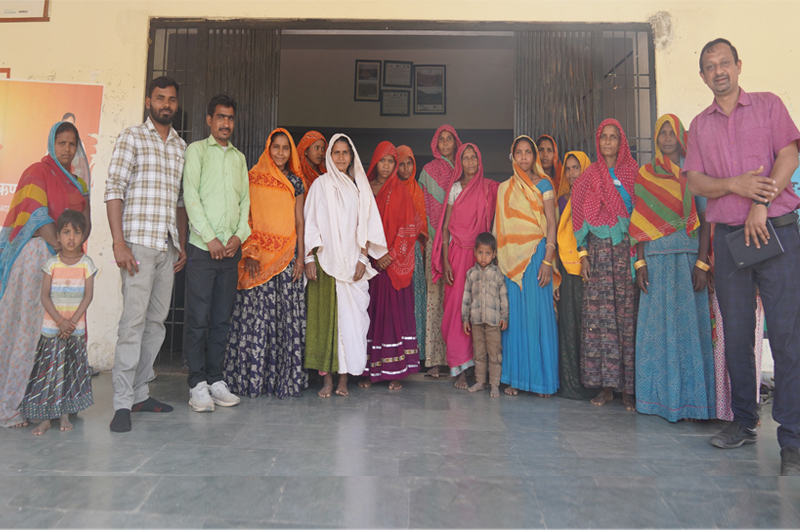
Social entrepreneur Rakesh Gupta has been steadily working for more than a decade to make marketable healthy food products while improving the livelihood of thousands of tribal women, and the nutrition and health of these communities. Bharat Dogra profiles Gramshree Foundation Trust, an NGO started by Gupta, which is having a positive impact on remote villages in Rajasthan and Chhattisgarh. It has established an important presence in a range of final and intermediate food products based on custard apple, Indian blackberry, Indian gooseberry and tamarind
The collection and processing of non-timber forest produce, also called minor forest produce, has been recognised as an important avenue of inclusive development focussing on the many tribal communities in India. Though these communities have been involved in such work for a long time, getting fair returns has been a challenge due to the intervention of traders. Value-addition based on health will fetch the marginalised communities a better profit margin, promote improved livelihood, nutrition and health, and also aid environment protection.
Recognising the potential, social entrepreneur Rakesh Gupta has been steadily working for over a decade to make marketable healthy food products while improving the livelihood of thousands of tribal women, and the nutrition and health of these communities. Gramshree Foundation Trust, an NGO started by him, has established an important presence in a range of final and intermediate food products based on custard apple (sitafal) and Indian blackberry (jamun), Indian gooseberry (amla) and tamarind (imli), while other possibilities are also being explored. Collection and processing work are integrated with efforts to promote nutrition, health and planting of trees, with a view to improving savings and economic security of women organised into self-help groups.
Through these means, income addition and livelihood support are being achieved in communities in very remote villages of Rajasthan and Chhattisgarh. Rakesh gratefully recalls the support and guidance of his mentor, Ved Arya, to this end. Gramshree Foundation Trust initiated a van dhan shakti (strength of forest resources) effort to empower tribal women to better utilise forest produce and gain higher returns.
Apart from Gramshree Foundation Trust, Rakesh also started Gramshree Development Services as a profit-making company, creating what he calls a hybrid model for taking forward similar objectives. As the new voluntary organisations struggled to establish a base, Ved Arya established the Buddha Fellowships to help socially relevant efforts to gain strength, particularly in their early stages of struggle. A regular stipend from there helped Rakesh, and the fellowship also opened the door for a loan of Rs 2.5 million for expansion efforts. “This helped us to spread our efforts to Chattisgarh State, apart from the two districts of South Rajasthan where we were already working (Udaipur and Rajsamand),” says Rakesh.
The basic idea of integrating the strengthening of the sustainable livelihood of tribal communities with improved nutrition and health was a sound one, and the new organisation soon attracted attention and even awards. Its coverage of tribal households has continued to grow over the years, as also the number of its products and the range of its activities. The COVID crisis saw Gramshree helping many households in distress with food and rations. More recent initiatives include poultry farming and growing many varieties of plants in nurseries to contribute to diversification of crops. In several villages, women’s self-help groups provide a strong base for the many-sided developmental interventions of Gramshree.
This writer recently spent a day in the villages of Sayra Block in Udaipur District with Rakesh and several team members like Vijay Dhakse. In one village, the main concern related to suitable housing for poultry which the villagers had recently acquired under a Gramshree initiative. Instead of creating a brick-and-cement structure, two women used bamboos from their own farms. Rakesh encouraged and praised this, telling team members that it could be a better option. Improvements to the bamboo structure to make the birds more comfortable were also discussed. Rakesh brainstormed with his team on how the women’s skills could be better used, and their savings increased.
Rakesh and his team also discussed with a small farmer of modest means in another village why his nursery plot was being under-utilised. There was concern regarding the harm caused by strong winds to the covering for plants, and ideas on how this could be mitigated were considered. Issues of monitoring nutrition and health conditions were also discussed. Such field-level, on-the-spot discussions and decisions based on real-life situations help identify emerging problems and issues, and resolve them without delay.
While such initiatives obviously have a bright future based on their high social relevance and well-recognised need, more care should be taken to ensure sustainability and reduce potential risks. For example, it is safer to work with the diverse forest produce and local farm produce, instead of introducing species whose suitability to local conditions is uncertain. By emphasising the need for safe and sustainable harvesting and helping to take better care of trees, the young organisation can establish high credibility for environment protection and sustainability. The knowledge and experience of elderly villagers, farmers, vaids (doctors), and particularly women, about local trees, plants and herbs, can be leveraged in this regard. Several valuable crops, including millets and herbs, which had an important role in nutrition and health, are likely to have vanished from present-day farms and gardens, and their revival and protection should be an important part of the development work being taken up.
(The writer is a senior freelance journalist and author who has been associated with several social movements and initiatives. He lives in New Delhi.)
 from Webdoux