

India’s fisherwomen face not only economic instability but also the shrinking availability of open spaces to carry out value-added fishing activities. Women’s employment is given limited priority in India’s draft blue economy policy framework. A more inclusive policy framework, strengthening traditional coastal activities for women and creating job opportunities in sectors dominated by men, are key steps toward empowering fisherwomen, suggest experts. Priyamvada Kowshik’s detailed report tells us why such steps are badly needed
Shaila D’Mello wakes up at 4 am to cook for her family and finish chores before she leaves for the jetty in Cacra Village, located in Tiswadi Taluka in Goa. Around 6.30 am, the fishing boats begin to arrive. One of them has her husband who had cast a net for sardines. Some of her neighbours give D’Mello and her husband a hand to pull in the 26-feet canoe onto the beach. For the next one hour, the couple is engaged in sorting the fish. On days when the catch is plenty, they send the produce to the Panjim market. Today, it’s just enough to be consumed locally.
Once the fishing work is done, D’Mello leaves for her day job – she works as a cook in some of the sprawling villas that are taking over the hillsides surrounding Cacra. Ever since the income from fishing began to diminish, D’Mello took up other jobs to supplement her family income. In the evening, she works as a part time municipal worker and sweeps the winding road to her fishing hamlet.
Destructive fishing practices
D’Mello is the president of the All Goa Small Scale Responsible Fishers Union, an organisation dedicated to advocating for the rights and challenges of small-scale fisher folk in Goa. The union has been vocal in addressing the urgent need to tackle illegal and destructive fishing practices, such as ‘bull trawling and ‘LED fishing’, which are wreaking havoc on marine ecosystems. Bull trawling involves two boats dragging a massive fishing net through the water leading to overfishing, significant bycatch, and severe damage to the seafloor while LED fishing uses powerful submersible light-emitting diodes to attract fish at night. Both of these illegal, unreported, and unregulated (IUU) practices violate regional, national, and international fisheries laws and pose a serious threat to the health of marine life.
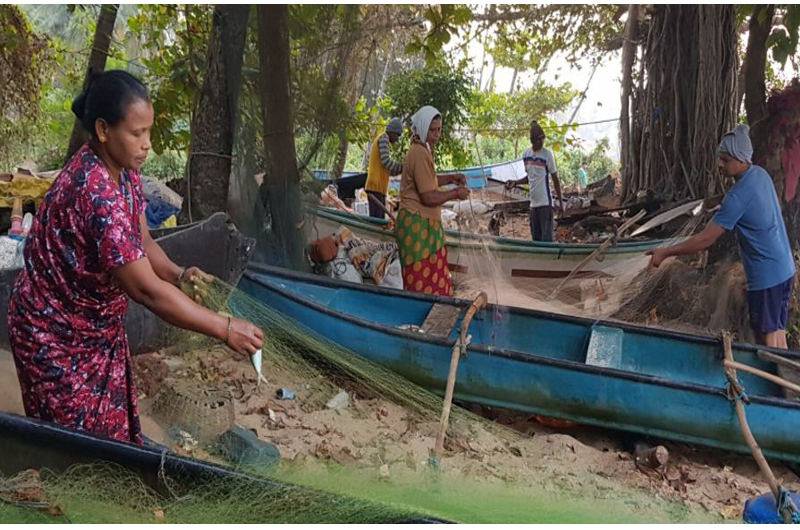
Small-scale fishers are also grappling with rising fuel costs, inadequate subsidies, and enforcement lapses; their calls for support have become increasingly urgent. Destructive fishing practices have impacted women involved in fisheries activities, says D’Mello. “For small-scale fishers like us, fishing is becoming increasingly challenging. Our livelihoods are at stake,” she says. Women are involved in all forms of activities around fishing – from sorting and cleaning to selling at the market and even door-to-door vending. They also dry fish and make value-added products, adds D’Mello.

She is the president of All Goa Small Scale Responsible Fishers Union, which advocates for the rights of small-scale fisher folk in the state.
A 2024 paper on women in fisheries reports that, out of the four million marine fisher folk, 47 per cent are women, and among the 23 million inland fisher folk, 44 per cent are women. Women predominantly work in fish processing and marketing, with 86 per cent of those involved in marketing within the marine sector being women. The report also highlights that women play a dominant role in post-harvest activities such as curing (drying), prawn peeling, processing, and working as labourers.
Fishers like D’Mello worry that while on the one hand the fish population in the sea is depleting, making fishing economically unsustainable, on the other hand, open spaces and commons to carry out production of value-added fishing activities are becoming inaccessible to them. “Government subsidies to small fisher folk are also drying up or delayed inordinately. We are being forced out of our traditional livelihood,” she says, posing a question to policy makers working on steering India’s blue economy: “How does it plan to secure our livelihoods and provide us opportunities to thrive?”
D’Mello’s words resonate with women and men engaged in fishing-based activities across India’s 7500-km coastline. General Secretary of the National Fishworkers Forum (NFF) Olencio Simoes, who represented India at the 8th General Assembly of the World Forum of Fisher Peoples held in Brazil in November 2024, says that despite being India’s biggest and oldest organisation of the fisher folk community, the NFF was not invited to stakeholder consultations in drafting India’s blue economy policy framework. According to him, several projects under the framework are not in favour of fisher folks. “Women are also particularly vulnerable and getting increasingly displaced from fishing-related activities,” he informs Mongabay India. Lakshmi Kovvada, president of the Andhra Pradesh Traditional Fishworkers Union, affiliated to NFF, is worried about the numbers of fisherwomen who are forced to look for work as domestic help. “Being a fisherman is challenging, and the fate of fisherwomen is even worse,” she says.
India’s booming blue economy
India’s Maritime Amrit Kaal Vision 2047 is a flagship initiative to promote responsible use of marine resources for economic growth, while ensuring ocean environmental protection. It aims to modernise ports, improve shipping infrastructure and promote renewable energy by 2047 with programmes such as Sagarmala, Integrated Coastal Zone Management and Deep Ocean Mission. Goal 14 of the United Nation’s 17 Sustainable Development Goals deals explicitly with the conservation and sustainable use of the oceans, seas and marine resources. The UN states that the blue economy should “promote economic growth, social inclusion, and the preservation or improvement of livelihoods while at the same time ensuring environmental sustainability of the oceans and coastal areas”.
Recognising the potential of its blue economy, India is one of the few countries that has published a draft blue economy policy framework. The Government of India projects a potential income of $1 to $3 trillion through coastal sectors by 2030. Additionally, the sector which employs over four million coastal people, has the potential to generate millions of jobs. India’s blue economy policy framework – the Maritime India Vision (MIV) 2030 and Amrit Kaal Vision 2047 – underlines efforts to inclusively realise India’s marine vision in all blue economy sectors. MIV 2030 outlines 150 initiatives aimed at propelling India to global maritime leadership.
In a 2024 paper on the major barriers to women’s participation and employment in coastal activities of India’s blue economy, researchers review the level of women’s exclusion or inclusion in India’s coastal activities and uncover the systemic inhibitors and enablers for women’s participation and employment. Lead researcher Matovu Baker says that the research dealt with the question of exploring pathways for women’s empowerment in coastal activities. “India’s focus on developing its blue economy and the Government of India’s investments in coastal infrastructure provide a great opportunity to empower coastal women, who have historically been involved in its less lucrative economic activities. Our research uses a ‘system thinking’ perspective to highlight the interconnections of various drivers that kick-start avenues for women’s empowerment,’” he says.
Coastal women face marginalisation, are severely underrepresented in leadership and decision-making roles. They are also vulnerable to environmental risks due to climate change. For instance, women engaged in coastal paddy cultivation in Sunderbans, West Bengal, and seaweed farming in Tamil Nadu, are increasingly facing challenges from pollution, climate change, and loss of land. Chime Youdon, head of the Blue Economy and Climate Change cluster at the maritime think-tank, National Maritime Foundation, says she believes in the importance of integrating co-management and co-ownership frameworks to enhance the contributions of coastal women, particularly in conservation-related activities.
“A significant portion of women’s livelihoods in coastal regions depends directly on marine ecosystems. As custodians of traditional ecological knowledge, women play a vital role as the primary guardians of these ecosystems, ensuring their preservation. Their work not only sustains local communities but also makes a tangible contribution to India’s GDP,” says Youdon. However, these ecosystems are increasingly threatened by climate change, posing a direct risk to the livelihoods of the women who rely on them. Alongside environmental challenges, coastal women often face barriers to securing funding and institutional support, further limiting their resilience and economic stability, she explains.

selling at the market and even door-to-door vending.
Coastal women’s work
While discussing women’s participation in the different sectors of India’s blue economy framework, the 2024 study notes that the fisherwomen involved in marine fishing comprise only 19 per cent of the total labour force, but women form 81 per cent of workforce managing inland fishing activities. The low participation of women becomes apparent when we look at the ratio of fisher folk employed in marine versus inland fishing – only 18 per cent of the total fisher folk are engaged in inland fishing versus 82 per cent in marine fishing, as per figures from Department of Fisheries, Government of India.
Youdon sees an opportunity for women in conservation-related coastal tourism businesses. She cites the example of mangrove safaris run by a women’s self-help group from the fisher community that has built a sustainable business of taking tourists on boat rides in the creeks of Sindhudurg, making them both recreational and educational. In the marine transport sector, the researchers note that while investments have increased with the launch of Sagarmala project, women’s engagement in port facilities, marine transport and shipping sectors is comparatively low.
(Courtesy: Mongabay India/ india.mongabay.com. This article was edited by Aarthi Menon for Mongabay India. This is a condensed version of the original.)
 from Webdoux